Clay and kaolin
Story context (click to hide this block) (click to show this block)
This paragraph may contain plot information.
Every morning, Maomao paints on her freckles using clay. She explains it herself: makeup doesn’t only serve to beautify; it can also conceal, protect, or deceive. Deliberately making herself less attractive is, for her, a survival strategy backstage at the palace, where a concubine’s beauty attracts as much danger as favor.
The subject in depth
Clays are hydrated aluminum silicates formed through the slow weathering of feldspar and other minerals in rock [Wikipedia] . They all occur as stacked sheet-like crystals, too small to see with the naked eye, with a thickness close to a nanometer.
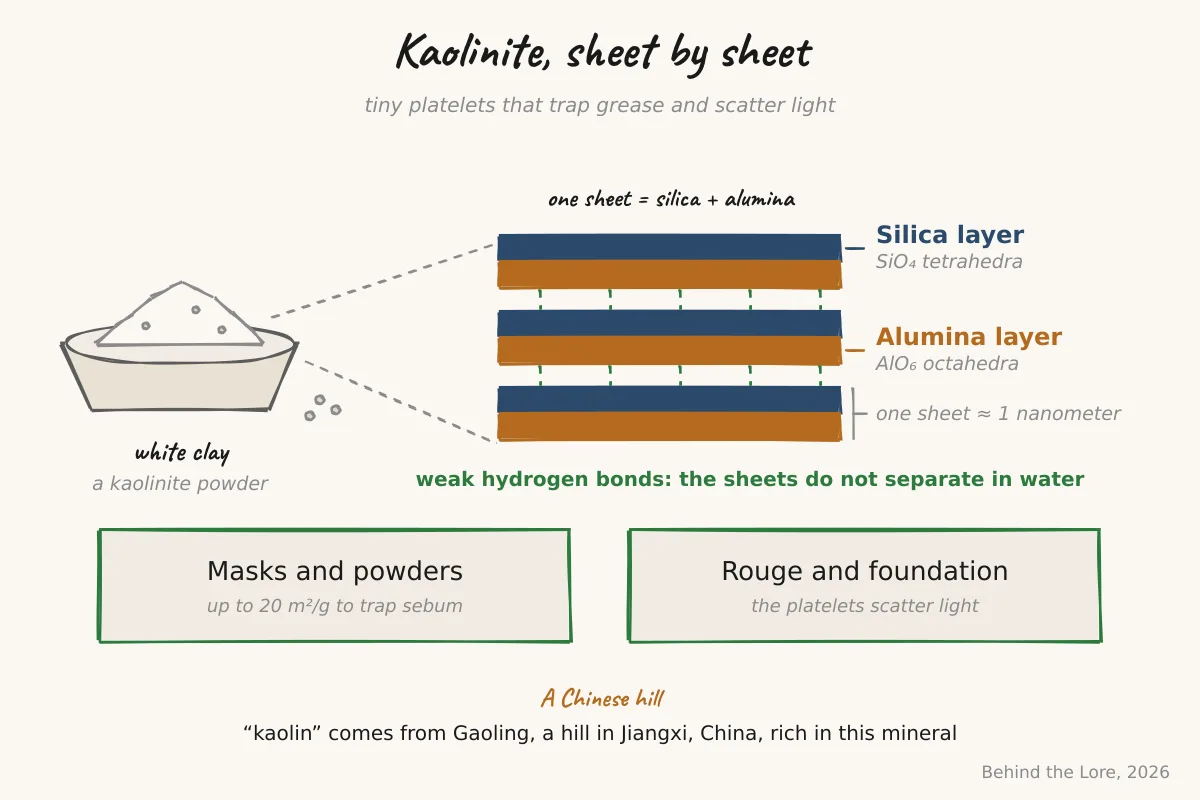
Kaolin is an off-white to white clay, made mainly of kaolinite [Wikipedia] . Kaolinite belongs to the group of 1:1 clays: each sheet consists of a silica layer (SiO₄ tetrahedra) bonded to an alumina layer (AlO₆ octahedra), producing a regular, compact stack. Unlike swelling clays such as montmorillonite, kaolinite’s sheets are held together by weak hydrogen bonds and do not separate in the presence of water: the mineral is stable, non-plastic, and chemically unreactive.
This structure explains two fundamental properties. First, adsorption: the vast total surface area of the sheets (up to 20 m²/g for kaolin) captures fatty molecules, pigments, and toxins on its surface without absorbing them into its bulk. Second, its covering power: the microscopic platelets reflect and scatter visible light, making the powder opaque even in a thin layer.
Kaolin’s natural color ranges from pure white to beige depending on impurity content. Iron ions (Fe³⁺, Fe²⁺), either built into the structure or adsorbed on the surface, shift the color from yellow to brick red; manganese produces gray or black tones. Combining differently colored earths let ancient cosmetic makers formulate rouges of varied shades without chemical synthesis.
Other cosmetic clays exploit different structures. Smectite (of the montmorillonite family) is a 2:1 clay whose sheets separate widely in the presence of water: it swells, absorbs far more, and produces the green or gray clay masks widely used for oily skin. Illite, intermediate between the two, colors orange and beige rouges through its iron and potassium ions.
Uses beyond cosmetics
Kaolin is not limited to skin care. When ingested, it acts as a digestive dressing: its surface adsorbs toxins and irritants in the intestinal lumen, which justifies its traditional use for infectious diarrhea, a principle carried over into some modern pharmaceutical preparations (kaopectate). Industrially, it goes into fine porcelain (the word “kaolin” comes from Gaoling, a hill in Jiangxi, China, rich in this mineral), coated paper (the bright white layer ink adheres to better), paints, and ceramics.
Going further
Sources
Published on
Keep investigating
Auto-suggested from shared concepts, disciplines, episodes, or characters.
Lead White Makeup
In The Apothecary Diaries, white makeup kills courtesans. We explain why this ceruse-based cosmetic caused deadly lead poisoning.
Orpiment and Arsenic
In The Apothecary Diaries, a yellow pigment poisons slowly. We explain orpiment, arsenic, and the chronic poisoning of court painters.
Flame Coloration
In The Apothecary Diaries, flame color serves as a clue. We explain why every metal salt burns a different color.
Galenic Formulations
In The Apothecary Diaries, an ointment gets prepared. We explain galenics: how a medicine's form determines how an active ingredient is absorbed.
Ginger
In The Apothecary Diaries, Maomao prepares ginger pastilles to keep warm. We explain gingerol, TRPV1, and Chinese pharmacopoeia.