Galenic Formulations
Story context (click to hide this block) (click to show this block)
This paragraph may contain plot information.
After diagnosing the stable hand’s allergic reaction, Maomao gives him an ointment, noting it should calm the inflammation. Later in the episode, she prepares another one as a preventive measure for the imperial reception. Both gestures are brief, but they reveal precise practical knowledge: Maomao doesn’t pick the ointment at random, she picks it because it’s the right form for a localized skin problem.
The subject in depth
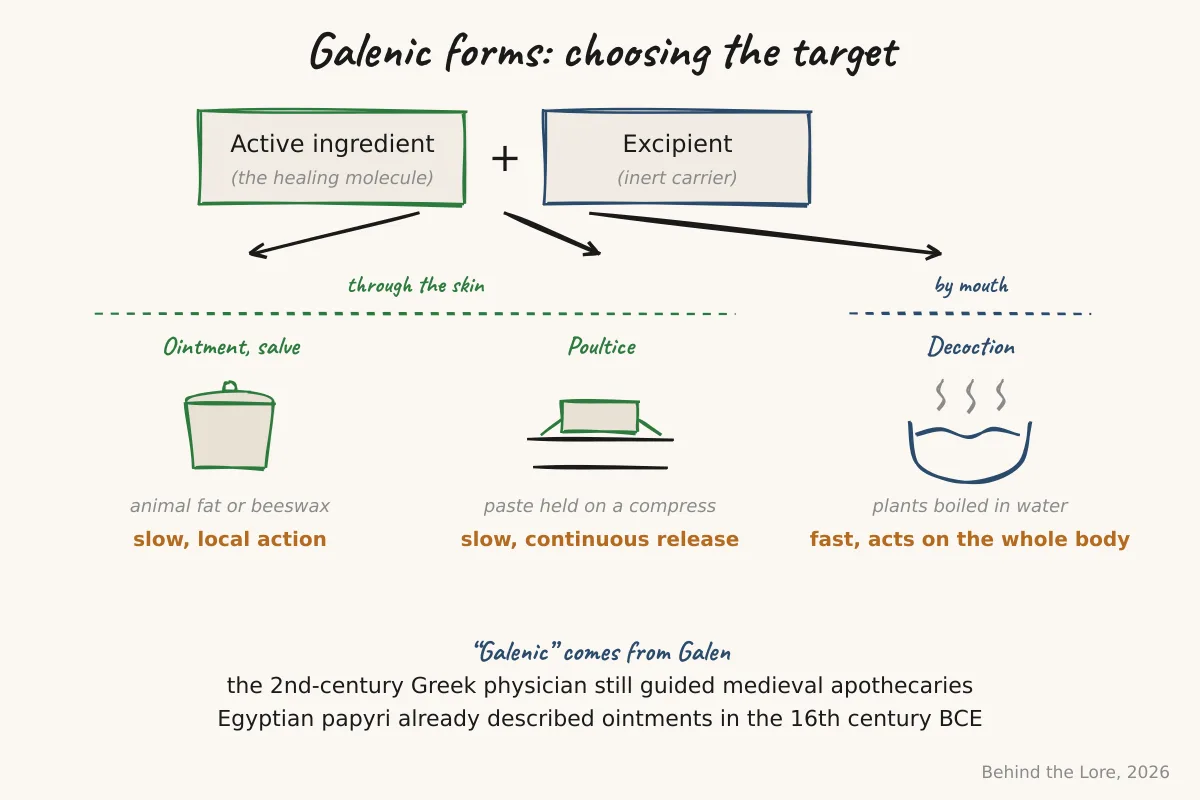
Galenics is the branch of pharmacology that studies how medicines are formulated
[Wikipedia] . Its founding principle is simple: an isolated active ingredient is almost never usable as is. It must be combined with an excipient, an inert carrier substance, to produce a stable, administrable form with controlled absorption.
Ointments and salves
An ointment is a semi-solid preparation meant for skin application [Wikipedia] . Its excipient is fatty (petroleum jelly, lanolin, vegetable oil, wax): this lipid phase serves two functions. First, it adheres to the skin and slows evaporation, keeping the active ingredient in contact with the target tissue. Second, it helps certain molecules pass through the stratum corneum, the outer barrier of the epidermis, whose lipid nature favors fat-soluble substances.
A salve is a thicker ointment, based on natural waxes. In the traditional Chinese pharmacopoeia Maomao practices, the line between ointment and salve is fluid: people speak indiscriminately of fatty preparations applied to the skin, whose common excipients are animal fat (tallow, lard) or beeswax.
Other topical and oral forms
A poultice is a solid or semi-solid preparation applied on a compress, held in place on the skin. It releases the active ingredient slowly and continuously, ideal for sustained action on a localized area (a sore joint, a wound, a bruise).
A decoction is an oral form obtained by prolonged boiling of plants in water: water-soluble active ingredients pass into the liquid and are absorbed quickly through the digestive tract. It is the common form used in traditional Chinese medicine for systemic treatments, those meant to act on the whole body.
A pill is a solid oral form with controlled release: the excipient (flour, honey, clay) coats the active ingredient and regulates its dissolution in the digestive tract.
Why form changes everything
The same active ingredient produces very different effects depending on its galenic form. Applied as an ointment on the skin, it acts locally with low systemic concentration; swallowed as a decoction, it enters the blood and reaches distant targets; placed as a poultice, it diffuses slowly over several hours. In both of Maomao’s cases, the ointment is the right choice because the inflammation is superficial and localized: there’s no point irritating the digestive tract with a substance that only needs to act on the skin.
Going further
Sources
Published on
Keep investigating
Auto-suggested from shared concepts, disciplines, episodes, or characters.
Mercury
In The Apothecary Diaries, quicksilver goes into a court poison. We explain mercury, its toxicity, and the immortality elixirs that killed emperors.
Orpiment and Arsenic
In The Apothecary Diaries, a yellow pigment poisons slowly. We explain orpiment, arsenic, and the chronic poisoning of court painters.
Aconite
In The Apothecary Diaries, aconite poisons even through honey. We explain aconitine, its action on nerves, and why it shows no mercy.
Ginger
In The Apothecary Diaries, Maomao prepares ginger pastilles to keep warm. We explain gingerol, TRPV1, and Chinese pharmacopoeia.
Clay and Kaolin
In The Apothecary Diaries, clay is used as makeup. We explain kaolinite, its layered structure, its absorbent power, and its uses.