Ginger and Its Warming Properties
Story context (click to hide this block) (click to show this block)
This paragraph may contain plot information.
While preparing for the outdoor imperial garden party, Maomao makes pastilles meant to keep people warm in bitter cold. She explains that ginger has warming properties and pairs it with citrus peel to stimulate blood flow. It is the gesture of a practitioner: she does not settle for intuition, she puts together a reasoned preparation from two ingredients whose distinct effects she knows well.
The subject in depth
Ginger, Zingiber officinale, is a tropical plant whose rhizome, the thickened underground part that resembles a knobby tuber, is the part put to use [Wikipedia] . Its pungent smell and taste come from a family of phenolic compounds, the main one in fresh ginger being gingerol, more precisely 6-gingerol.
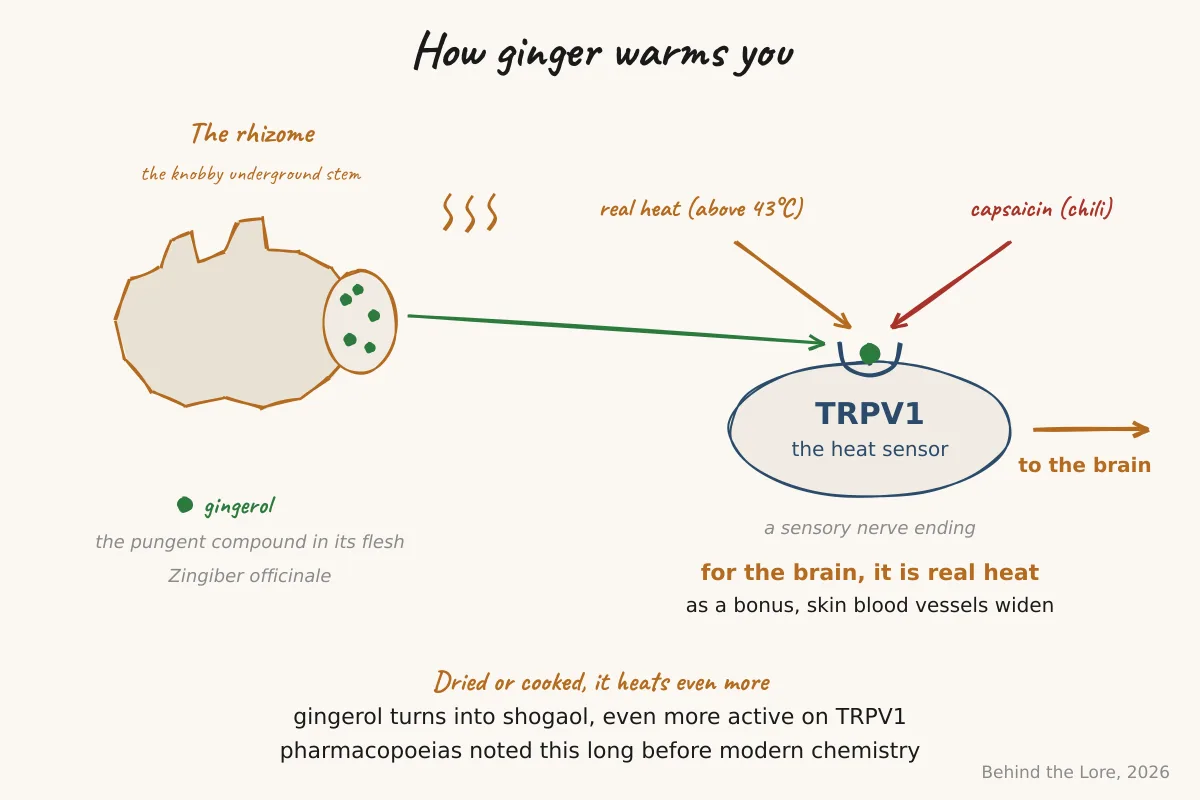
Gingerol acts on a specific molecular target: the TRPV1 receptor (Transient Receptor Potential Vanilloid 1) [Wikipedia] . This receptor is an ion channel found on sensory nerve endings. It opens in response to heat above 43°C, to acidity, and to capsaicin, the active compound in chili peppers. Gingerol borrows the same mechanism: by binding to the receptor, it forces it open even at room temperature, sending the brain a signal indistinguishable from real heat.
This is therefore a central sensory effect: the sensation of warmth is neurologically genuine, even though the body’s core temperature does not change. On top of this comes a peripheral vascular effect. Stimulating TRPV1 in skin capillaries triggers vasodilation: surface vessels widen, skin blood flow increases, and the skin genuinely warms to the touch. In cold weather, this peripheral blood flow eases the sensation of cold even though it offers no protection against deep hypothermia.
When ginger is dried or cooked, some of its gingerol converts into shogaol, a more concentrated and pungent compound with an even higher affinity for TRPV1. This is why dried ginger or cooked preparations are pharmacologically more active than freshly grated ginger, a detail traditional pharmacopoeias had worked out long before modern chemistry explained it.
Going further
Sources
Published on
Keep investigating
Auto-suggested from shared concepts, disciplines, episodes, or characters.
Nicotine and Tobacco
In The Apothecary Diaries, macerated tobacco serves as a poison. We explain nicotine, its acute toxicity, and why diluting a poison can make it worse.
Aconite
In The Apothecary Diaries, aconite poisons even through honey. We explain aconitine, its action on nerves, and why it shows no mercy.
Dehydration and Rehydration
In The Apothecary Diaries, Maomao treats heatstroke with salted, sweetened water. We explain dehydration and why salt is vital.
Kudzu
In The Apothecary Diaries, over-concentrated kudzu turns into glue. We explain kuzu starch, its medicinal uses, and its invasion beyond Asia.
Galenic Formulations
In The Apothecary Diaries, an ointment gets prepared. We explain galenics: how a medicine's form determines how an active ingredient is absorbed.