Kudzu: Starch, Remedy, and Invasive Plant
Story context (click to hide this block) (click to show this block)
This paragraph may contain plot information.
Maomao prepares a kudzu infusion and realizes she has overdone the dose: as it cools slightly, the decoction thickens to the point of sticking to the bowl’s sides. She explains that licking the spoon is enough to thin it out again, thanks to the amylases in saliva, and draws an analogy with the wheat-flour glue used in papermaking, which follows exactly the same chemical principle. In a handful of lines, the scene packs in three concepts: the behavior of gelatinized starch, the action of salivary enzymes, and the chemical kinship between a medicinal drink and a craftsman’s glue.
The subject in depth
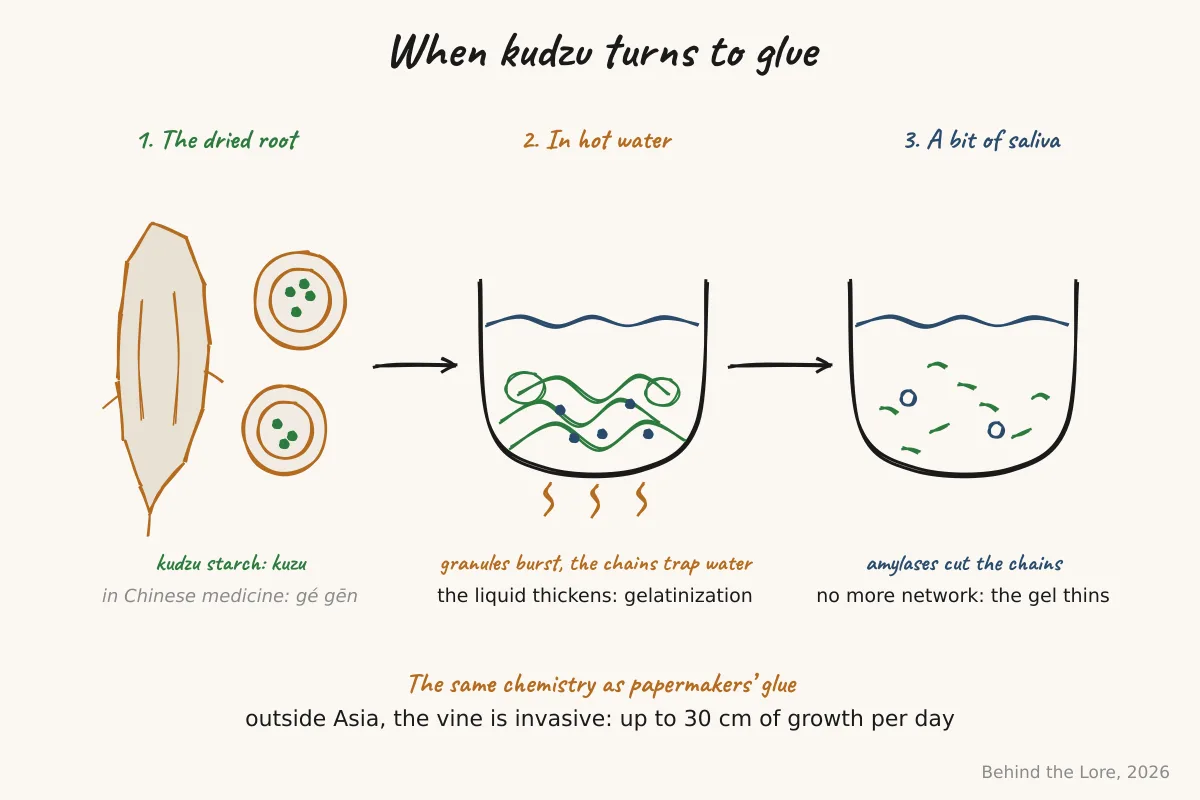
Kudzu, Pueraria montana var. lobata, is a perennial vine in the legume family, native to East Asia [Wikipedia] . Its tuberous root can weigh several dozen kilograms and holds a large amount of starch. It is this starch, extracted and dried, that the Japanese call kuzu and the Chinese call gé fěn: a fine white flour, comparable to potato starch but with a gentler gelatinizing power.
Starch gelatinization
Starch is a glucose polymer organized into two intertwined molecules: amylose and amylopectin. At rest in cold water, these chains form compact, poorly soluble granules. As temperature rises, the granules absorb water, swell, and eventually burst: the chains unwind and form a network that traps water, this is called gelatinization. The liquid thickens. If the starch concentration is high, the result can become very viscous, even solid on cooling: exactly what Maomao observes with her over-concentrated infusion.
Amylases, enzymes abundant in saliva, cut the long starch chains into short fragments (maltose, dextrins). These fragments no longer form a network, and the gel thins. This is the same mechanism that makes a mouthful of rice, chewed long enough, seem to melt, or that pre-digests starch before it even reaches the stomach [Wikipedia] .
Medicinal uses: gé gēn
In traditional Chinese medicine, the dried, sliced root of kudzu is called gé gēn and has featured in the pharmacopoeia for centuries. It is classically prescribed to:
- Lower fever and relieve neck stiffness (the so-called “surface” syndrome)
- Ease headaches and congestion
- Calm hangover symptoms, a use attested in Chinese and Japanese folk medicine
These effects are studied today through the lens of the isoflavones the root contains, notably puerarin and daidzein. These molecules, related to soy phytoestrogens, act on blood circulation and vasodilation, which may partly explain the perceived effect on headaches and hot flashes. Research into puerarin and alcohol use disorder is still ongoing, and its results remain preliminary.
An invasive plant outside Asia
Introduced to the United States in the late 19th century as forage and an erosion-control tool, kudzu proved catastrophic there. Its growth can reach 30 centimeters per day in hot, humid climates. Without the plant-eating insects and fungal diseases that keep it in check in Asia, it smothers trees, riverbanks, and buildings, choking out all vegetation beneath its leaves. It is now considered one of the most invasive plants in North America [Wikipedia] .
Going further
Sources
Published on
Keep investigating
Auto-suggested from shared concepts, disciplines, episodes, or characters.
Datura
In The Apothecary Diaries, datura is used to induce sleep and feign death. We explain its alkaloids, its toxicity, and its role in the history of anesthesia.
Aconite
In The Apothecary Diaries, aconite poisons even through honey. We explain aconitine, its action on nerves, and why it shows no mercy.
Rhododendron and Mad Honey
In The Apothecary Diaries, a tainted honey and a burned plant cause poisoning. We explain rhododendron's grayanotoxins and the famous mad honey.
Ginger
In The Apothecary Diaries, Maomao prepares ginger pastilles to keep warm. We explain gingerol, TRPV1, and Chinese pharmacopoeia.
Mandarin Peel
In The Apothecary Diaries, an infusion of mandarin peel. We explain chen pi, its flavonoids, its essential oils, and what modern science confirms.