Mandarin Peel: Chen Pi and Medicine
Story context (click to hide this block) (click to show this block)
This paragraph may contain plot information.
At the Garnet Pavilion, Lady Gyokuyou offers an infusion, noting that it is “brewed with mandarin peel, very comforting.” The detail is subtle, but it signals that the imperial court draws on the ingredients of everyday pharmacopeia: mandarin peel is not a garnish in the cup, it is an ingredient with an established medicinal reputation.
The subject in depth
Chen pi refers to the peel of mandarins or closely related citrus fruits, sun-dried over several years. The longer the aging (some preparations reach ten or twenty years), the more concentrated the active compounds become and the milder the bitterness [Wikipedia] . Traditional Chinese medicine has used it for centuries, mainly to support digestion (regulating digestive qi in classical terminology), soothe coughs, and thin bronchial secretions.
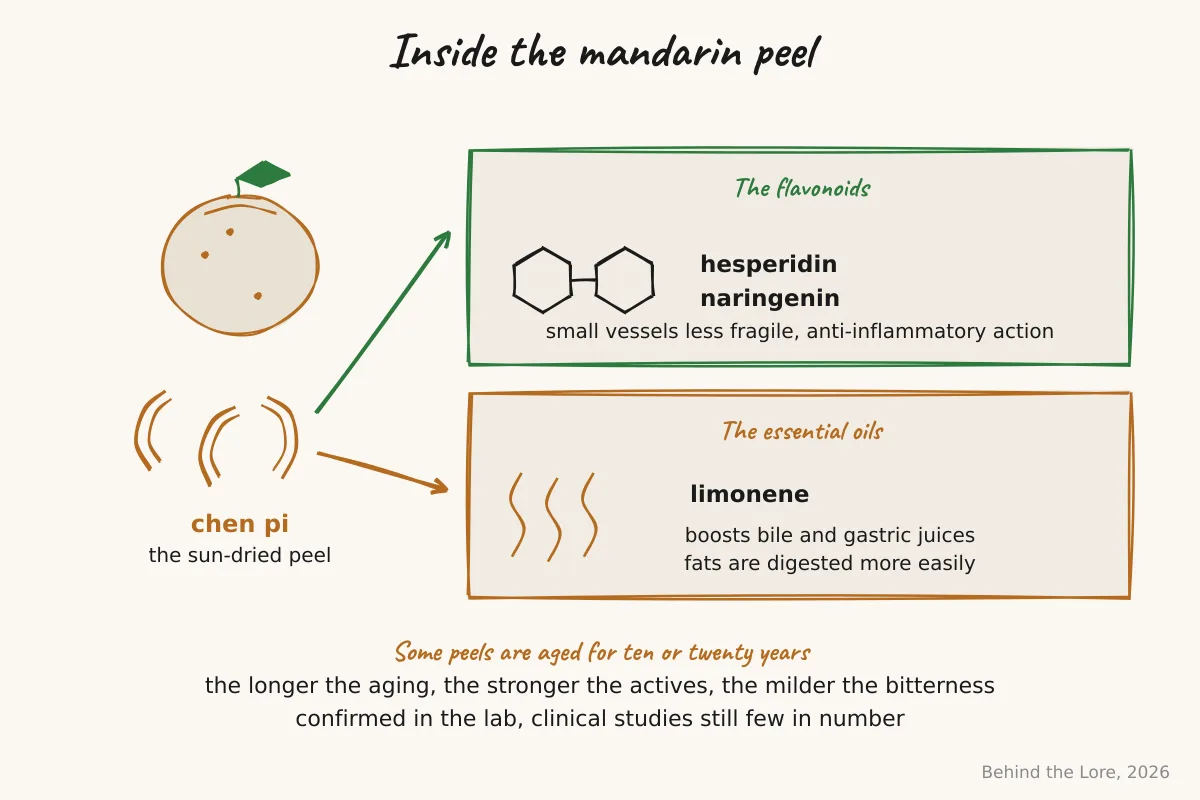
The underlying chemistry has become much better understood in recent decades. Mandarin peel contains two major families of active compounds.
The first is the flavonoids, chief among them hesperidin [Wikipedia] . This polyphenol acts on the permeability of small blood vessels, making them less fragile, which earns it a place in common vein-toning medications used in Europe (venous insufficiency, capillary fragility). In vitro studies also credit it with anti-inflammatory and antioxidant effects, by reducing the production of inflammatory mediators such as prostaglandins. Naringenin, another citrus flavonoid, contributes to these effects.
The second family is essential oils, dominated by limonene. These volatile compounds are responsible for the characteristic scent of fresh peel. Limonene stimulates the secretion of bile and gastric juices, which helps digest fats, and has a mild antispasmodic action on the digestive tract. This is the mechanism behind the traditional use of citrus peel for bloating and mild nausea.
On the respiratory side, certain alkaloids and flavonoids in the peel are thought to be mucolytic (they promote expectoration by thinning mucus), which aligns with the folk use of peel infusions for chesty coughs. Clinical studies remain scarce and small in scale, however: the preclinical data (cell culture, animal models) are solid, but their translation into robust human results is not yet complete.
Going further
- Aconite
- Dehydration and Rehydration
- Discipline: Pharmacology
- Discipline: Botany
- Discipline: Food Science
Sources
Published on
Keep investigating
Auto-suggested from shared concepts, disciplines, episodes, or characters.
Aconite
In The Apothecary Diaries, aconite poisons even through honey. We explain aconitine, its action on nerves, and why it shows no mercy.
Dehydration and Rehydration
In The Apothecary Diaries, Maomao treats heatstroke with salted, sweetened water. We explain dehydration and why salt is vital.
Ginger
In The Apothecary Diaries, Maomao prepares ginger pastilles to keep warm. We explain gingerol, TRPV1, and Chinese pharmacopoeia.
Kudzu
In The Apothecary Diaries, over-concentrated kudzu turns into glue. We explain kuzu starch, its medicinal uses, and its invasion beyond Asia.
Honey Preservation
Honey has preserved food for millennia. Here's why: low water activity, osmolarity, acidity, and hydrogen peroxide all work together to stop microbes.