Honey Preservation: Why It Never Spoils
Story context (click to hide this block) (click to show this block)
This paragraph may contain plot information.
When Maomao discovers that Lady Fonmin comes from a family of beekeepers, she notices that the Garnet Pavilion holds a wide variety of luxurious, carefully stored honeys. The scene is brief, but it grounds the story in a reality every court apothecary knows: honey lasts, and that is precisely why it is kept with such care. Owning such a collection is a mark of wealth, but also a serious pharmacological resource.
The subject in depth
Pure honey doesn’t spoil, or nearly so. Honey jars found in three-thousand-year-old Egyptian tombs were still edible. This remarkable fact is explained by several mutually reinforcing mechanisms
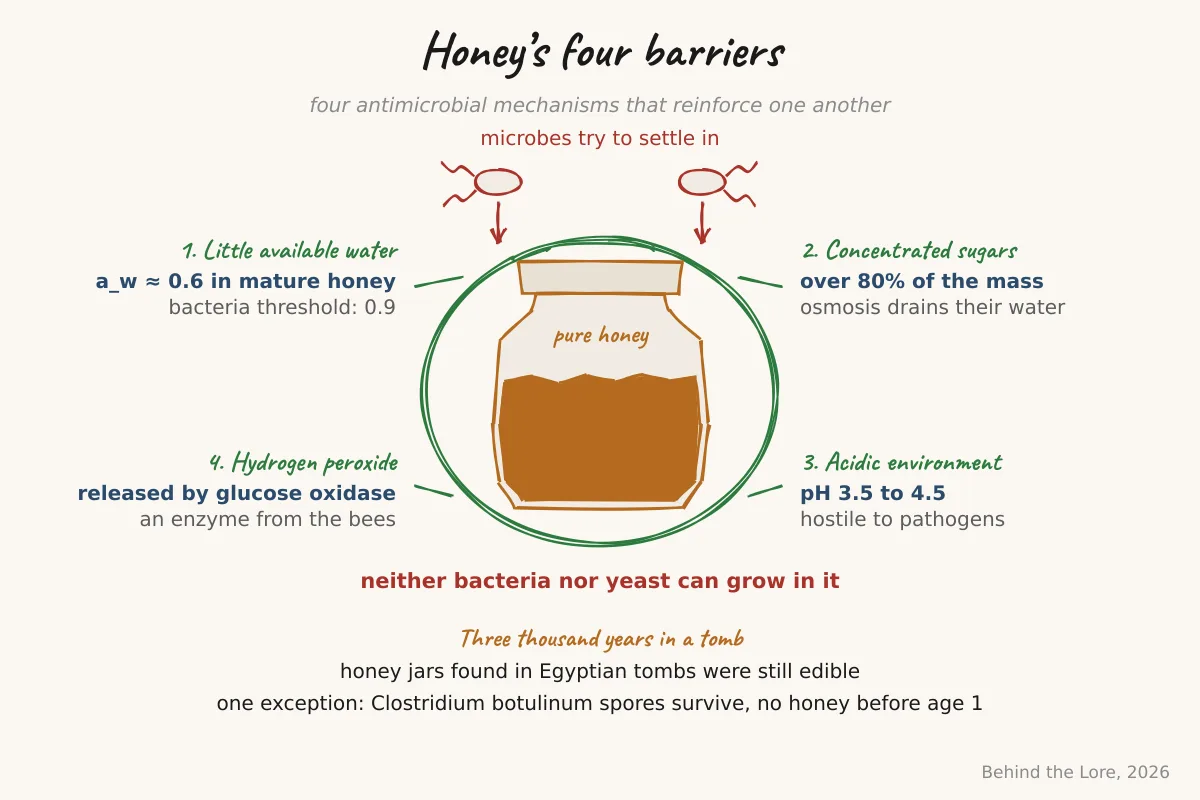
Water activity. A food’s shelf life depends less on its total water content than on the fraction of water actually available to microorganisms, measured as water activity (a_w, between 0 and 1)
[Wikipedia] . Most pathogenic bacteria need an a_w above 0.9, yeasts above 0.7. Mature honey has an a_w around 0.6, well below these thresholds. Microorganisms simply lack the water they need to function and reproduce there.
Osmolarity. Honey’s sugar concentration, which exceeds 80% of its mass, generates high osmotic pressure. Any microbial cell in contact with honey loses its water through osmosis, a dehydration process called plasmolysis. The bacterium is left without its watery cytoplasm and dies.
Acidity. Honey’s pH sits between 3.5 and 4.5, a range hostile to nearly all pathogens, which prefer neutral to slightly alkaline environments. This acidity comes from organic acids, notably gluconic acid, produced by bees during nectar maturation.
Hydrogen peroxide. Bees add an enzyme, glucose oxidase, to the nectar; in the presence of water, it oxidizes glucose into gluconic acid and releases small amounts of hydrogen peroxide. This compound acts as an antiseptic, destroying microorganisms through oxidation. In pure, little-diluted honey the concentration stays modest but still contributes to the overall effect. When honey is diluted with water, the reaction speeds up and produces more peroxide, which explains its historical use in treating wounds and burns.
Going further
- Honey and infant botulism
- Aconite
- Rhododendron and mad honey
- Discipline: Chemistry
- Discipline: Microbiology
- Discipline: Food science
Sources
Published on
Keep investigating
Auto-suggested from shared concepts, disciplines, episodes, or characters.
Aconite
In The Apothecary Diaries, aconite poisons even through honey. We explain aconitine, its action on nerves, and why it shows no mercy.
Honey and Infant Botulism
In The Apothecary Diaries, honey kills a baby. We explain infant botulism: why honey is forbidden before age one, and safe afterward.
Rhododendron and Mad Honey
In The Apothecary Diaries, a tainted honey and a burned plant cause poisoning. We explain rhododendron's grayanotoxins and the famous mad honey.
Salting and Brining
In The Apothecary Diaries, Maomao dates a batch of seaweed using her knowledge of brining. We explain how salt preserves food, and why it eventually fails.
Beeswax
Beeswax, a hydrophobic mix of esters that melts around 62°C. Candles, ointments, waterproofing, lost-wax casting: its ancient uses explained.