Beeswax: Chemistry and Ancient Uses
Story context (click to hide this block) (click to show this block)
This paragraph may contain plot information.
When Maomao enters the Garnet pavilion, she discovers that Lady Fonmin comes from a family of beekeepers and owns a collection of rare, luxurious honeys. This detail grounds the scene in the era’s beekeeping economy: beekeepers did not only produce honey, they also harvested wax from the combs, a raw material as prized as honey itself in an imperial court where candles and ointments carried social status.
The subject in depth
Beeswax is synthesized by worker bees aged twelve to eighteen days, via four pairs of wax glands located on their abdomen. They produce tiny scales of raw wax, which they knead with their mandibles before using them to build the hexagonal cells of the comb [Wikipedia] .
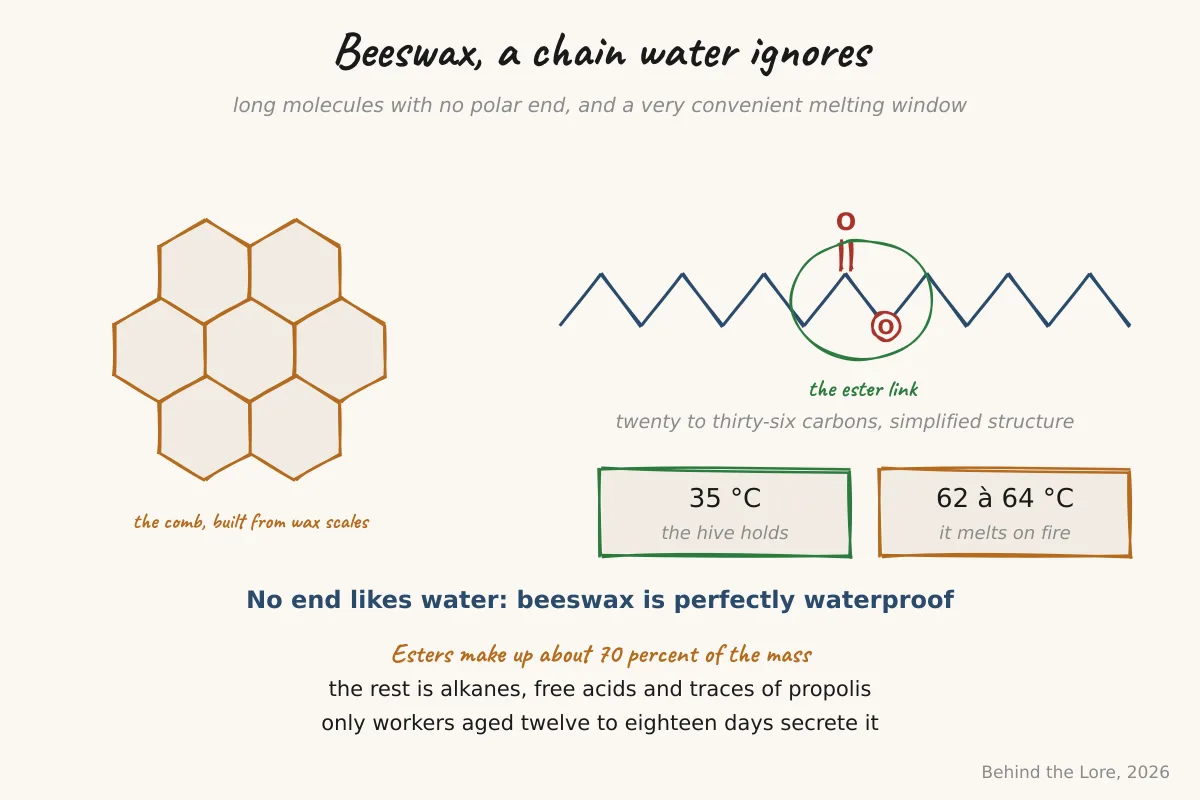
Chemically, beeswax is mainly a mixture of esters formed by the reaction of a long-chain fatty acid and a long-chain fatty alcohol [Wikipedia] . These esters make up about 70% of the total mass; the rest consists of hydrocarbons (alkanes), free acids, and traces of propolis, pigments, and floral scents picked up during foraging. The carbon chain length, generally between twenty and thirty-six carbon atoms, gives the molecule its strictly nonpolar character: no charged end can bond with water molecules, hence the wax’s perfect imperviousness.
The wax’s melting point falls between 62 and 64°C [Wikipedia] . This value is no accident: it is high enough for the comb to hold up at a hive’s summer temperature (around 35°C), but low enough for an artisan to melt it over a moderate fire without degrading its properties. This precise thermal window is what has made wax so convenient to work with throughout history.
Going further
Sources
Published on
Keep investigating
Auto-suggested from shared concepts, disciplines, episodes, or characters.
Honey and Infant Botulism
In The Apothecary Diaries, honey kills a baby. We explain infant botulism: why honey is forbidden before age one, and safe afterward.
Rhododendron and Mad Honey
In The Apothecary Diaries, a tainted honey and a burned plant cause poisoning. We explain rhododendron's grayanotoxins and the famous mad honey.
Beekeeping
In The Apothecary Diaries, Lady Fonmin's luxurious honeys come from a beekeeping family. Colony structure, castes, varietal honeys, and the history of beekeeping.
Royal Jelly
In The Apothecary Diaries, Maomao recognizes royal jelly. We explain how this secretion turns a larva into a queen, and its limits in humans.
Honey Preservation
Honey has preserved food for millennia. Here's why: low water activity, osmolarity, acidity, and hydrogen peroxide all work together to stop microbes.