Royal Jelly: Queen or Worker?
Story context (click to hide this block) (click to show this block)
This paragraph may contain plot information.
While examining Lady Fuyou’s honey jar, Maomao lets a thought slip out: “royal jelly…” A one-second remark that’s enough to show she’s noticed something no one else has. Her apothecary’s instinct instantly recognizes a precious substance mixed into ordinary honey, signaling that the Garnet Pavilion’s supply isn’t that of a mere cook.
The subject in depth
Royal jelly is a secretion produced by the hypopharyngeal and mandibular glands of nurse bees, young workers between five and fifteen days old [Wikipedia] . Its creamy, whitish-yellow texture gives it its name. All larvae receive it during their first two to three days; after that, only the larva destined to become queen keeps receiving it, exclusively and continuously, until pupation.
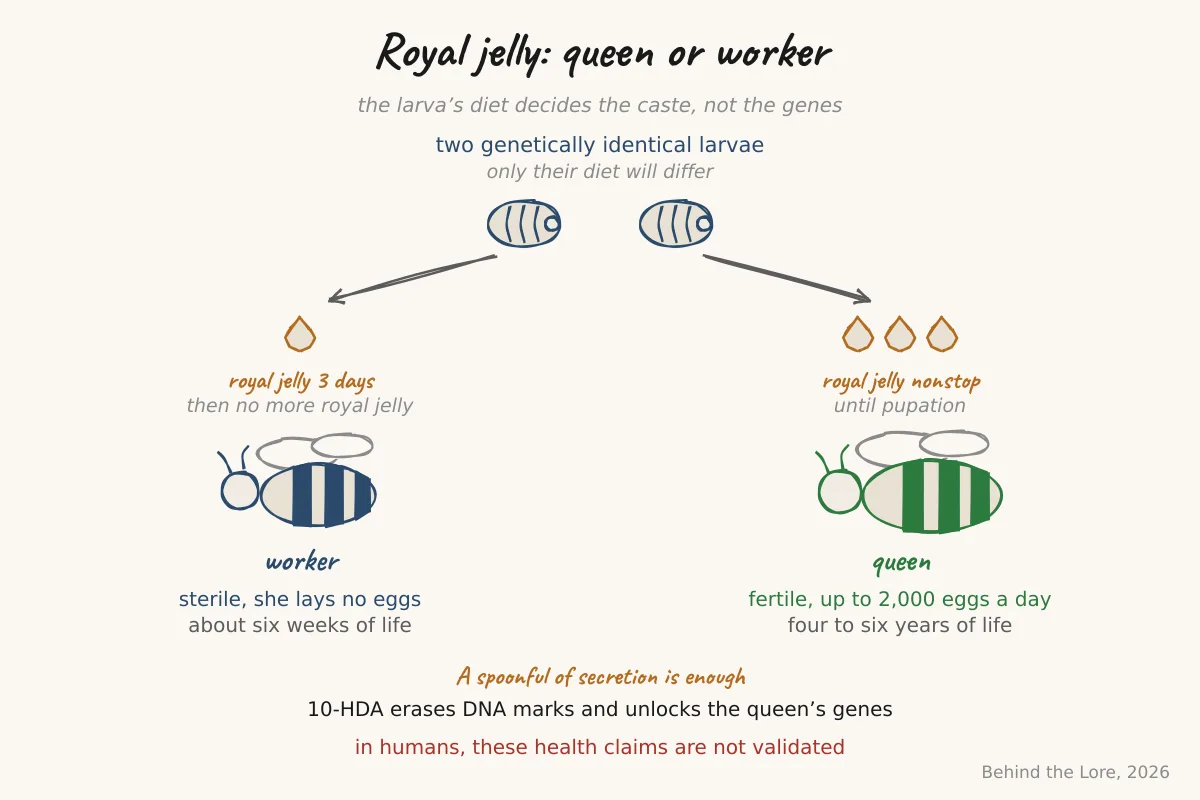
This difference in diet alone is enough to produce two radically different animals from the same genetic material [Wikipedia] . The queen is larger, has functional ovaries, can lay up to two thousand eggs a day, and lives four to six years, compared to about six weeks for a worker. It’s the same genome, but a very different pattern of gene expression.
The mechanism is epigenetic. Royal jelly contains several active molecules. The most characteristic is 10-hydroxy-2-decenoic acid, or 10-HDA, a long-chain fatty acid unique to this secretion. Studies have shown that 10-HDA inhibits certain DNA methylations, chemical marks that regulate access to genes. By reducing these marks, royal jelly lifts the blocks that would otherwise prevent the larva from activating the growth and reproductive pathways specific to the queen. Among royal jelly’s proteins, royalactin was long presented as the determining factor, but more recent studies suggest the effect is multifactorial and that overall composition matters as much as any single isolated component.
All of this illustrates a fundamental principle of biology: genes are not a fixed destiny. What is eaten, and in what quantity, can durably rewrite which genes are active. The same DNA sequence can produce a sterile worker living a few weeks or a reproductive queen living several years. The environment, here reduced to a spoonful of secretion, makes all the difference.
Going further
Sources
Published on
Keep investigating
Auto-suggested from shared concepts, disciplines, episodes, or characters.
Honey and Infant Botulism
In The Apothecary Diaries, honey kills a baby. We explain infant botulism: why honey is forbidden before age one, and safe afterward.
Rhododendron and Mad Honey
In The Apothecary Diaries, a tainted honey and a burned plant cause poisoning. We explain rhododendron's grayanotoxins and the famous mad honey.
Beeswax
Beeswax, a hydrophobic mix of esters that melts around 62°C. Candles, ointments, waterproofing, lost-wax casting: its ancient uses explained.
Beekeeping
In The Apothecary Diaries, Lady Fonmin's luxurious honeys come from a beekeeping family. Colony structure, castes, varietal honeys, and the history of beekeeping.
Honey Preservation
Honey has preserved food for millennia. Here's why: low water activity, osmolarity, acidity, and hydrogen peroxide all work together to stop microbes.