Beekeeping: bees, hive, and honey
Story context (click to hide this block) (click to show this block)
This paragraph may contain plot information.
When Maomao discovers Lady Fonmin’s honey collection, the series notes that she comes from a family of beekeepers, which explains the variety and luxury of her stock. This detail grounds the honey in its real production context: it isn’t a uniform product, but a substance whose quality and flavor profile vary with its floral origin and the keeper’s expertise.
The subject in depth
Beekeeping rests on the social biology of honeybees, particularly Apis mellifera
[Wikipedia] . A colony is made up of three castes: a queen (the sole reproductive female, capable of laying up to 2,000 eggs a day), workers (sterile females that forage, ventilate, guard, and feed the colony), and drones (males whose sole role is to fertilize the queen). A colony can number between 20,000 and 80,000 individuals at the height of the season.
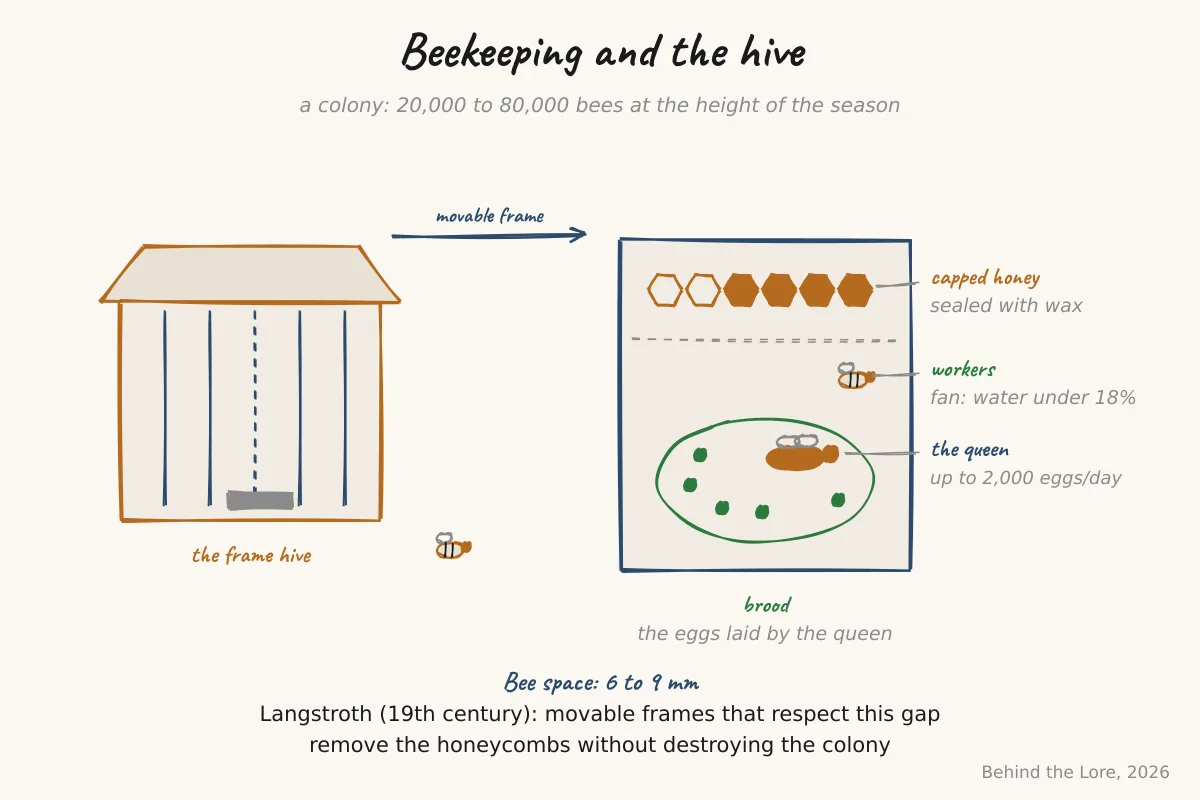
Honey production follows a precise process. Forager bees collect nectar from flowers, enrich it with salivary enzymes, and deposit it in wax cells. Workers then fan the hive to evaporate the water until its content no longer exceeds about 18%, the threshold below which yeasts can no longer ferment. The cells are then capped with wax: the honey is stabilized and can keep indefinitely
The diversity of honeys comes down to the plant foraged. A monofloral honey (acacia, lavender, chestnut, buckwheat) has a distinct aromatic profile, a characteristic color, and a crystallization speed tied to its dominant sugars. A wildflower or polyfloral honey combines the contributions of multiple floral species and varies by season and terrain.
Going further
- Honey and Infant Botulism
- Rhododendron and Mad Honey
- Aconite and Toxic Honey
- Discipline: Biology
- Discipline: History of Science
Sources
Published on
Keep investigating
Auto-suggested from shared concepts, disciplines, episodes, or characters.
Aconite
In The Apothecary Diaries, aconite poisons even through honey. We explain aconitine, its action on nerves, and why it shows no mercy.
Honey and Infant Botulism
In The Apothecary Diaries, honey kills a baby. We explain infant botulism: why honey is forbidden before age one, and safe afterward.
Rhododendron and Mad Honey
In The Apothecary Diaries, a tainted honey and a burned plant cause poisoning. We explain rhododendron's grayanotoxins and the famous mad honey.
Beeswax
Beeswax, a hydrophobic mix of esters that melts around 62°C. Candles, ointments, waterproofing, lost-wax casting: its ancient uses explained.
Royal Jelly
In The Apothecary Diaries, Maomao recognizes royal jelly. We explain how this secretion turns a larva into a queen, and its limits in humans.