Salting and brining: preserving food with salt
Story context (click to hide this block) (click to show this block)
This paragraph may contain plot information.
Maomao investigates in the kitchens after a bureaucrat’s poisoning. Facing suspicion falling on some seaweed, she immediately rules out the idea of a year-old stock, pointing out that brine does not guarantee indefinite preservation: even soaked in salt, seaweed harvested the previous year would not have held up. This reasoning gives her a chronological clue for dating the goods and directing her investigation. Later, she mentions that brine-preservation is the normal way to import this seaweed, which explains how it could travel from a distant region without rotting along the way.
The subject in depth
Preservation by salt relies on two linked mechanisms. The first is the reduction of water activity, denoted a_w, a value that measures the fraction of water in a food that is actually available for chemical and biological reactions [Wikipedia] . A fresh food has a water activity close to 1: the water is free, and microorganisms can use it for their enzymes, metabolism, and reproduction. By saturating a food with salt, part of that water becomes chemically bound to sodium and chloride ions, which drives a_w down. Below 0.9, most pathogenic bacteria stop multiplying; below 0.7, nearly all common microorganisms are inhibited.
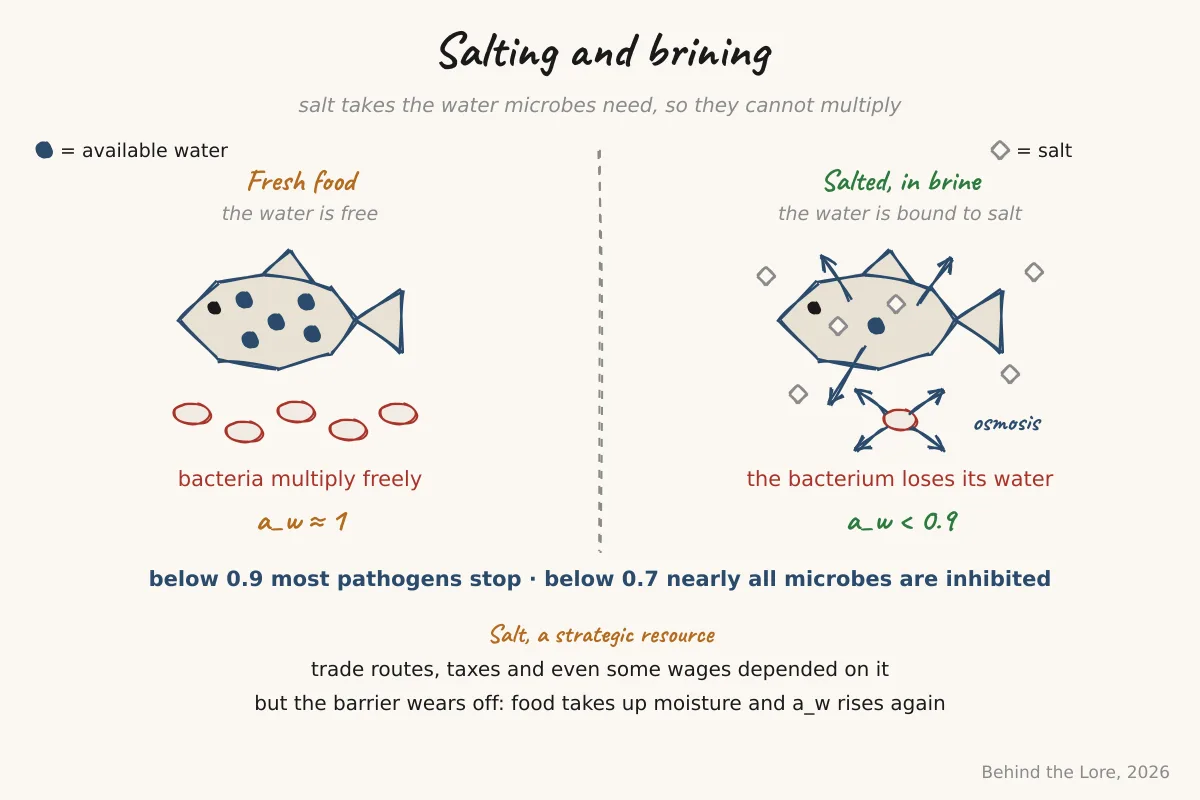
The second mechanism is osmosis [Wikipedia] . Salt creates a high ionic concentration outside microbial cells. Through osmosis, water leaves those cells toward the more concentrated surrounding medium, dehydrating them until they can no longer function. This osmotic pressure is also why meat or fish placed in a strong brine themselves lose water: the salt does not soak into the food, the food dries out from the inside.
Salting takes two main forms. Dry salting involves rubbing or coating the food with crystalline salt, which gradually draws out moisture and forms its own brine on the surface. Wet brining plunges the food directly into a saturated or semi-saturated saltwater solution; diffusion is faster and more even, which suits thick cuts or preparations meant for import and transport.
Acidity plays a complementary protective role. In brine, halophilic (salt-tolerant) lactic acid bacteria ferment the food’s sugars and produce lactic acid. This low pH creates a second barrier for microorganisms that cannot tolerate acid. Many traditional salt-based preparations, from sauerkraut to fermented fish to olives, rely on this combined effect: salt selects for lactic acid bacteria, and those bacteria then acidify the environment, making the niche hostile to pathogens.
But this protection is neither absolute nor permanent. Some halophilic or halotolerant microorganisms resist high salt concentrations. Others, like Clostridium botulinum, the cause of botulism, can grow under anaerobic, low-a_w conditions if the salt concentration is insufficient. And time itself matters: salt can redistribute over time, the food can absorb ambient moisture, and a_w can rise back up. This is exactly what Maomao expresses in the story when she says that even in salt, a year-old batch of seaweed eventually degrades.
Going further
- Honey and Infant Botulism
- Dehydration and Rehydration
- Discipline: Chemistry
- Discipline: Microbiology
- Discipline: Food Science
Sources
Published on
Keep investigating
Auto-suggested from shared concepts, disciplines, episodes, or characters.
Dehydration and Rehydration
In The Apothecary Diaries, Maomao treats heatstroke with salted, sweetened water. We explain dehydration and why salt is vital.
Honey and Infant Botulism
In The Apothecary Diaries, honey kills a baby. We explain infant botulism: why honey is forbidden before age one, and safe afterward.
Honey Preservation
Honey has preserved food for millennia. Here's why: low water activity, osmolarity, acidity, and hydrogen peroxide all work together to stop microbes.
Food Smoking
Tsukasa smokes his meat in Dr Stone: we explain the chemistry of smoke, the role of aldehydes and phenols, and the modern health risks.
Sulfa Drugs
Senku aims for a miracle drug in Dr Stone. We explain sulfa drugs, the first synthetic antibacterials of the 1930s, and how they stop bacteria.