Sulfa drugs: the first synthetic antibacterial
Story context (click to hide this block) (click to show this block)
This paragraph may contain plot information.
To save Ruri, who suffers from chronic pneumonia, Senku sets himself a wildly ambitious goal: producing a genuine medicine. He targets sulfanilamide, which he describes as an antibacterial capable of defeating the infection. The whole village rallies around this “miracle drug”, the scientific and emotional high point of the season.
The subject in depth
The term “sulfonamide” first refers to a chemical group (a sulfur atom bonded to two oxygen atoms and one nitrogen atom). In medicine, it refers to a family of antibacterial drugs derived from a parent molecule, sulfanilamide [Wikipedia] . These are the first synthetic antibacterial agents, made by chemistry rather than extracted from a living organism, as penicillin later would be.
Their mechanism relies on an elegant molecular trick [Wikipedia] . To build their DNA, bacteria need folic acid (vitamin B9). But unlike us, they cannot draw it from their food: they must synthesize it themselves, from a precursor called para-aminobenzoic acid, or PABA [Wikipedia] . A bacterial enzyme, dihydropteroate synthase, assembles PABA with other building blocks to kick off this synthesis.
Sulfanilamide has a shape and size very close to PABA’s. When it is present, the bacterial enzyme grabs it “by mistake”, like a lock accepting a fake key. The enzyme stays jammed, the folic acid assembly line grinds to a halt, and the bacterium, deprived of the building blocks of its DNA, stops multiplying. This is called competitive inhibition: the drug competes with the natural substrate for the enzyme’s active site.
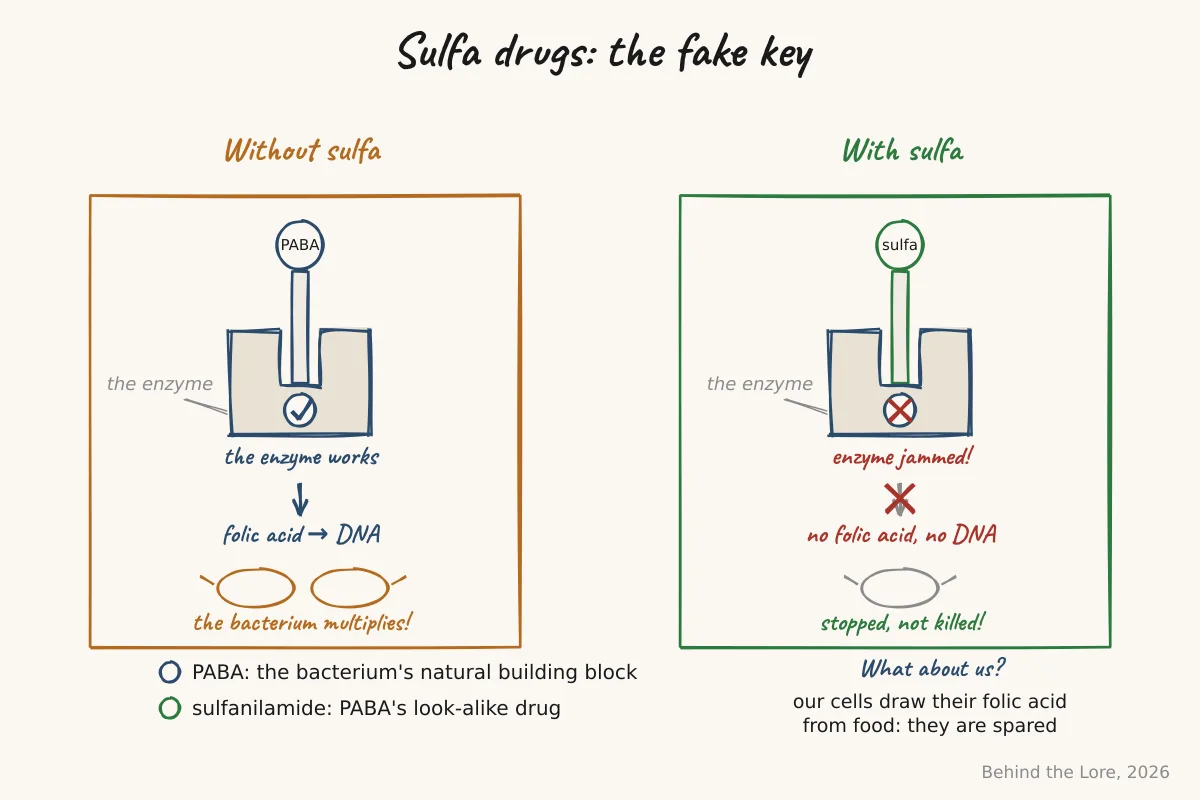
One detail explains why this poison is selective. Our own cells do not make their folic acid: they absorb it from food. They therefore lack the targeted enzyme, and the sulfa drug spares them. This is what we call selective toxicity, the founding principle of all anti-infective chemotherapy: strike a target the microbe has but the host does not.
Note that sulfa drugs are bacteriostatic, not bactericidal: they stop bacteria from proliferating but do not kill them directly. It is the immune system that then wipes out the population halted in its growth.
Going further
- Coming soon: Aniline
- Coming soon: The pneumococcus
- Discipline: Medicine
- Discipline: Chemistry
Sources
Published on
Going further
Auto-suggested from shared concepts, disciplines, episodes, or characters.
Acetanilide
Senku makes acetanilide in Dr Stone. We explain this historical painkiller and fever reducer, an ancestor of paracetamol, and why it was abandoned.
Fugu and Tetrodotoxin
In The Apothecary Diaries, Maomao loves fugu and its poison. We explain tetrodotoxin, how it paralyzes, and why there's no antidote.
Salting and Brining
In The Apothecary Diaries, Maomao dates a batch of seaweed using her knowledge of brining. We explain how salt preserves food, and why it eventually fails.
Black Powder
Senku makes gunpowder in Dr Stone. We explain its composition (saltpeter, charcoal, sulfur), the chemical reaction, and its history.
Brandy
Senku turns his wine into brandy by distillation: we explain medieval eau-de-vie, alchemical aqua vitae, and how you get to 40-proof spirit.