Black powder explained: the chemistry of Dr Stone
Story context (click to hide this block) (click to show this block)
This paragraph may contain plot information.
To stand up to Tsukasa, Senku decides to make a firearm. He points out that Japan is a volcanic archipelago, and therefore rich in sulfur, and launches the production of powder, presenting it as the first great weapon of the kingdom of science.
The subject in depth
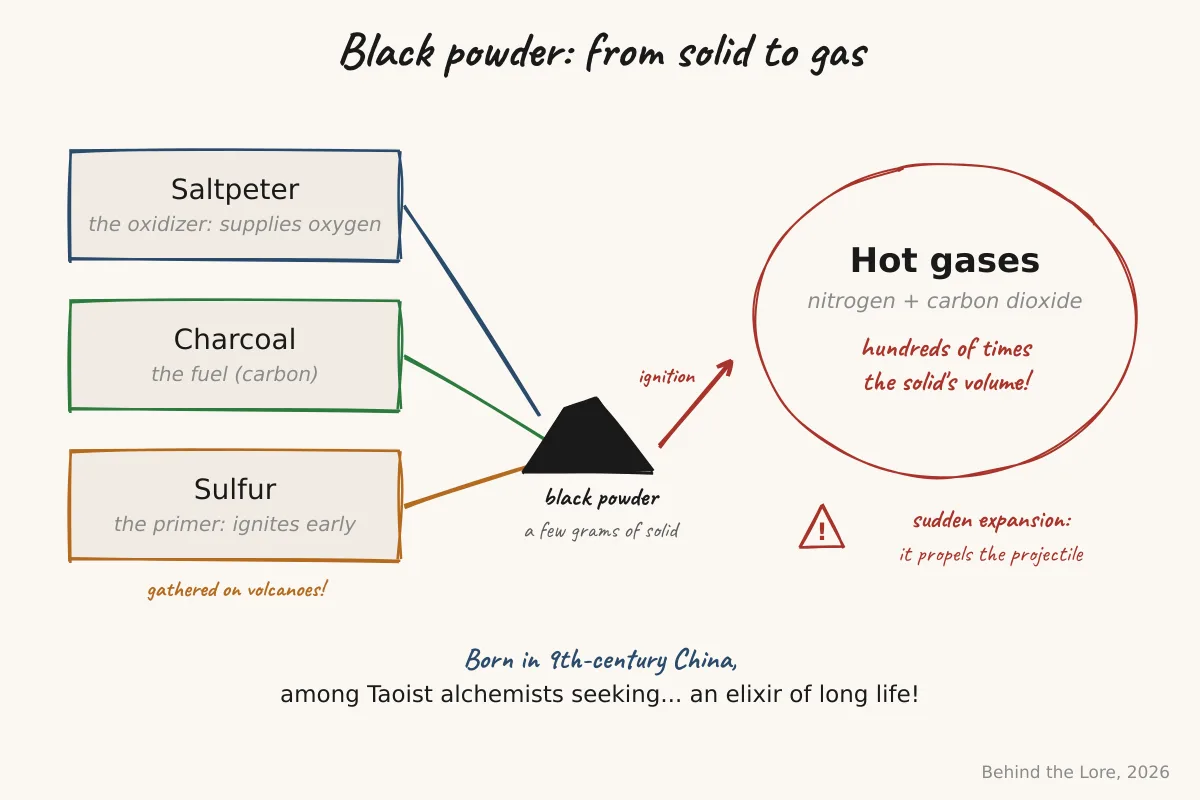
Black powder relies on a redox reaction [Wikipedia] . Saltpeter (potassium nitrate, KNO₃) plays the role of oxidizer: when heated, it releases oxygen. That oxygen is immediately consumed by a fuel, charcoal (essentially carbon). Sulfur is the third player: it ignites at a lower temperature than charcoal and acts as a primer, speeding up the ignition of the whole mixture.
A simplified equation for the combustion reads: 2 KNO₃ + S + 3 C → K₂S + N₂ + 3 CO₂. The essential point lies in the ratio between solid and gas. A few grams of solid powder produce, in a fraction of a second, hundreds of times their volume in hot gases (nitrogen, carbon dioxide). It is this sudden expansion that propels a bullet or bursts a charge.
Black powder deflagrates; it does not detonate: its combustion front advances at a few hundred meters per second, well below the speed of sound in the material, unlike modern high explosives (nitroglycerin, TNT), which detonate at several kilometers per second. Grain size matters too: a powder that is finely ground and then recompacted into grains burns more evenly than a loose dust, a major innovation of medieval pyrotechnics.
Going further
Sources
- Black powder (French Wikipedia)
- Saltpeter (French Wikipedia)
- Robert P. Multhauf, The Origins of Chemistry (1966)
- Lewis Dartnell, The Knowledge: How to Rebuild Our World from Scratch (2014)
Published on
Going further
Auto-suggested from shared concepts, disciplines, episodes, or characters.
Guano and Nitrification
Senku exploits bat droppings to produce nitric acid: we explain bacterial nitrification and the history of saltpeter.
Nitric Acid
Senku finds nitric acid in a bat cave: we explain the chemistry of HNO₃, bacterial nitrification, and the industrial Ostwald process.
Dynamite
How did Nobel tame nitroglycerin? We explain dynamite, absorption into kieselguhr, and the link with the Nobel Prize.
Papermaking
Senku makes paper in Dr Stone. We explain how alkaline cooking frees cellulose fibers by dissolving lignin, then how the sheet is formed.
Acetanilide
Senku makes acetanilide in Dr Stone. We explain this historical painkiller and fever reducer, an ancestor of paracetamol, and why it was abandoned.