Black powder: chemistry of an ancient invention
Story context (click to hide this block) (click to show this block)
This paragraph may contain plot information.
While examining the feifa confiscated at the end of the investigation, Maomao lays out its mechanics without hesitation: friction between the metal fittings produces a spark, and that spark ignites the powder made of charcoal, saltpeter, and sulfur. She then recognizes on a suspect the unpleasant smell reminiscent of rotten eggs, the same smell released when the feifa goes off. It is this cross-match between the chemical formula and the olfactory signature that lets her reconstruct what happened.
The subject in depth
Black powder is one of the oldest intentionally manufactured chemical mixtures. Its composition is threefold [Wikipedia] : about 75% saltpeter, 15% charcoal, and 10% sulfur. These proportions have been known since at least the 11th century in China and have changed little over the centuries, which says something about the robustness of the formula.
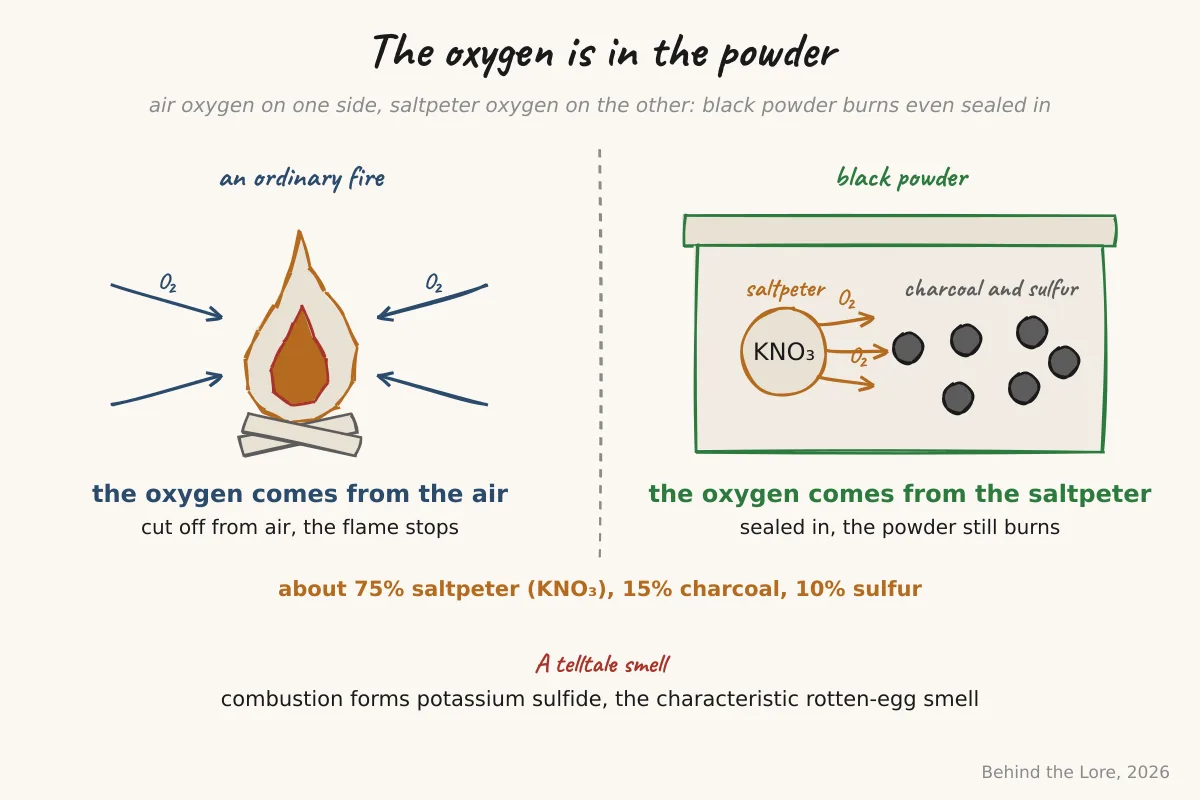
Each ingredient plays a distinct role in the reaction. Charcoal is the main fuel, the part that burns and releases energy. Sulfur is a secondary fuel, easier to ignite than charcoal alone, which lowers the mixture’s ignition temperature and speeds up flame propagation. But it is saltpeter, potassium nitrate (KNO₃), that makes the mixture particularly powerful [Wikipedia] . Unlike ordinary combustion, which depends on oxygen from the surrounding air, saltpeter carries its own oxygen bound within its molecule. As it decomposes under heat, it releases that oxygen directly at the heart of the mixture, allowing combustion to spread very rapidly, even in a confined space where air cannot circulate.
The result is a deflagration: a very fast combustion that produces a large volume of hot gas in a very short time. These gases are what propel a projectile out of a cannon or a feifa. We speak of deflagration rather than explosion in the strict sense, because the combustion front advances slower than the speed of sound, unlike a shattering (detonating) explosive. This detail of physics has had important practical consequences throughout the history of weapons.
The products of this reaction are varied: carbon dioxide, nitrogen, but also potassium sulfide (K₂S) and sulfur dioxide (SO₂) [Wikipedia] . These sulfur compounds, particularly K₂S, whose smell resembles rotten eggs, give black powder its distinctive odor. The association between powder smoke and this smell is so consistent that it has stayed attached to firearms throughout their history.
Going further
Sources
Published on
Keep investigating
Auto-suggested from shared concepts, disciplines, episodes, or characters.
Orpiment and Arsenic
In The Apothecary Diaries, a yellow pigment poisons slowly. We explain orpiment, arsenic, and the chronic poisoning of court painters.
Carbon Monoxide
In The Apothecary Diaries, embers bring guests down at a party. We explain carbon monoxide, why it suffocates without warning, and the right thing to do.
A Dog's Sense of Smell
Maomao deduces that the dog tracked gunpowder. We explain why dogs smell a hundred times better, how they follow a trail, and how it's used today.
Elixirs of Immortality
Several Chinese emperors were killed by elixirs meant to make them immortal. Waidan alchemy, cinnabar, mercury, and arsenic explained.
Frog Skin
Frog skin is both a respiratory organ and a chemical arsenal. Protective mucus, bufotoxins, batrachotoxin, and chan su in traditional medicine.