A Dog's Sense of Smell: why it's so sharp
Story context (click to hide this block) (click to show this block)
This paragraph may contain plot information.
During the investigation into the feifa incident, Maomao explains that a dog’s nose easily recognizes the smell left by gunpowder, and deduces from this that the hunting dogs were deliberately kept away by the shooter to avoid being caught. Moments later, the dog does indeed track down the culprit from the scent trail of gunpowder alone, and Maomao concludes: “What a brilliant animal.” In two lines, this exchange condenses the real biology of canine smell and its application to forensic tracking.
The subject in depth
A dog’s sense of smell is one of the most striking examples of sensory specialization among mammals [Wikipedia] . It all begins in the nose: the olfactory epithelium, the surface lined with nerve cells that captures odor molecules, covers between 100 and 150 cm² in a dog, compared to just 3 to 5 cm² in a human. This vastly expanded surface hosts around 300 million olfactory receptors, fifty times more than our 6 million.
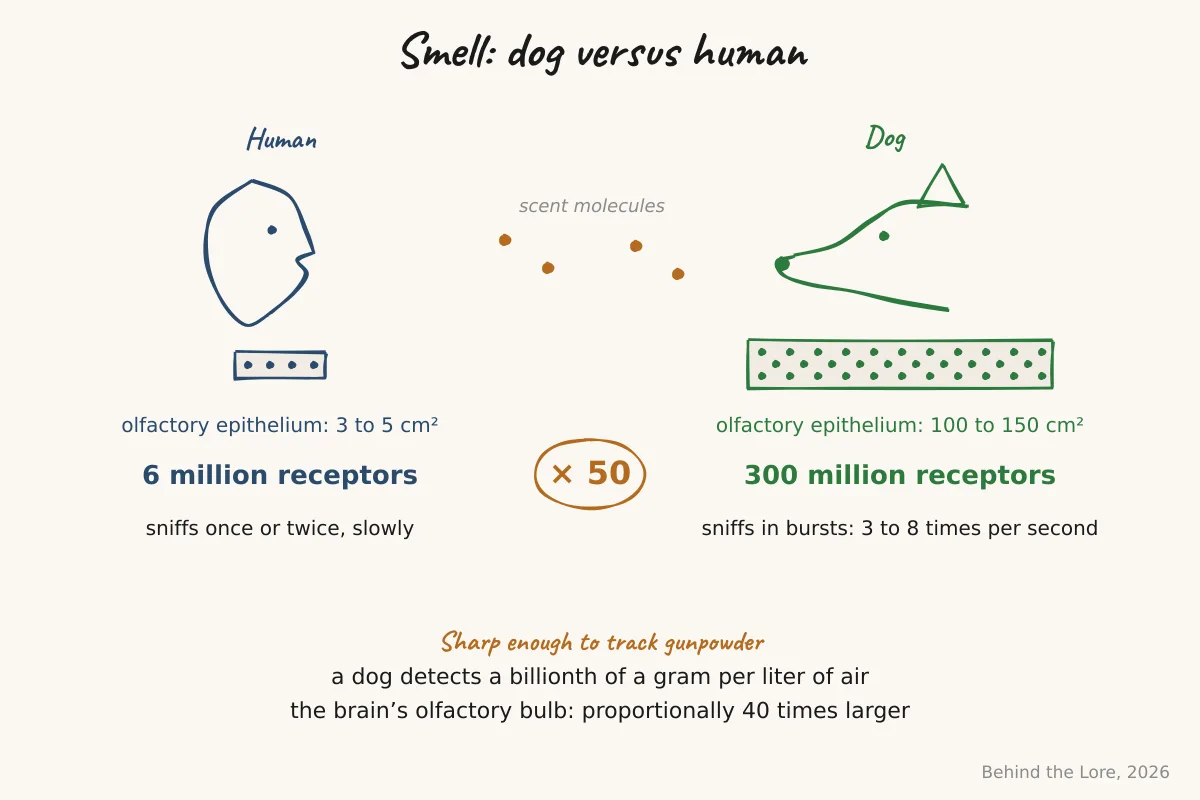
Olfactory receptors are membrane proteins that each recognize one or several molecules: when a molecule binds to one, it triggers an electrical signal that travels to the brain’s olfactory bulb. In dogs, the olfactory bulb is proportionally forty times larger than in humans relative to total brain mass. The canine brain therefore devotes a far greater share of its processing power to olfactory information, which explains an exceptional scent memory: a dog can recognize an odor encountered years earlier.
On top of this, there’s a distinctive sniffing mechanism. When a dog searches for a scent, it sniffs in short, rapid bursts, three to eight times per second. Each sniff refreshes the air in contact with the epithelium without fully expelling the previous one, maintaining a film of concentrated molecules on the receptors. Humans sniff once or twice, slowly, and expel the air through the same path. Dogs, by contrast, have anatomically separate nostrils for inhaling and exhaling, creating a one-way airflow that optimizes contact between the air and the receptors.
Finally, dogs have an additional organ absent in adult humans: the vomeronasal organ, or Jacobson’s organ, located at the base of the nasal septum. It detects low-volatility chemical signals, including pheromones and other chemical communication molecules [Wikipedia] .
Following a trail: the scent gradient
When someone passes through a place, they leave behind scent molecules deposited on the ground, on plants, and on surfaces. These molecules disperse through diffusion and convection, so the concentration is highest at the most recent point of passage and decreases moving back toward the starting point. A tracking dog “reads” this gradient: by comparing the concentration detected at each step, it steers its course toward the zones where the scent is stronger, that is, toward the most recent source. This ability, called natural olfactometry, lets it determine not just where someone went, but which direction they were heading and how long ago.
Going further
Sources
Published on
Keep investigating
Auto-suggested from shared concepts, disciplines, episodes, or characters.
Carbon Monoxide
In The Apothecary Diaries, embers bring guests down at a party. We explain carbon monoxide, why it suffocates without warning, and the right thing to do.
Frog Skin
Frog skin is both a respiratory organ and a chemical arsenal. Protective mucus, bufotoxins, batrachotoxin, and chan su in traditional medicine.
Black Powder
In The Apothecary Diaries, Maomao states the exact formula for black powder. We explain the role of each ingredient, the reaction, and the rotten-egg smell.
Bear Bile
Why did bear bile, a traditional TCM remedy, lead to a modern drug? UDCA dissolves gallstones and treats the liver.
Beekeeping
In The Apothecary Diaries, Lady Fonmin's luxurious honeys come from a beekeeping family. Colony structure, castes, varietal honeys, and the history of beekeeping.