Dynamite: stabilizing nitroglycerin
Story context (click to hide this block) (click to show this block)
This paragraph may contain plot information.
After producing his nitroglycerin, Senku presents it as dynamite, the decisive weapon against Tsukasa’s empire. He invokes the power of an explosive that, in our history, changed warfare and civil engineering, and whose inventor bequeathed his name to the most prestigious of scientific distinctions.
The subject in depth
Dynamite was born from a practical problem: pure nitroglycerin is an explosive of remarkable power, but its instability makes it almost unusable [Wikipedia] . In liquid form, it detonates at the slightest shock, oozes out of cartridges, and freezes and thaws in dangerous ways. Transporting it and using it on a worksite was a deadly gamble, and accidents numbered in the dozens in the mid-19th century.
The solution Alfred Nobel found is elegantly simple [Wikipedia] . He soaked the liquid nitroglycerin into a solid, porous, chemically inert material: kieselguhr, or diatomaceous earth, a powdery rock formed from the siliceous skeletons of microscopic algae. This material behaves like a mineral sponge: through adsorption, its countless pores fix the explosive liquid and hold it in place [Wikipedia] . The mixture becomes a moldable paste, packaged into sticks. Above all, it becomes far less sensitive: a shock or friction is no longer enough to make it detonate, and it now takes a detonator, a small priming charge, to trigger the explosion at will.
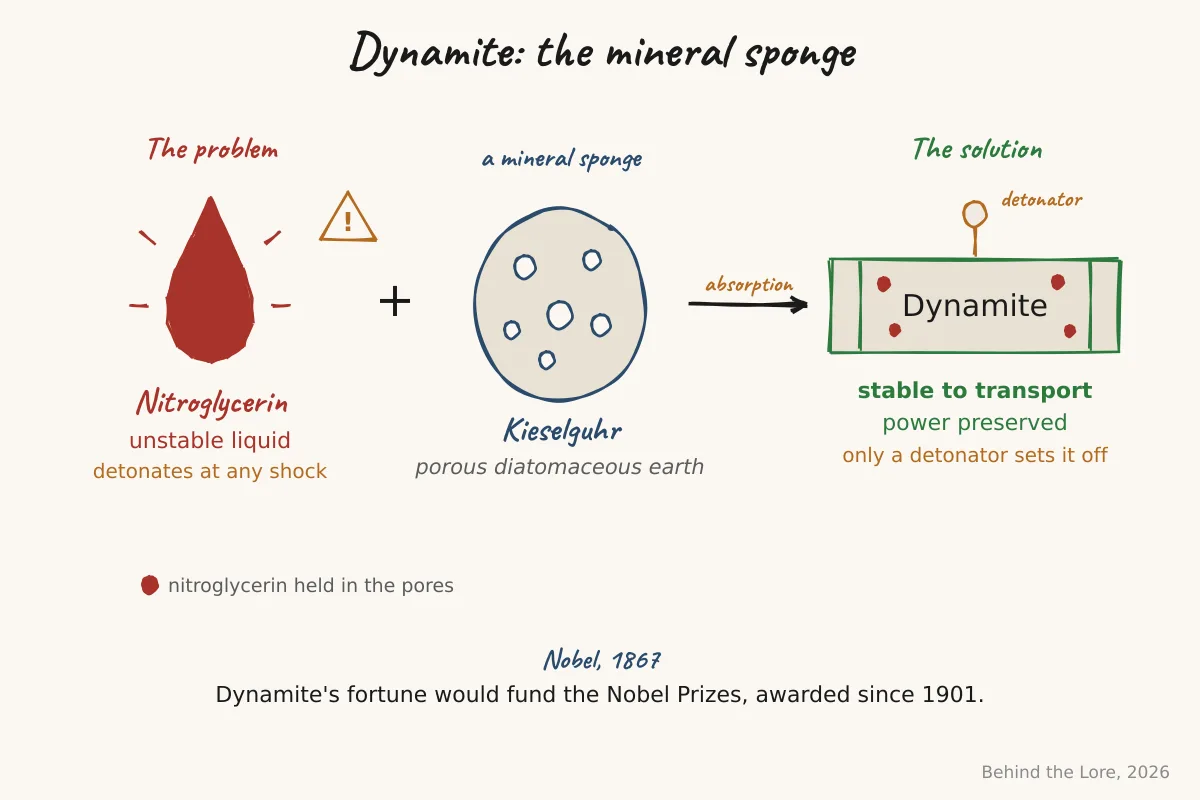
The trade-off is a winning one. A little power per unit of mass is lost, since part of the volume is taken up by an inert absorbent, but a decisive margin of safety is gained. Dynamite can be stored, handled, and placed precisely where it is wanted, then primed at the chosen moment. This control transforms the explosive from an uncontrollable danger into an engineering tool: tunnel boring, mine opening, demolition, earthworks.
Going further
- Coming soon: Nitroglycerin: the unstable liquid explosive that dynamite tames
- Black powder: the ancestor of chemical explosives
- Discipline: Chemistry
- Discipline: History of Science
Sources
Published on
Going further
Auto-suggested from shared concepts, disciplines, episodes, or characters.
Black Powder
Senku makes gunpowder in Dr Stone. We explain its composition (saltpeter, charcoal, sulfur), the chemical reaction, and its history.
Papermaking
Senku makes paper in Dr Stone. We explain how alkaline cooking frees cellulose fibers by dissolving lignin, then how the sheet is formed.
Acetanilide
Senku makes acetanilide in Dr Stone. We explain this historical painkiller and fever reducer, an ancestor of paracetamol, and why it was abandoned.
Brandy
Senku turns his wine into brandy by distillation: we explain medieval eau-de-vie, alchemical aqua vitae, and how you get to 40-proof spirit.
Calcium Carbonate
Senku presents calcium carbonate as civilization's cornerstone: we explain CaCO₃, the lime cycle, and its uses in agriculture and construction.