Papermaking in Dr Stone S2E5
Story context (click to hide this block) (click to show this block)
This paragraph may contain plot information.
To organize the kingdom of science and pass knowledge on, Senku needs a durable, reproducible writing medium. He sets out to produce paper, which he presents as a tool of civilization on a par with machines: without a medium to record formulas and blueprints, knowledge stays fragile and depends on memory alone.
The subject in depth
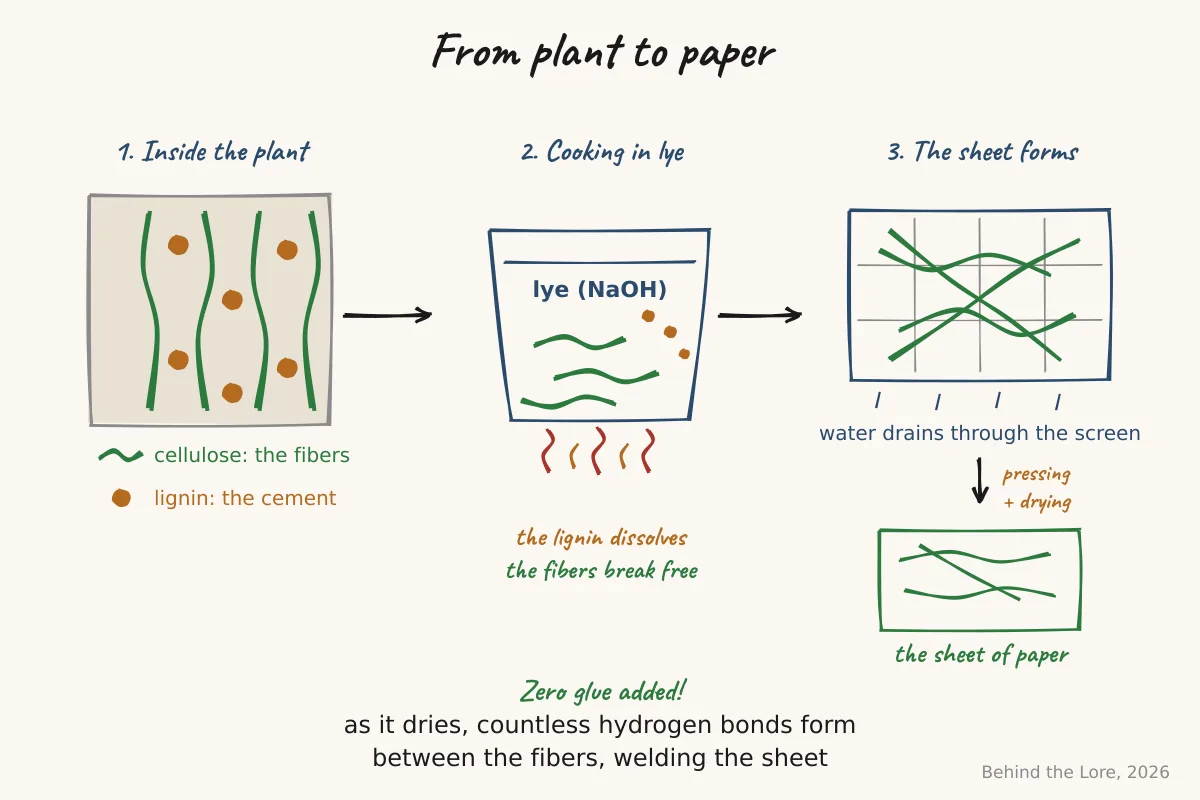
A woody plant is not a homogeneous block. Its cellulose fibers, long chain molecules built from glucose, give it its tensile strength [Wikipedia] . But these fibers are coated and cemented by another substance, lignin, a phenolic polymer that stiffens cell walls and makes them waterproof [Wikipedia] . Lignin is what makes a piece of wood hard and brittle rather than supple and fibrous. To make paper, you therefore have to separate the good fibers from that cement.
That is the job of chemical pulping [Wikipedia] . Wood chips or plant fibers are cooked in a strongly alkaline (that is, basic) solution, typically lye, sodium hydroxide [Wikipedia] . Hot, this basic medium attacks and dissolves the lignin, which passes into solution, while the cellulose fibers, more resistant to the attack, stay intact and come apart from one another. The result is a slurry of clean fibers suspended in water: paper pulp. The dominant industrial method, the kraft process, adds sodium sulfide to speed up this delignification and preserve the fibers’ strength [Wikipedia] .
Then the sheet must be formed. The diluted pulp is poured over a fine screen. The water drains through the mesh and the fibers settle into an entangled layer, forming a random mat. This wet web is pressed to drive out the remaining water, then dried. As it dries, the cellulose fibers draw close enough to form countless hydrogen bonds between them, those weak but innumerable attractions that arise between hydroxyl groups. It is this multitude of bonds, not any added glue, that welds the fibers together and gives the sheet its cohesion. Paper is thus, essentially, pure cellulose reorganized into a network.
Going further
- Coming soon: The composite material
- Sodium carbonate
- Coming soon: Brine electrolysis
- Discipline: Chemistry
- Discipline: History of Science
Sources
Published on
Going further
Auto-suggested from shared concepts, disciplines, episodes, or characters.
Sodium Carbonate
Senku mentions seaweed-derived sodium carbonate as a soap ingredient: we explain the chemistry of Na₂CO₃, its natural sources, and its shift to industry.
Black Powder
Senku makes gunpowder in Dr Stone. We explain its composition (saltpeter, charcoal, sulfur), the chemical reaction, and its history.
Dynamite
How did Nobel tame nitroglycerin? We explain dynamite, absorption into kieselguhr, and the link with the Nobel Prize.
Acetanilide
Senku makes acetanilide in Dr Stone. We explain this historical painkiller and fever reducer, an ancestor of paracetamol, and why it was abandoned.
Brandy
Senku turns his wine into brandy by distillation: we explain medieval eau-de-vie, alchemical aqua vitae, and how you get to 40-proof spirit.