Acetanilide, the ancestor of paracetamol
Story context (click to hide this block) (click to show this block)
This paragraph may contain plot information.
Part of the village is suffering, and Senku sets out to produce a medicine against pain and fever. He aims for acetanilide, which he obtains from aniline and presents as a painkiller capable of putting the sick back on their feet by the next day. The process follows the same logic as the rest of the series: rebuilding the modern pharmacy from accessible organic chemistry reactions.
The subject in depth
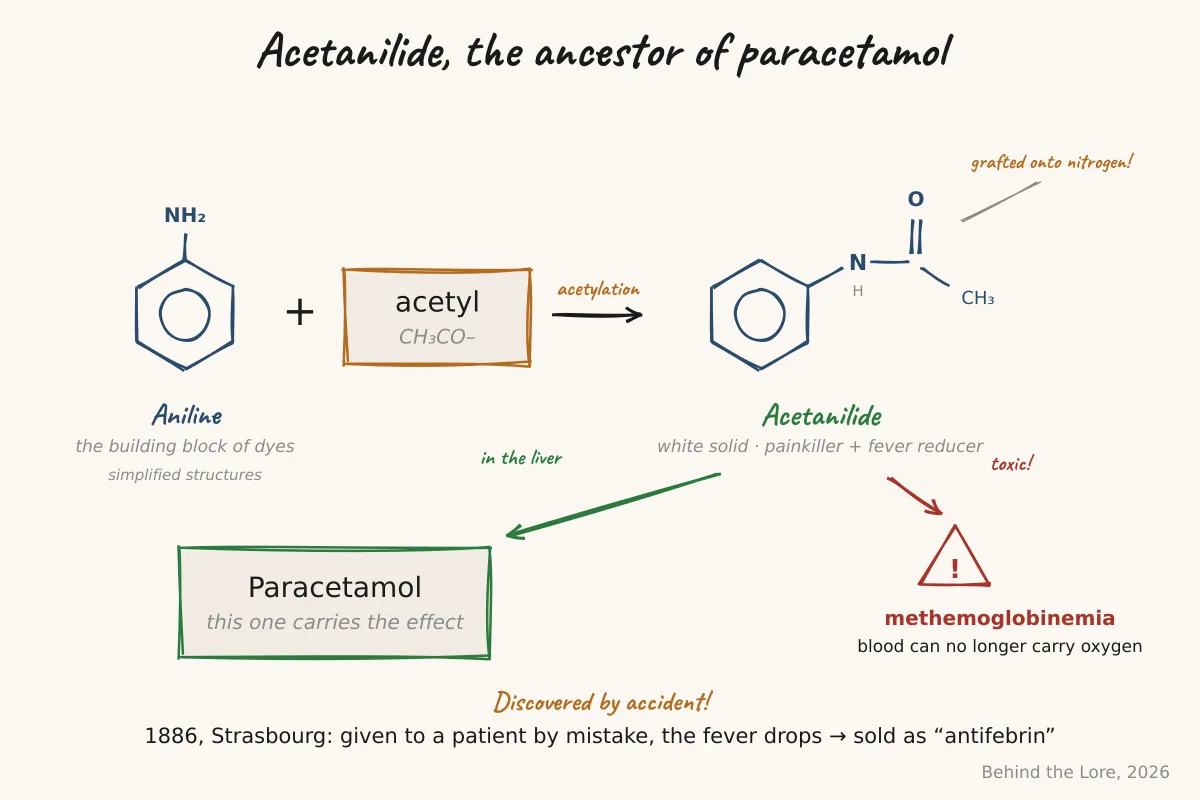
Acetanilide is born from a simple organic chemistry reaction: the acetylation of aniline [Wikipedia] . Aniline is an aromatic amine, a basic building block of the 19th-century dye industry [Wikipedia] . By grafting an acetyl group onto its nitrogen atom (for instance with acetic anhydride or acetic acid), you obtain acetanilide, a white crystalline solid.
Its discovery as a medicine was a matter of chance. In 1886, two physicians in Strasbourg mistakenly administered acetanilide to a patient and observed a sharp drop in fever. The product was immediately marketed under the name antifebrin. For several decades, it would be a common painkiller and fever reducer.
The real mechanism would only be worked out much later. Acetanilide is in fact a prodrug: once ingested, the liver partly metabolizes it into paracetamol (acetaminophen) [Wikipedia] . It is this metabolite that carries most of the analgesic and antipyretic effect. In other words, prescribing acetanilide partly amounted to administering paracetamol by a detour. This lineage explains why, once paracetamol was identified and purified, it logically replaced its cumbersome ancestor.
Going further
Sources
Published on
Going further
Auto-suggested from shared concepts, disciplines, episodes, or characters.
Sulfa Drugs
Senku aims for a miracle drug in Dr Stone. We explain sulfa drugs, the first synthetic antibacterials of the 1930s, and how they stop bacteria.
Syphilis
In The Apothecary Diaries, syphilis erases a courtesan's memories. We explain Treponema pallidum, the disease's phases, and neurosyphilis.
Fly Agaric
The fly agaric in Dr Stone: we explain why the red mushroom with white spots is hallucinogenic, the role of muscimol, and how toxic it really is.
Black Powder
Senku makes gunpowder in Dr Stone. We explain its composition (saltpeter, charcoal, sulfur), the chemical reaction, and its history.
Brandy
Senku turns his wine into brandy by distillation: we explain medieval eau-de-vie, alchemical aqua vitae, and how you get to 40-proof spirit.