The fly agaric in Dr Stone
Story context (click to hide this block) (click to show this block)
This paragraph may contain plot information.
As this look back at the first steps of the kingdom of science unfolds, attention turns to an iconic mushroom, bright red and dotted with white flecks, instantly recognizable. The scene underlines its special status in the collective imagination and its extraordinary properties, a far cry from those of an ordinary foraged mushroom.
The subject in depth
The fly agaric, scientific name Amanita muscaria, is arguably the most recognizable mushroom in the world: a scarlet-red cap sprinkled with white flakes, sitting on a pale stem [Wikipedia] . It is the archetypal fairy-tale mushroom, and its image adorns children’s books and video games alike. Its name comes from an old use: crumbled into sweetened milk, it was used to stun and attract flies.
What makes this mushroom singular is not a deadly toxin but a cocktail of psychoactive molecules. The two main ones are ibotenic acid and muscimol [Wikipedia] . In the fresh mushroom, ibotenic acid dominates; as it dries or is heated, part of it is converted by decarboxylation into muscimol, which is markedly more active. Muscimol is an agonist of GABA-A receptors, the brain’s main braking system. By binding in their place, it depresses neuronal activity and causes sedation, disorientation, perceptual distortions and hallucinations, often followed by deep sleep.
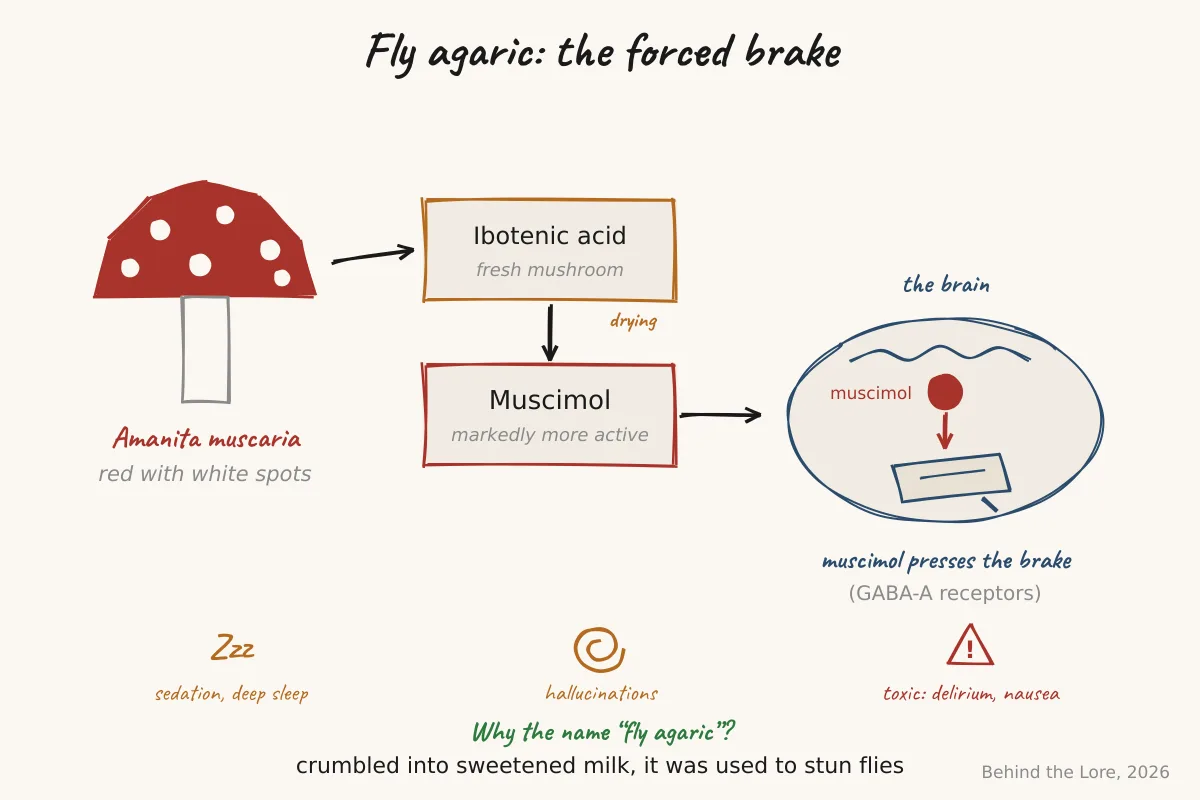
This effect is very different from that of the so-called “magic” psilocybin mushrooms, which act on the serotonin system. It also differs radically (and this is essential) from the mode of action of the deadly amanitas. The fly agaric is toxic but rarely lethal in adults: it causes nausea, vomiting, agitation, delirium and sometimes convulsions, with a higher risk in children. Severe poisonings remain possible, especially when species are confused.
That is the real danger. Several amanitas look alike at early stages of development, and some, like the death cap or the destroying angel, are deadly through their amatoxins, which destroy the liver. Mistaking a poisonous amanita for an edible species, or underestimating the toxicity of the fly agaric, can have dramatic consequences.
Going further
Sources
Published on
Going further
Auto-suggested from shared concepts, disciplines, episodes, or characters.
Destroying Angel
Senku recognizes the destroying angel on sight: we explain why this mushroom is deadly, the molecular mechanism of α-amanitin, and the treatments available.
Acetanilide
Senku makes acetanilide in Dr Stone. We explain this historical painkiller and fever reducer, an ancestor of paracetamol, and why it was abandoned.
Caffeine
Senku brews a caffeine stimulant from tea leaves. We explain how caffeine acts on the brain, its real effects, and how much of the power-up drink is myth.
Medicinal Plants
Swertia, licorice, Coptis: these medicinal plants contain real, documented active compounds. We break down their uses in Dr Stone.
Wild Foraging
Senku sorts mushrooms and plants in seconds: we explain the rules of mycological identification and the risks of poisoning.