The medicinal plants of Dr Stone explained
Story context (click to hide this block) (click to show this block)
This paragraph may contain plot information.
With no pharmacy available, Senku falls back on the plant pharmacopeia and runs through plants with recognized virtues: a bitter plant for digestion, licorice against inflammation, a berberine-bearing herb for its antibacterial action. He stays cautious about what he can actually expect from them, which is good scientific posture.
The subject in depth
Medicinal plants are not mere folklore: they manufacture complex molecules, known as secondary metabolites, some of which have real pharmacological activity. The three examples cited illustrate three distinct families of effects.
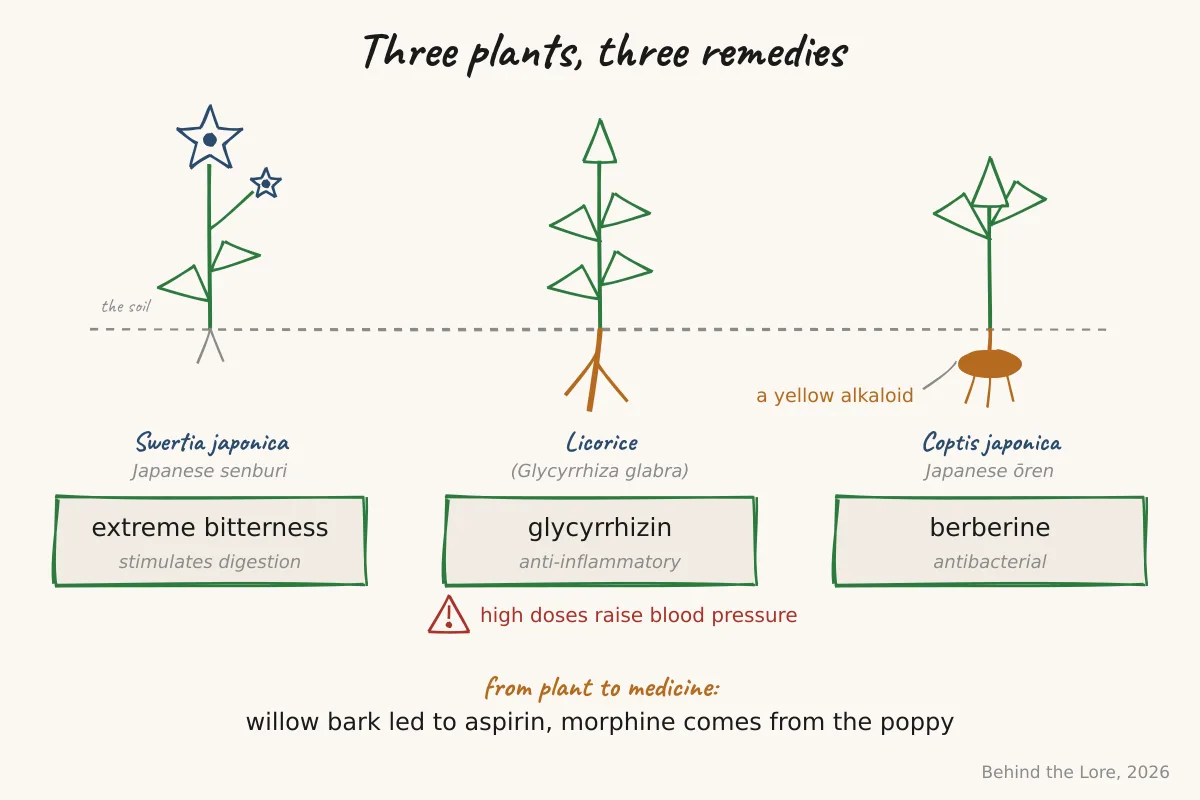
Swertia japonica, a gentian-family plant known in Japan as senburi, is one of the most powerful bitters known [Wikipedia] . Its extremely bitter taste reflexively stimulates the secretion of saliva and gastric juices: that is the principle behind digestive bitters, traditionally used as stomach tonics and appetite stimulants. Licorice (Glycyrrhiza glabra) contains glycyrrhizin, a sweet-tasting saponin with anti-inflammatory and soothing properties, long used against throat irritation and digestive complaints [Wikipedia] . But that same glycyrrhizin, at high doses or with prolonged use, causes sodium retention and raises blood pressure: a good reminder that active does not mean harmless.
The third case is the clearest pharmacologically. Coptis japonica (ōren in Japanese) contains berberine, a yellow alkaloid whose antibacterial and anti-inflammatory activity is well documented by modern research [Wikipedia] . Berberine is found in several plants of traditional East Asian medicine and has been the subject of numerous studies, notably on metabolism and digestive infections. What these three plants have in common is that they concentrate an identifiable active compound, which sets them apart from purely symbolic uses.
Going further
Sources
Published on
Going further
Auto-suggested from shared concepts, disciplines, episodes, or characters.
Aconite
Senku panics at the sight of aconite: we explain why this plant is deadly, its mechanism on sodium channels, and its ethnobotanical history.
Camphor Tree
The camphor tree that shelters Yuzuriha for 3,700 years: we explain the chemistry of camphor, terpenes, and this Japanese tree's age-old uses.
Acetanilide
Senku makes acetanilide in Dr Stone. We explain this historical painkiller and fever reducer, an ancestor of paracetamol, and why it was abandoned.
Bear Bile
Why did bear bile, a traditional TCM remedy, lead to a modern drug? UDCA dissolves gallstones and treats the liver.
Caffeine
Senku brews a caffeine stimulant from tea leaves. We explain how caffeine acts on the brain, its real effects, and how much of the power-up drink is myth.