Caffeine in Dr Stone S1E13
Story context (click to hide this block) (click to show this block)
This paragraph may contain plot information.
Before a decisive showdown, Senku brews a beverage meant to power up his allies. He counts on caffeine extracted from tea leaves, combined with honey for the sugar boost and with sweet flag, a plant with a soothing reputation, to compose a stimulant drink built for battle.
The subject in depth
Caffeine is an alkaloid of the methylxanthine family, naturally present in tea leaves, coffee beans, cocoa beans, and a few other plants [Wikipedia] . It is the most widely consumed psychoactive substance in the world. In the plant, it plays the role of a natural pesticide, deterring or paralyzing the insects that attack the leaves.
Its mechanism of action is well understood. Over the course of a day, a molecule called adenosine builds up in the brain and binds to its receptors, which slows neuronal activity and gradually settles in the feeling of fatigue. Caffeine’s molecular shape is close enough to adenosine’s for it to lodge itself on the same receptors without activating them: it acts as an antagonist. By occupying the spot, it prevents adenosine from transmitting its drowsiness signal [Wikipedia] . The result is not an intake of energy, but a temporary release of the fatigue brake, which translates into heightened alertness, reduced drowsiness, and slight cardiac and respiratory stimulation.
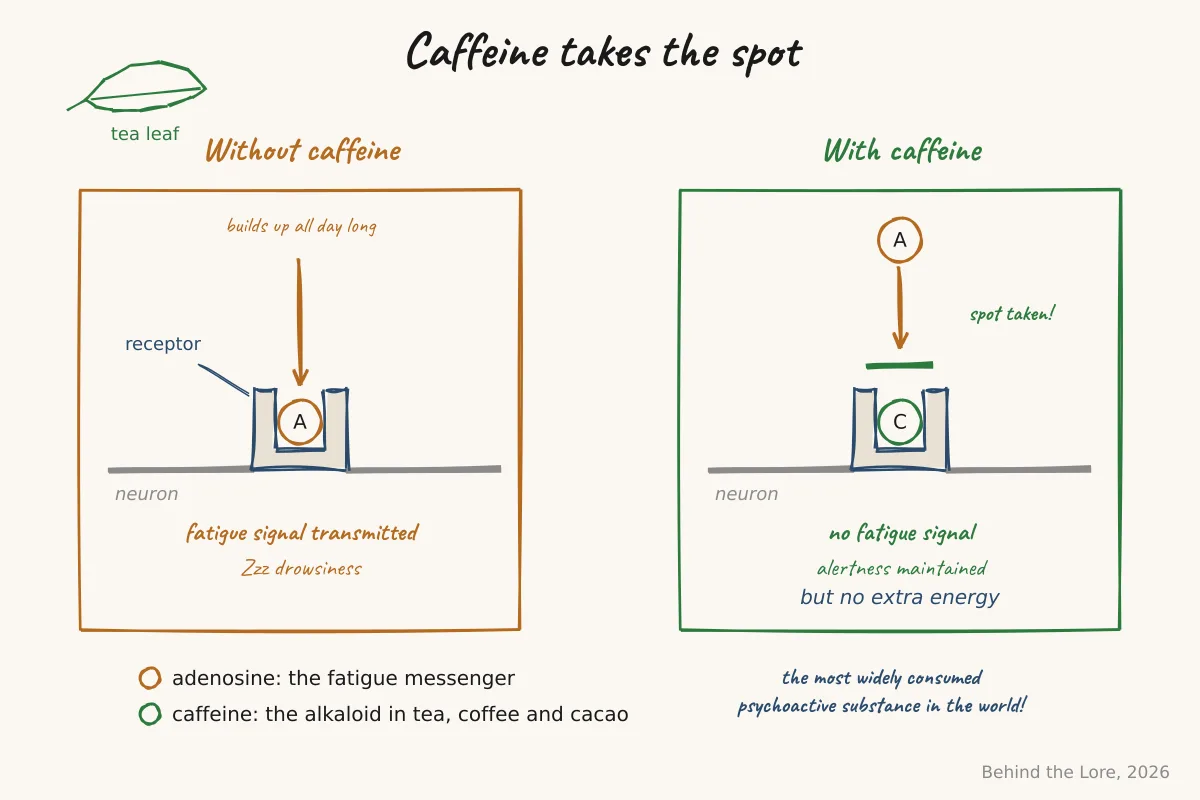
Tea leaves are a particularly convenient source in a survival context. The tea plant, Camellia sinensis, concentrates caffeine in its young leaves, at levels comparable to or higher than those of coffee beans at equal mass [Wikipedia] . A simple hot-water infusion is enough to extract the alkaloid, which is water-soluble. The added honey provides quickly assimilated sugars, a very real source of metabolic energy, while sweet flag stems from a traditional use as a soothing plant whose effects remain poorly established scientifically.
Going further
Sources
Published on
Going further
Auto-suggested from shared concepts, disciplines, episodes, or characters.
Aconite
Senku panics at the sight of aconite: we explain why this plant is deadly, its mechanism on sodium channels, and its ethnobotanical history.
Camphor Tree
The camphor tree that shelters Yuzuriha for 3,700 years: we explain the chemistry of camphor, terpenes, and this Japanese tree's age-old uses.
Acetanilide
Senku makes acetanilide in Dr Stone. We explain this historical painkiller and fever reducer, an ancestor of paracetamol, and why it was abandoned.
Activated Carbon
In Dr Stone, Senku activates charcoal for his gas mask. We explain activation, porosity, and the adsorption that traps molecules.
Beeswax
Beeswax, a hydrophobic mix of esters that melts around 62°C. Candles, ointments, waterproofing, lost-wax casting: its ancient uses explained.