Activated Carbon: How Does It Filter?
Story context (click to hide this block) (click to show this block)
This paragraph may contain plot information.
While preparing the equipment needed to cross the toxic gas zone, Senku has to build an effective filter. He does not settle for ordinary charcoal: he activates it, transforming it to multiply its filtering power, a key step in his improvised gas mask.
The subject in depth
A piece of ordinary charcoal is already porous, but activated carbon pushes this property to the extreme [Wikipedia] . Activation consists of carving a dense network of microscopic pores into the material. The result is spectacular: a single gram of activated carbon can develop an internal surface area of several hundred to more than a thousand square meters. All of this surface is offered up to the molecules in the environment.
The phenomenon that makes this material work is adsorption, not to be confused with absorption [Wikipedia] . To adsorb is to fix molecules onto the surface of a solid, like magnets sticking to a wall, without dissolving them into the bulk. Molecules of gas, odors, or pollutants in solution get trapped in the pores and are held there by surface forces. The larger the available surface, the higher the retention capacity, hence the interest in maximizing porosity.
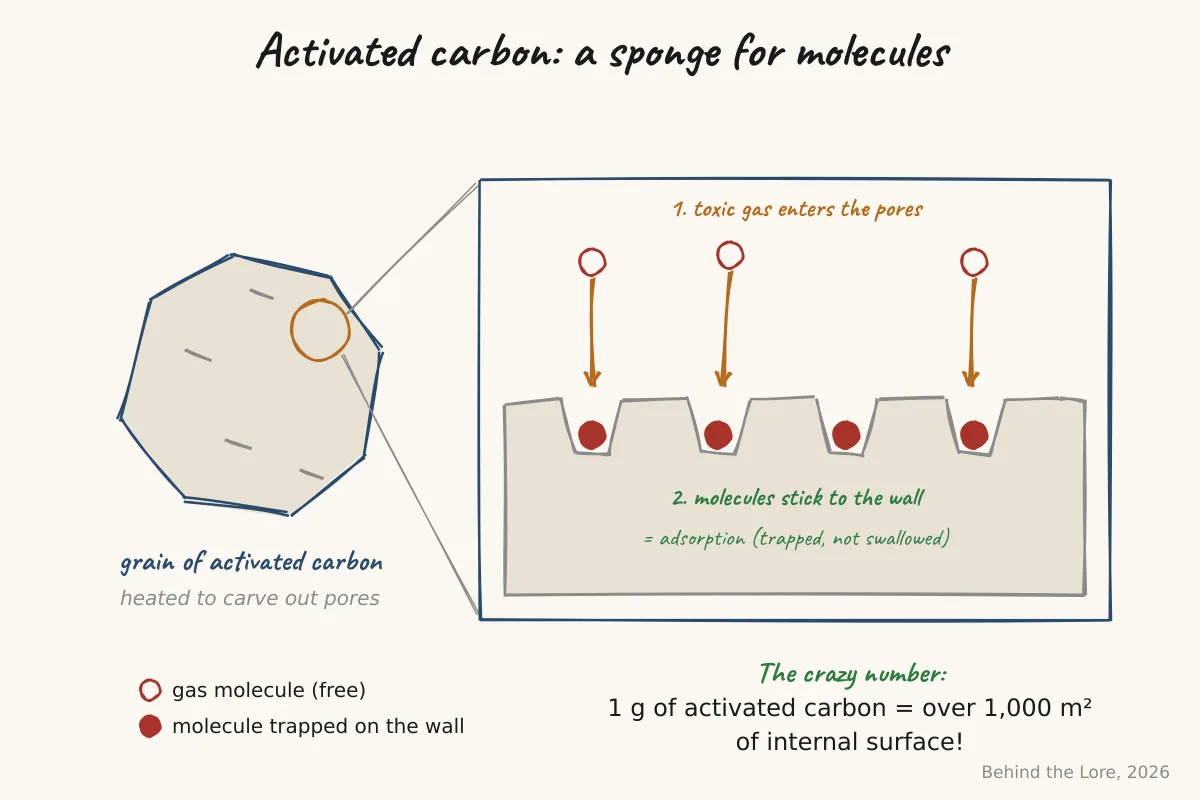
There are two main routes to activation. Physical activation heats the carbon to very high temperatures (around 800 to 1,000 °C) under a stream of water vapor or carbon dioxide, which gradually eats away at the structure and opens up the pores. Chemical activation first impregnates the raw material with an agent such as phosphoric acid or zinc chloride, before a thermal treatment. In both cases, the goal is the same: to turn a compact carbon into a molecular sponge. This activated carbon is what fills the cartridges of filtering masks, water filters, and odor-trapping range hoods.
Going further
- Coming soon: The Gas Mask
- Discipline: Chemistry
Sources
Published on
Going further
Auto-suggested from shared concepts, disciplines, episodes, or characters.
Acetanilide
Senku makes acetanilide in Dr Stone. We explain this historical painkiller and fever reducer, an ancestor of paracetamol, and why it was abandoned.
Aconite
Senku panics at the sight of aconite: we explain why this plant is deadly, its mechanism on sodium channels, and its ethnobotanical history.
Black Powder
Senku makes gunpowder in Dr Stone. We explain its composition (saltpeter, charcoal, sulfur), the chemical reaction, and its history.
Brandy
Senku turns his wine into brandy by distillation: we explain medieval eau-de-vie, alchemical aqua vitae, and how you get to 40-proof spirit.
Caffeine
Senku brews a caffeine stimulant from tea leaves. We explain how caffeine acts on the brain, its real effects, and how much of the power-up drink is myth.