Syphilis: Dementia and Neurosyphilis Explained
Story context (click to hide this block) (click to show this block)
This paragraph may contain plot information.
During her visit to the Verdigris Palace, Maomao observes Suirei, a former courtesan whose condition strikes her. She offers a sober clinical assessment: the disease is erasing her memories. The remedy has proven effective in the past, but it is now struggling to help her, and there’s nothing else that can be done. The narration specifies that Suirei had contracted syphilis, that the disease was still in its incubation phase when Maomao’s father first treated her, and that a few years later the symptoms returned and the illness spread rapidly. In a few sentences, the episode describes the disease’s classic progression: a deceptive period of silence, a relapse, then a terminal neurological decline that nothing can reverse.
The subject in depth
Syphilis is a sexually transmitted infection caused by a spiral-shaped bacterium: Treponema pallidum [Wikipedia] . It progresses through four distinct phases, the first three of which can pass largely unnoticed, and that is precisely what the story portrays accurately.
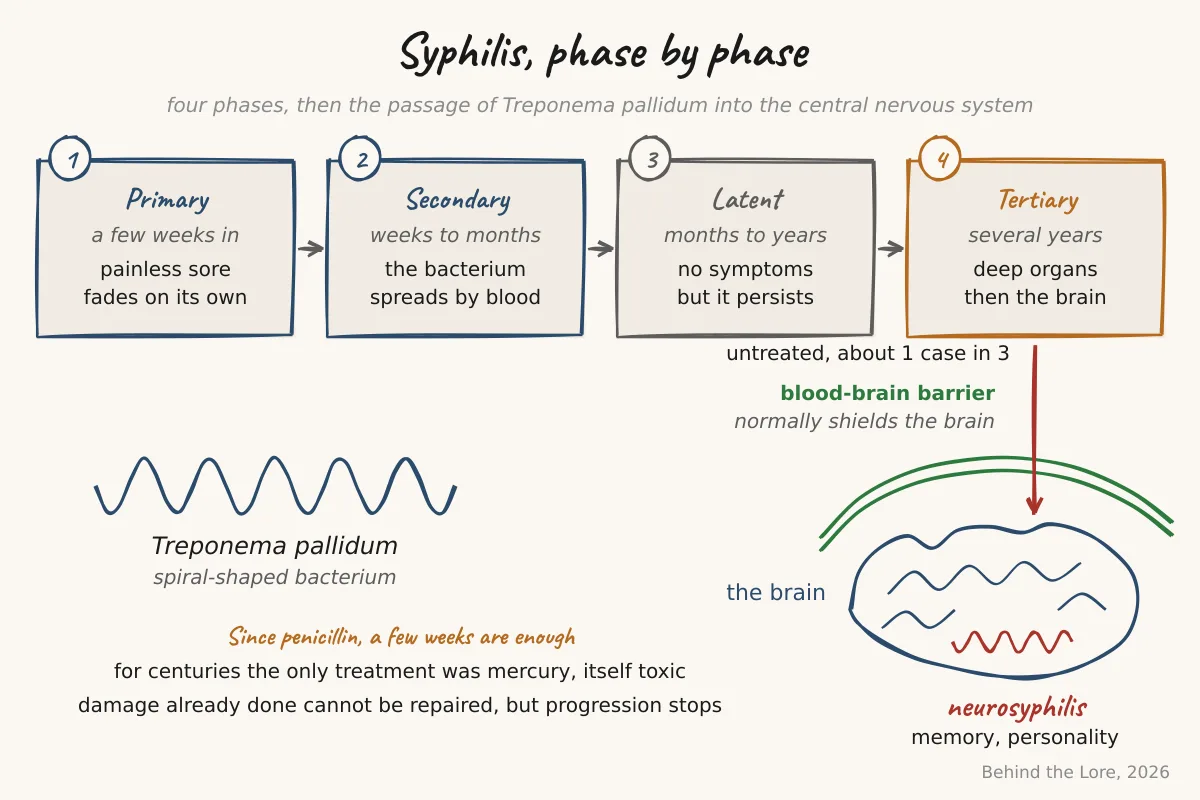
Primary phase. A few weeks after infection, a painless sore (the chancre) appears at the bacterium’s point of entry, then disappears on its own. Many people never notice it.
Secondary phase. Weeks to a few months later, the bacterium circulates throughout the body via the bloodstream. It produces skin rashes, mucosal lesions, and general symptoms resembling an ordinary flu. This phase also resolves on its own, without treatment, and gives way to a silent period.
Latent phase. For months or years, the bacterium persists in the body without producing apparent symptoms. This is the silent incubation period referenced in the episode. The carrier is not cured: Treponema pallidum keeps multiplying in the tissues.
Tertiary phase and neurosyphilis. Left untreated, about a third of infected people develop severe complications after several years. The bacterium reaches deep organs: the heart, major arteries, bones. Above all, it can cross the blood-brain barrier, the membrane that normally shields the brain from infectious agents circulating in the blood [Wikipedia] . When Treponema pallidum settles into the central nervous system, this is called neurosyphilis.
The most devastating form of neurosyphilis is general paresis. The brain is progressively destroyed by the infection: neurons die, connections break down. Early signs are memory problems, irritability, and loss of concentration. Then personality disintegrates, dementia sets in, and the patient loses all cognitive autonomy. Without treatment, the outcome is fatal. This is exactly the picture Suirei presents in the episode: a woman whose memory is fading and whom the available remedy can no longer save.
Going further
Sources
Published on
Keep investigating
Auto-suggested from shared concepts, disciplines, episodes, or characters.
Lead White Makeup
In The Apothecary Diaries, white makeup kills courtesans. We explain why this ceruse-based cosmetic caused deadly lead poisoning.
Mercury
In The Apothecary Diaries, quicksilver goes into a court poison. We explain mercury, its toxicity, and the immortality elixirs that killed emperors.
Datura
In The Apothecary Diaries, datura is used to induce sleep and feign death. We explain its alkaloids, its toxicity, and its role in the history of anesthesia.
Acetanilide
Senku makes acetanilide in Dr Stone. We explain this historical painkiller and fever reducer, an ancestor of paracetamol, and why it was abandoned.
Honey and Infant Botulism
In The Apothecary Diaries, honey kills a baby. We explain infant botulism: why honey is forbidden before age one, and safe afterward.