Papermaking: Fibers and Cellulose
Story context (click to hide this block) (click to show this block)
This paragraph may contain plot information.
Maomao is called to see a eunuch whose family has worked with paper for generations. The surface of the sheets they produce has become crumbly, even though the raw materials haven’t changed. She notices that cattle have recently joined the premises and that the water source is open to the air. By questioning the process step by step (soaking, grinding, sizing with wheat flour, drying), she identifies that contamination of the production water by the cattle’s saliva may be degrading the sizing agent and weakening the surface, a surface-quality problem that has nothing to do with the quality of the fibers themselves, and one that only precise knowledge of the process can pinpoint.
The subject in depth
Paper relies on a material abundant in the plant kingdom: cellulose [Wikipedia] . It is a glucose polymer whose long, rigid chains assemble into microfibrils. These microfibrils make up the walls of plant cells, giving stems, trunks, and leaves their mechanical strength. To make paper, these structures must first be broken down to obtain individual fibers capable of tangling freely into a flat web.
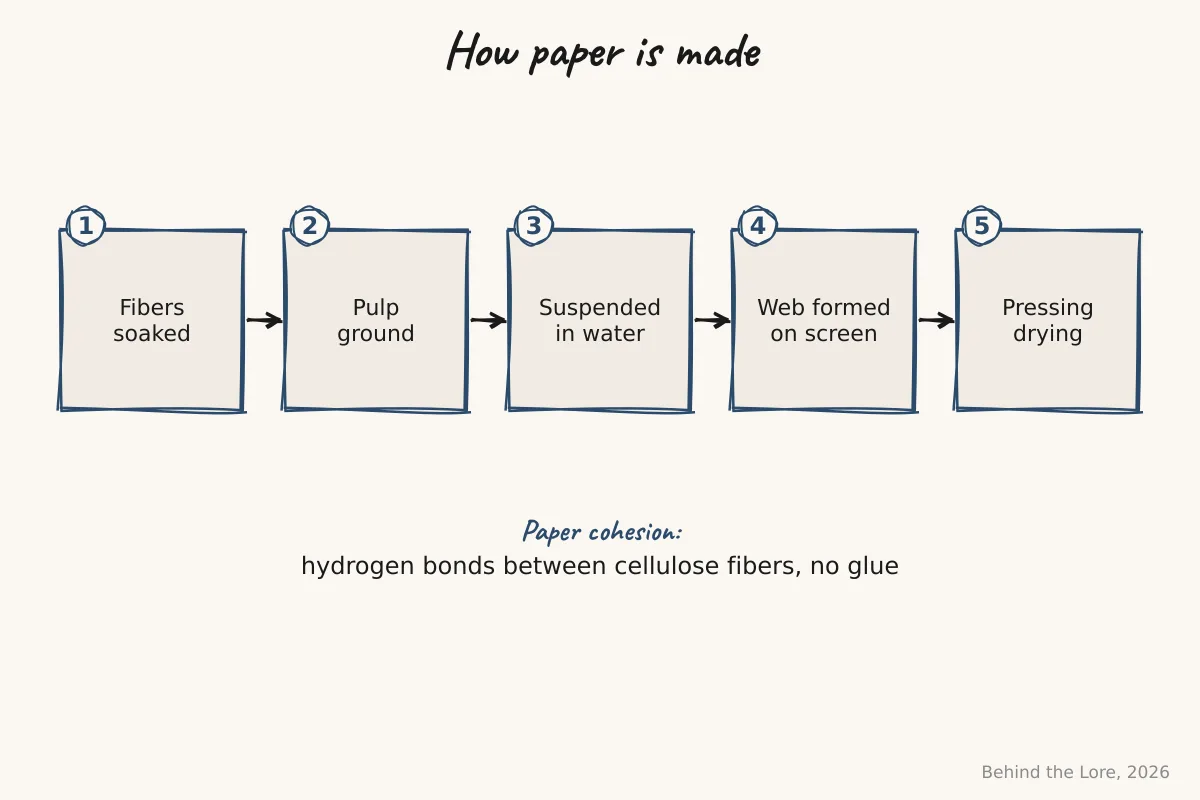
The process follows six linked steps.
Soaking. The raw material (hemp, mulberry stems, bamboo, rice straw, bark) soaks in water, sometimes with alkaline ash, to soften the bonds holding the fibers together and dissolve some of the lignin and pectins.
Grinding. The softened mass is pounded or mechanically ground until a homogeneous pulp is obtained, in which the cellulose fibers are separated and free. The longer the grinding, the shorter and smoother the fibers become; the resulting paper is denser and its surface more even.
Suspension. The pulp is diluted in a large volume of water. The fibers float in suspension, evenly distributed.
Draining on a screen. A frame strung with plant fibers or silk threads is dipped into the vat, then lifted horizontally. Water drains through the mesh; the fibers remain on top, deposited in an even layer. This is the step where the sheet is formed: the final thickness depends on the concentration of the suspension and the speed of draining.
Sizing. On certain papers meant for writing, a sizing agent is applied, starch glue (wheat flour, rice water) or other natural binders. Sizing partially seals the surface pores, keeps ink from spreading, and strengthens the sheet’s resistance to moisture. It is precisely this sizing that bacterial contamination of the water can degrade: certain enzymes (amylases, proteases) found in animal saliva can hydrolyze the starch and make the surface crumbly.
Pressing and drying. The wet sheet is pressed between boards to squeeze out residual water, then dried in air or on a heated surface. As it dries, the cellulose fibers form hydrogen bonds with one another: it is this network of bonds that gives paper its final cohesion, without needing any external binder in the sheet itself.
The invention attributed to Cai Lun
Chinese tradition credits Cai Lun, a senior eunuch official at the Han court, with codifying papermaking around 105 CE [Wikipedia] . He probably didn’t invent it from scratch: fragments of paper predating his time have been found in China. His achievement was likely to have systematized the process and promoted the use of varied raw materials, in particular rags, mulberry bark, and hemp, where earlier writing supports (silk, bamboo) were costly or heavy. Paper then spread along the trade routes to Central Asia, reached the Islamic world in the 8th century, and medieval Europe in the 11th and 12th centuries [Wikipedia] .
Going further
Sources
Published on
Keep investigating
Auto-suggested from shared concepts, disciplines, episodes, or characters.
Mercury
In The Apothecary Diaries, quicksilver goes into a court poison. We explain mercury, its toxicity, and the immortality elixirs that killed emperors.
Orpiment and Arsenic
In The Apothecary Diaries, a yellow pigment poisons slowly. We explain orpiment, arsenic, and the chronic poisoning of court painters.
Aconite
In The Apothecary Diaries, aconite poisons even through honey. We explain aconitine, its action on nerves, and why it shows no mercy.
Gluten
In The Apothecary Diaries, wheat-flour glue illustrates gluten. We explain glutenins, gliadins, viscoelasticity, and celiac disease.
Sugar and Confectionery
Sucrose, crystallization, the states of cooked sugar, and sugar preservation: the chemistry behind the confections mentioned in The Apothecary Diaries.