Gluten: A Sticky Protein Network
Story context (click to hide this block) (click to show this block)
This paragraph may contain plot information.
Trying to understand why the surface of the eunuch’s paper had turned brittle, Maomao discovers that the glue used to size it is wheat-flour based. The decoction needs to “set” properly to work. She then draws a parallel with kudzu: just as gelatinized kudzu starch is thinned by salivary amylases, wheat-flour glue owes its stickiness to its proteins, and more precisely to the network they form in hot water. In a short exchange, the story shows that two very different-looking materials can share the same underlying chemical behavior.
The subject in depth
Wheat flour contains between 10 and 15% protein depending on the variety. Two families among them play a decisive role: glutenins and gliadins [Wikipedia] . When dry, they coexist without interacting much. As soon as water is added and the dough is kneaded, they hydrate, unfold, and associate.
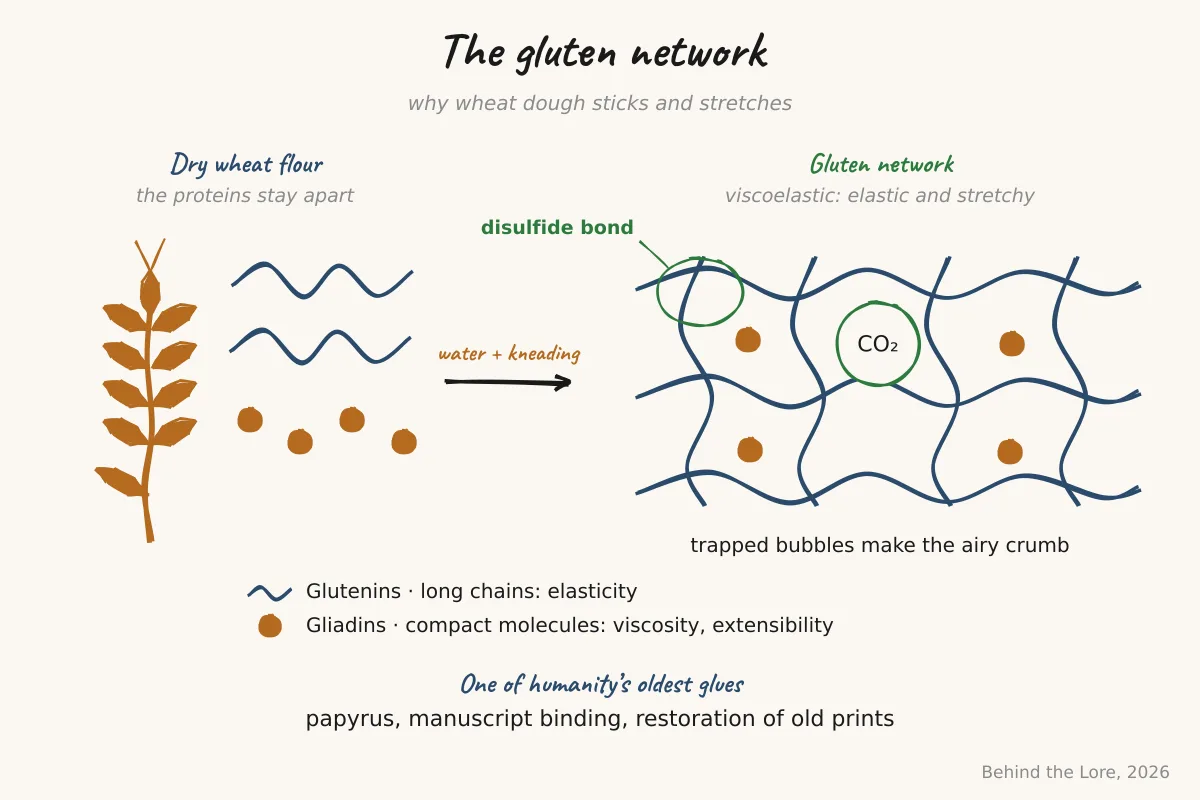
Glutenins are long polymerized chains held together by disulfide bonds. They form the network’s scaffold, giving it elasticity: the dough resists stretching and springs back. Gliadins, by contrast, are more compact monomeric proteins that slot into this network like a lubricant
[Wikipedia] . They contribute viscosity and extensibility: the dough can stretch without tearing.
Together they form a viscoelastic network, a technical term for a material that behaves both like an elastic solid (it springs back into shape) and a viscous liquid (it can flow slowly). It is precisely this dual property that explains the sticky behavior of wheat-flour dough and, by extension, of wheat-flour glue: the gluten network adheres to surfaces, deforms to hug them, and holds together well enough not to fall apart immediately.
In bread-making, these properties are put to essential use. Kneading develops the network, which then traps the carbon dioxide bubbles released by yeast fermentation. Without a well-developed gluten network, the bubbles escape and the crumb stays dense. This is why low-protein flours (soft wheat, oats) produce less-risen loaves than high-protein durum wheat flours.
Celiac disease is an autoimmune condition triggered by ingesting gluten. In affected people, certain peptides produced by the digestion of gliadins activate the immune system, which attacks the villi of the small intestine responsible for absorbing nutrients. The only treatment is total, lifelong avoidance of gluten, which means eliminating not just wheat but also barley and rye, which contain homologous proteins.
Going further
Sources
Published on
Keep investigating
Auto-suggested from shared concepts, disciplines, episodes, or characters.
Dehydration and Rehydration
In The Apothecary Diaries, Maomao treats heatstroke with salted, sweetened water. We explain dehydration and why salt is vital.
Aconite
In The Apothecary Diaries, aconite poisons even through honey. We explain aconitine, its action on nerves, and why it shows no mercy.
Sugar and Confectionery
Sucrose, crystallization, the states of cooked sugar, and sugar preservation: the chemistry behind the confections mentioned in The Apothecary Diaries.
Kudzu
In The Apothecary Diaries, over-concentrated kudzu turns into glue. We explain kuzu starch, its medicinal uses, and its invasion beyond Asia.
Papermaking
In The Apothecary Diaries, Maomao diagnoses crumbly paper. We explain papermaking, cellulose, and Cai Lun's invention.