Sugar and Confectionery: Crystals and Cooking
Story context (click to hide this block) (click to show this block)
This paragraph may contain plot information.
Early in the episode, Maomao takes stock of the remedies and provisions on hand: among the fine items she receives is a mandarin confection, presented as a rare treat this time of year. The rarity stems from two overlapping constraints: the seasonality of citrus fruit, since mandarins are only available fresh in winter, and the need to preserve them candied in order to offer them out of season. This brief line of dialogue quietly illustrates the role of sugar as a preserving agent in imperial China.
The subject in depth
Confectioner’s sugar is nearly pure sucrose, a disaccharide made of a bonded glucose and fructose [Wikipedia] . Dissolved in water, it yields a syrup; concentrated and then cooled slowly, it recrystallizes into monoclinic prisms, the basis of both crystallized sugar and fondant.
Sugar crystallization
When a sucrose solution is supersaturated (holding more dissolved sugar than the theoretical limit allows at room temperature), the slightest seed, dust particle, or sudden movement triggers crystallization [Wikipedia] . Confectioners control this process: a syrup stirred quickly yields many small crystals (smooth fondant), while a syrup left to rest favors large crystals (rock candy). Adding glucose syrup or cream of tartar slows crystallization by interfering with the formation of the sucrose lattice, producing smooth or stretchable textures.
The states of cooked sugar
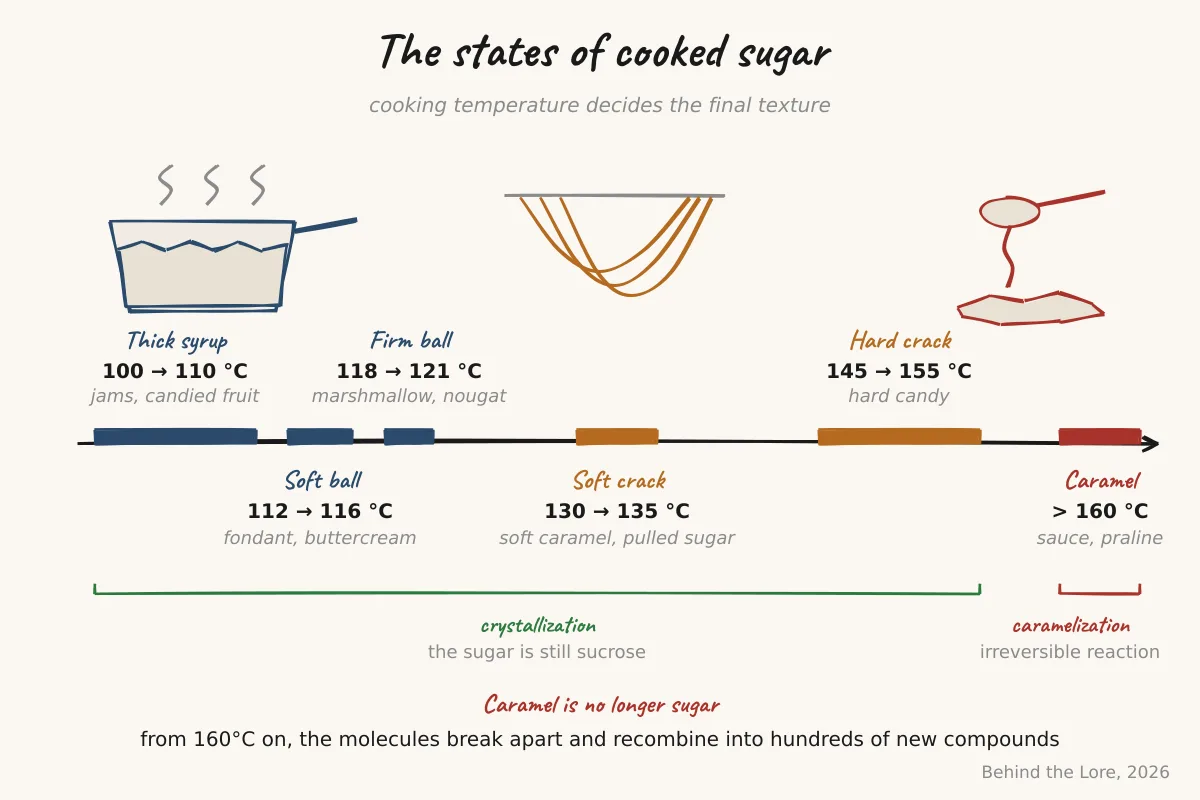
The cooking temperature of the syrup determines how the cooled sugar behaves:
| Temperature (°C) | State | Typical use |
|---|---|---|
| 100 to 110 | Thick syrup | Jams, candied fruit (first dip) |
| 112 to 116 | Soft ball | Fondant, buttercream |
| 118 to 121 | Firm ball | Marshmallow, nougat |
| 130 to 135 | Soft crack | Soft caramel, pulled sugar |
| 145 to 155 | Hard crack | Blown sugar, hard candy |
| > 160 | Caramel | Caramel sauce, praline |
From 160°C onward, sucrose breaks down through caramelization: the molecules split apart and recombine into hundreds of new aromatic and colored compounds (furanones, pyranones), and the color shifts from pale yellow to deep amber. This is no longer crystallization but an irreversible chemical reaction.
Sugar as a preserving agent
At high concentration, dissolved sugar binds water molecules and makes them unavailable to microorganisms. This phenomenon is measured by water activity (aw): below an aw of 0.85, most pathogenic bacteria can no longer grow; below 0.60, molds are blocked as well. Candied fruit (aw around 0.65–0.75) and fruit pastes exploit this principle, exactly like salt in cured meats or honey in the honeycomb. It’s the same osmotic chemistry, with different solutes.
Going further
Sources
Published on
Keep investigating
Auto-suggested from shared concepts, disciplines, episodes, or characters.
Dehydration and Rehydration
In The Apothecary Diaries, Maomao treats heatstroke with salted, sweetened water. We explain dehydration and why salt is vital.
Gluten
In The Apothecary Diaries, wheat-flour glue illustrates gluten. We explain glutenins, gliadins, viscoelasticity, and celiac disease.
Kudzu
In The Apothecary Diaries, over-concentrated kudzu turns into glue. We explain kuzu starch, its medicinal uses, and its invasion beyond Asia.
Papermaking
In The Apothecary Diaries, Maomao diagnoses crumbly paper. We explain papermaking, cellulose, and Cai Lun's invention.
Honey Preservation
Honey has preserved food for millennia. Here's why: low water activity, osmolarity, acidity, and hydrogen peroxide all work together to stop microbes.