Flame Coloration from Metal Salts
Story context (click to hide this block) (click to show this block)
This paragraph may contain plot information.
To expose a culprit, Maomao doesn’t look for a witness or a confession. She presents three flames of different colors and asks the stable hand if he recognizes the fireworks. Her demonstration fits in a single sentence: flames change color depending on the fuel used. This observation alone establishes that a tablet had been coated with a particular metal salt, and that burning it revealed what was hidden inside. The whole investigation rests on this one chemical fact.
The subject in depth
The flame test is one of the oldest techniques in analytical chemistry. Its principle is simple: a sample is placed in a sufficiently hot flame, and the color it emits is observed. Each metal produces a reproducible, recognizable color [Wikipedia] .
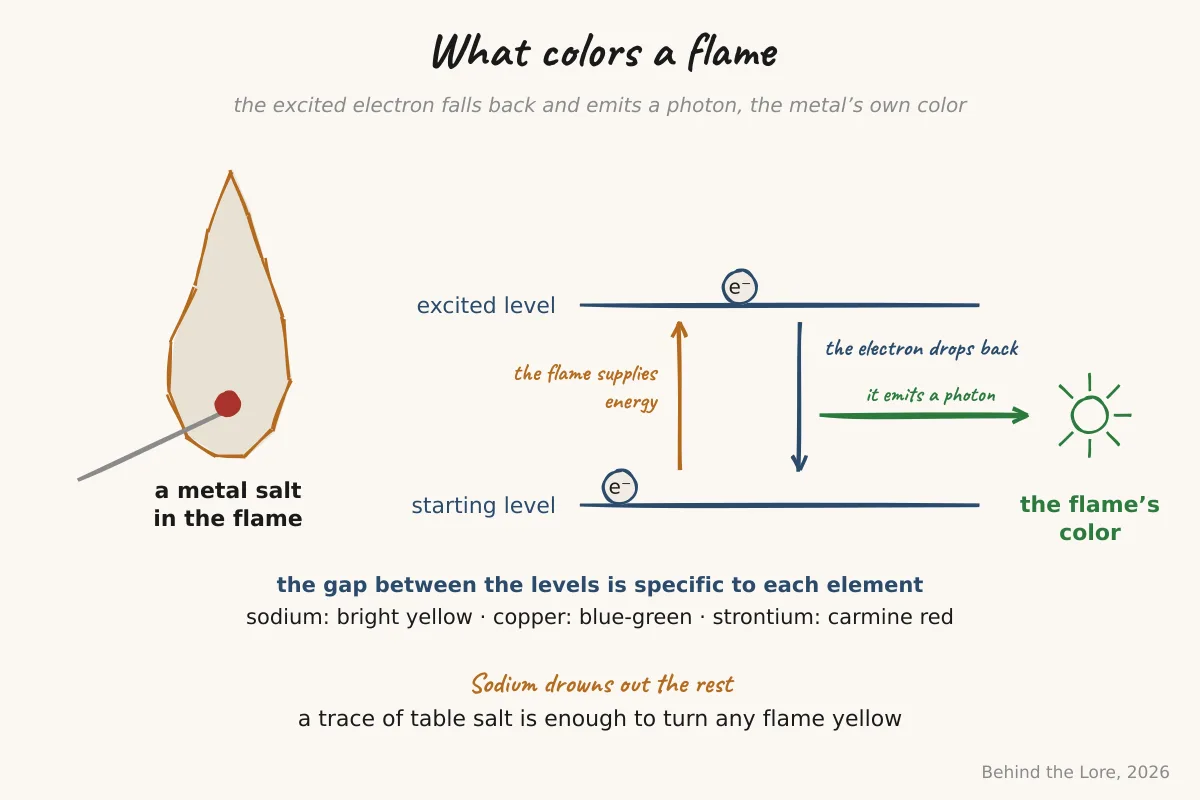
The mechanism is quantum. Inside an atom, electrons occupy discrete energy levels, somewhat like steps on a staircase. When the flame supplies energy, some electrons jump to a higher step: the atom is said to be excited. This state is unstable. In a very short time, the electron drops back to its starting level and, in doing so, releases the energy difference as a photon of light [Wikipedia] . The wavelength of that photon (its color) depends exactly on the gap between the two levels, which is specific to each chemical element. That’s why flame color is a signature of the atom, not of the salt or the solvent it was dissolved in.
The most common colors seen in the lab are as follows: sodium produces a very intense, bright yellow flame, so distinctive that a mere trace of table salt is enough to tint any flame yellow; copper gives a vivid blue-green; potassium produces a pale violet, sometimes hard to distinguish with the naked eye; strontium gives an intense carmine red. Lithium also produces red, but a more crimson shade than strontium’s, which allows the two to be told apart. Barium gives a distinctive apple green.
This principle has immediate applications in two fields the show cleverly connects. In analytical chemistry, the flame test allows quick identification of an unknown metal salt with minimal equipment: a platinum or nichrome wire, a Bunsen burner flame, and observation of the color. In pyrotechnics, it is exactly the same phenomenon harnessed to color fireworks [Wikipedia] . Chinese pyrotechnicians had long known certain coloring effects, but the systematic study of flame-coloring chemistry in 19th-century Europe made today’s full palette possible.
Going further
Sources
Published on
Keep investigating
Auto-suggested from shared concepts, disciplines, episodes, or characters.
Lead White Makeup
In The Apothecary Diaries, white makeup kills courtesans. We explain why this ceruse-based cosmetic caused deadly lead poisoning.
Mercury
In The Apothecary Diaries, quicksilver goes into a court poison. We explain mercury, its toxicity, and the immortality elixirs that killed emperors.
Orpiment and Arsenic
In The Apothecary Diaries, a yellow pigment poisons slowly. We explain orpiment, arsenic, and the chronic poisoning of court painters.
Clay and Kaolin
In The Apothecary Diaries, clay is used as makeup. We explain kaolinite, its layered structure, its absorbent power, and its uses.
Galenic Formulations
In The Apothecary Diaries, an ointment gets prepared. We explain galenics: how a medicine's form determines how an active ingredient is absorbed.