The Bezoar: Universal Antidote or Myth?
Story context (click to hide this block) (click to show this block)
This paragraph may contain plot information.
Jinshi pulls an object from a pouch and presents it to Maomao as “a foreign body, a treasure of the pharmacopoeia, found in only one bovine in a thousand.” The description alone is enough to light up the apothecary’s eyes: she immediately recognizes the value of the piece. Later, wounded in the hand during the investigation, she quips with characteristic self-assurance: “Have I earned my bezoar?” The line reveals the character’s professional instinct, calculating the price of her services in rare pharmacopoeia currency.
The subject in depth
The bezoar is a mineral and organic concretion that forms gradually in the digestive tract, most often in the stomach or gallbladder of certain mammals: cattle, goats, llamas, horses [Wikipedia] . It forms through an accretion process: a foreign body (sometimes a hair or a plant fragment) serves as a nucleus around which successive layers of calcium carbonates and phosphates, keratin, bile salts, and organic matter build up. The result is a sphere or ovoid ranging from a few millimeters to several centimeters, with a smooth or layered surface, often brownish-green in color.
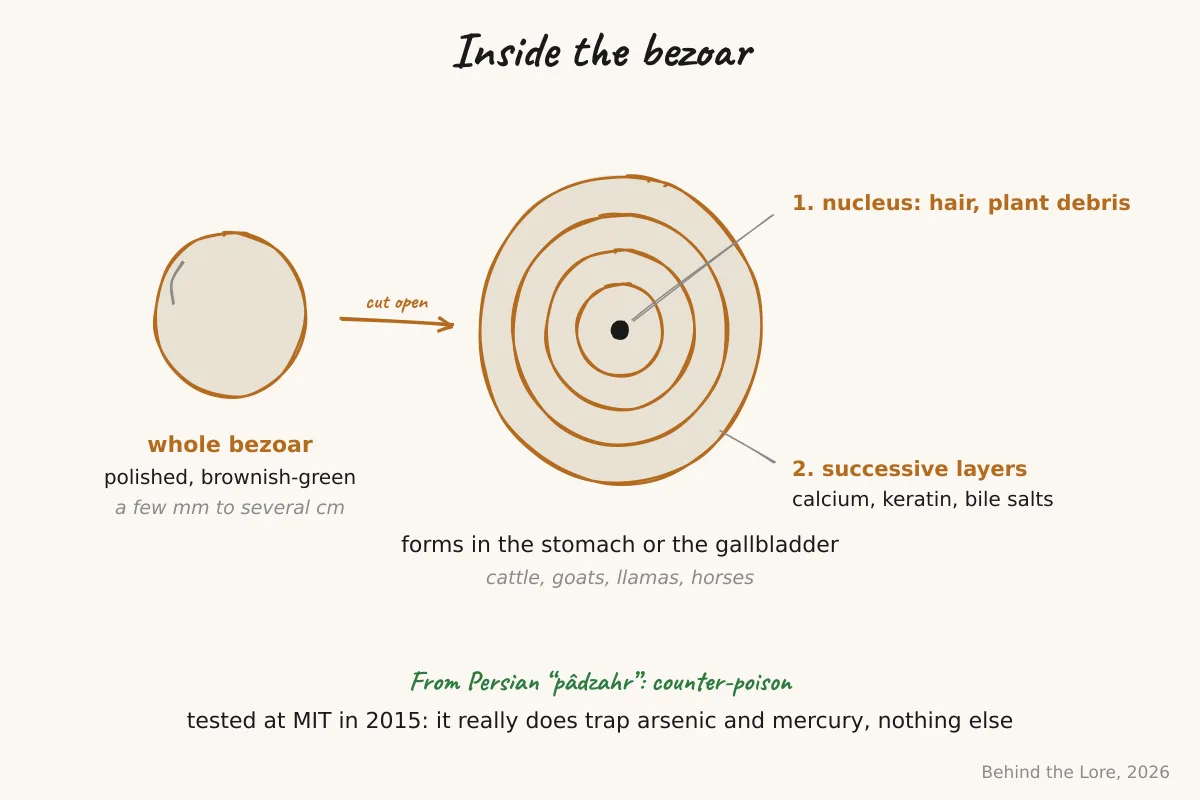
The frequency of formation varies considerably by species and husbandry conditions. The figure quoted in the episode, “one bovine in a thousand,” is a narrative approximation that dramatizes the rarity. In some cattle populations, the prevalence of gallstones can in fact reach several percent according to modern veterinary studies, still rare, but not exceptional.
The word’s etymology reveals its original use: “bezoar” comes from the Persian pâdzahr, literally “counter-poison.” This Persian origin directly reflects the primary use ascribed to it: countering the action of ingested poisons, whether plant-based, animal, or mineral.
A universal antidote across every pharmacopoeia
The bezoar appears in medical traditions that are geographically and culturally very distant from one another, a testament to its worldwide reputation. In medieval Arabic pharmacopoeia, it was an ingredient in theriac, the great panacea inherited from antiquity. In Persian medicine, Avicenna devoted an entry to it in the Canon of Medicine. In Western Europe, it was prescribed from the Middle Ages through the Renaissance as protection against poisoning, particularly at royal courts where the risk of a poisoned cup was considered real. It was set in gold, embedded in cups or spoons, in the belief that its contact neutralized poisons dissolved in liquid [Wikipedia] .
In traditional Chinese medicine, the bovine bezoar is called niu huang (牛黃). Its use is different but no less valued: as an antipyretic, anticonvulsant, and liver protectant, it appears in formulations still used today in Asian integrative medicine, with bilirubin, bile acids, and cholesterol as its main components.
What modern science has found
The reputation of a universal antidote is unfounded in the strict pharmacological sense: the bezoar has no documented action on plant alkaloids like aconitine, nor on biological toxins like tetrodotoxin. It does not neutralize acids or most organic poisons.
However, a 2015 study published in PLOS ONE by MIT researchers brought an important nuance: the bovine bezoar shows a real capacity for adsorption of certain metal ions, notably arsenic and mercury compounds. This partial chelating property stems from the bezoar’s composition, rich in functional groups capable of binding heavy metals. And heavy-metal poisoning was precisely the most common kind at imperial and royal courts of the premodern era, where arsenic and cinnabar (mercury sulfide) were poisons of choice.
In other words: the bezoar does not work on everything, but it did work on a share of the most common poisons in the historical context where it was used. Its lasting reputation is no accident.
Going further
- Orpiment and Arsenic, medicine
- Mercury, history of science
- Aconite, toxicology
- Discipline: Medicine
- Discipline: History of Science
Sources
Published on
Keep investigating
Auto-suggested from shared concepts, disciplines, episodes, or characters.
Mercury
In The Apothecary Diaries, quicksilver goes into a court poison. We explain mercury, its toxicity, and the immortality elixirs that killed emperors.
Orpiment and Arsenic
In The Apothecary Diaries, a yellow pigment poisons slowly. We explain orpiment, arsenic, and the chronic poisoning of court painters.
Aconite
In The Apothecary Diaries, aconite poisons even through honey. We explain aconitine, its action on nerves, and why it shows no mercy.
Physic Garden
The physic garden is the cradle of plant-based pharmacopoeia. Monasteries, universities, imperial China: the history of a centuries-old place of knowledge.
The Caesarean Section
Before antisepsis and anesthesia, caesarean section almost always killed the mother. We explain why, and what changed everything in the 19th century.