The Dandelion: medicinal and edible plant
Story context (click to hide this block) (click to show this block)
This paragraph may contain plot information.
Walking through the palace’s outer courtyard, Maomao mentally notes how scarce medicinal herbs are. Among the few plants she identifies, the dandelion catches her attention, alongside mugwort. For her, it’s a practitioner’s plain observation: in a well-kept courtyard, finding dandelion means finding an ordinary but reliable medicinal resource, available to anyone who knows how to recognize it.
The subject in depth
The dandelion, Taraxacum officinale, is a plant of the daisy family found in meadows, along roadsides, and in gardens across the temperate Northern Hemisphere [Wikipedia] . Its French common name, pissenlit (literally “wet the bed”) leaves no ambiguity about its best-known effect: the plant increases urine production, a property recognized for a very long time. In English it’s called “dandelion” (a corruption of the French “dent-de-lion,” for its jagged leaves), but also “pissabed” in rural dialects, for the same reason.
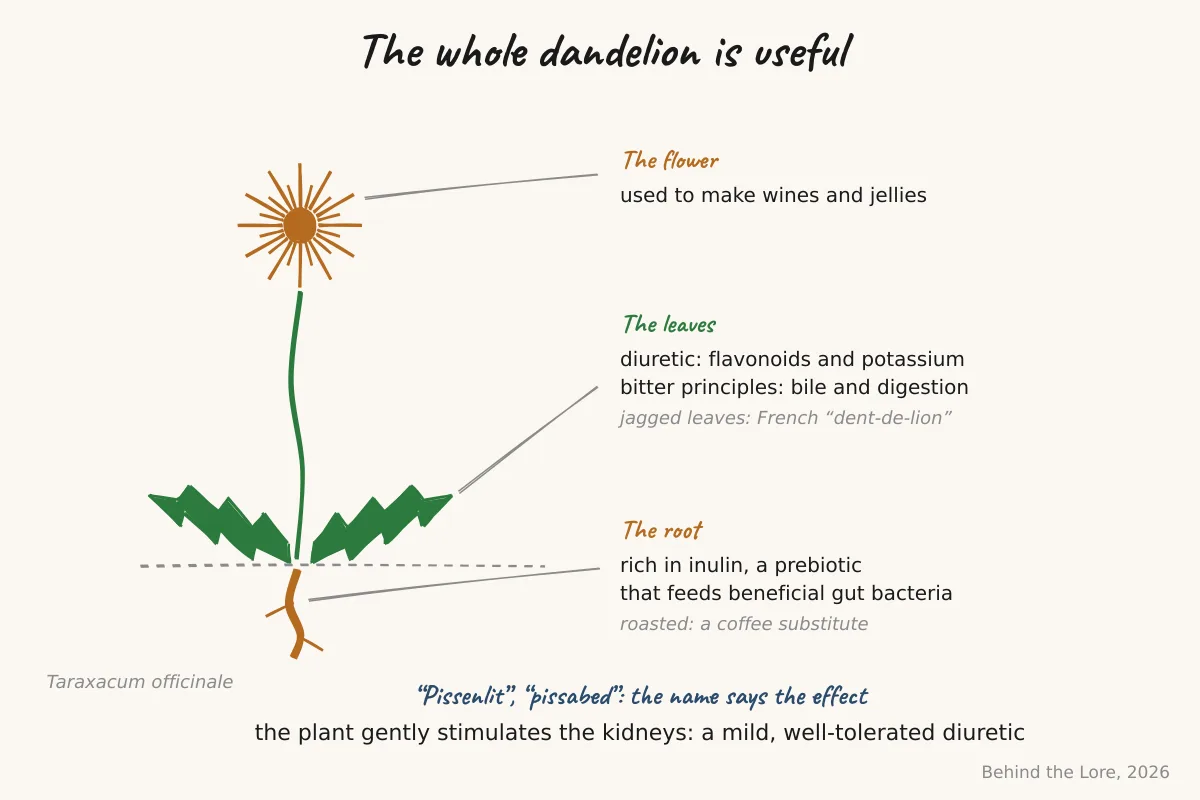
The dandelion’s diuretic property is attributed to several components acting together. The flavonoids and phenolic acids in its leaves stimulate kidney filtration [Wikipedia] . What makes the dandelion particularly interesting pharmacologically is that its leaves are naturally rich in potassium: where most chemical diuretics cause a potassium loss that must be compensated separately, the dandelion supplies this mineral itself, limiting the risk of hypokalemia.
The plant also contains bitter principles, mainly taraxacin and taraxacerin, which stimulate bile secretion and aid digestion. These bitter compounds are concentrated in young leaves, most intense in spring before flowering. The root, meanwhile, is rich in inulin, a non-digestible polysaccharide that acts as a prebiotic: it feeds beneficial bacteria in the colon without being absorbed by the small intestine, making it valuable for gut flora.
The whole plant is edible. The leaves are eaten raw in salads, prized for their bitterness in many culinary traditions. The flowers are used to make wines and jellies. The root, roasted, has served as a coffee substitute in times of scarcity. This dual food-and-medicine versatility is precisely what Maomao sees when she spots dandelion in the courtyard: a plant without prestige, but of genuine practical use.
Going further
Sources
Published on
Keep investigating
Auto-suggested from shared concepts, disciplines, episodes, or characters.
Aconite
In The Apothecary Diaries, aconite poisons even through honey. We explain aconitine, its action on nerves, and why it shows no mercy.
Orpiment and Arsenic
In The Apothecary Diaries, a yellow pigment poisons slowly. We explain orpiment, arsenic, and the chronic poisoning of court painters.
Mugwort
In The Apothecary Diaries, mugwort is one of the court's medicinal herbs. We explain its uses and artemisinin, Tu Youyou's antimalarial drug (Nobel 2015).
Ginger
In The Apothecary Diaries, Maomao prepares ginger pastilles to keep warm. We explain gingerol, TRPV1, and Chinese pharmacopoeia.
Kudzu
In The Apothecary Diaries, over-concentrated kudzu turns into glue. We explain kuzu starch, its medicinal uses, and its invasion beyond Asia.