Mugwort: from medicinal plant to Nobel Prize
Story context (click to hide this block) (click to show this block)
This paragraph may contain plot information.
While inspecting the palace’s outer courtyard, Maomao mentally catalogs the medicinal herbs available. She notes that medicinal plants are scarce there, and singles out two in particular: dandelion and mugwort. The observation is brief, almost clinical, but it says a great deal about her apothecary’s eye: even in an out-of-the-way corner, she looks for what can be useful. Mugwort, a plant most would consider unremarkable, is to her a recognized healing tool.
The subject in depth
Mugwort refers to a vast botanical genus, Artemisia, comprising more than five hundred species spread across every continent [Wikipedia] . These plants are recognizable by their finely cut, often silvery leaves and their characteristic aromatic scent. Several of them hold a prominent place in traditional pharmacopoeias, particularly in East Asia.
Traditional uses. Common mugwort (Artemisia vulgaris) and Chinese mugwort (Artemisia argyi) have been used since Antiquity as digestive plants, to relieve intestinal spasms and stimulate appetite, and as gynecological plants, to regulate menstrual cycles. They go into decoctions, poultices, and fumigations. Moxibustion, a central technique of traditional Chinese medicine, involves burning cones or sticks of dried mugwort leaves (moxa) near acupuncture points to stimulate the flow of vital energy. The very word “moxibustion” comes from the Japanese mogusa, the local name for mugwort.
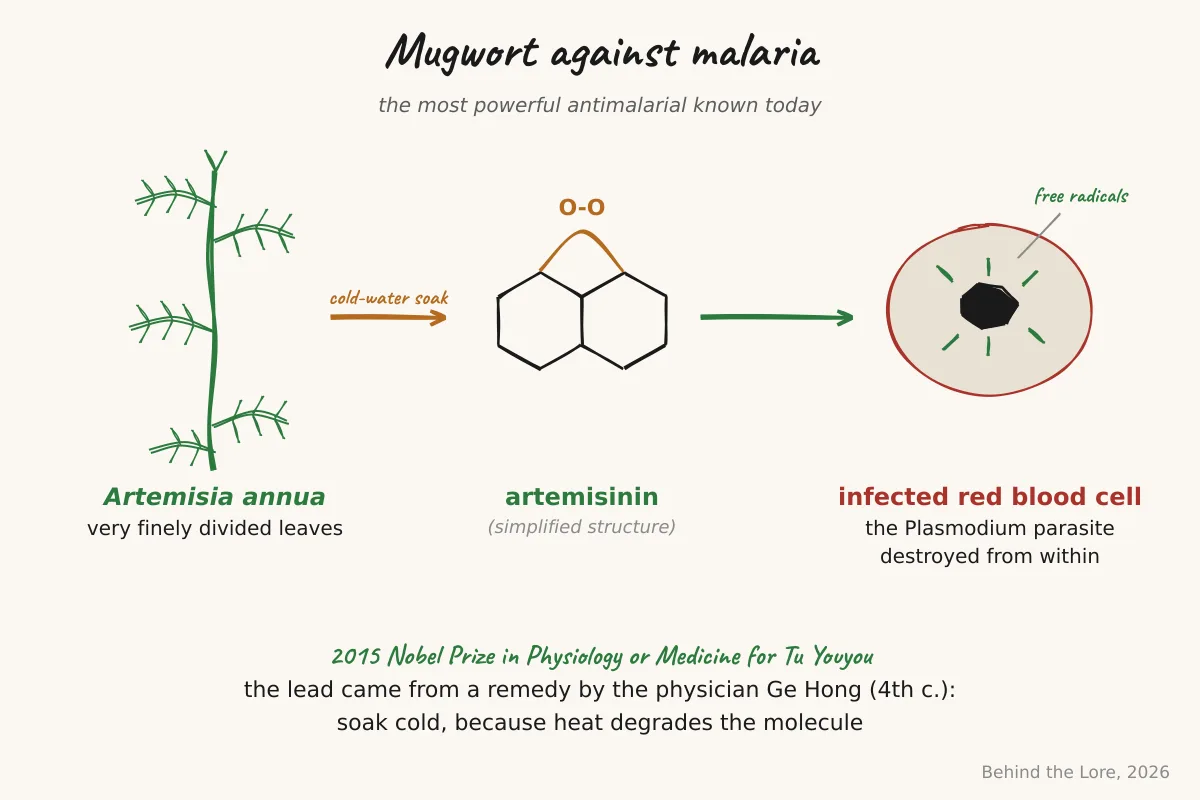
Artemisinin: from an ancient text to the Nobel Prize. The most important discovery linked to this genus is that of artemisinin, extracted from Artemisia annua, an annual species with very finely divided leaves [Wikipedia] . In the 1960s and 1970s, Chinese researcher Tu Youyou worked on a secret military program aimed at finding new treatments for malaria, a parasitic disease that kills hundreds of thousands of people each year, mainly in sub-Saharan Africa and Southeast Asia [Wikipedia] . After reviewing hundreds of traditional Chinese medicine recipes, Tu Youyou settled on a 4th-century text by the physician Ge Hong, which recommended soaking annual mugwort in cold water to treat intermittent fevers, a classic symptom of malaria. This detail, cold soaking rather than hot decoction, led her to extract the active molecule without degrading it with heat. Artemisinin acts against the Plasmodium parasite by generating free radicals inside the infected red blood cell, destroying the parasite from within. It acts quickly and against strains resistant to earlier treatments. Tu Youyou received the 2015 Nobel Prize in Physiology or Medicine for this discovery.
A toxicological caution. Mugwort contains thujone, a terpenic compound present in varying concentrations depending on the species and plant part used. At high or repeated doses, thujone is neurotoxic. Traditional medicinal uses rely on small, occasional amounts, but concentrated or prolonged preparations are not advised. Artemisinin itself, in its modern synthetic forms (artesunate, artemether), is prescribed under medical supervision at precisely calibrated doses.
Going further
Sources
Published on
Keep investigating
Auto-suggested from shared concepts, disciplines, episodes, or characters.
Datura
In The Apothecary Diaries, datura is used to induce sleep and feign death. We explain its alkaloids, its toxicity, and its role in the history of anesthesia.
Nicotine and Tobacco
In The Apothecary Diaries, macerated tobacco serves as a poison. We explain nicotine, its acute toxicity, and why diluting a poison can make it worse.
Aconite
In The Apothecary Diaries, aconite poisons even through honey. We explain aconitine, its action on nerves, and why it shows no mercy.
The Dandelion
In The Apothecary Diaries, Maomao identifies dandelion as a medicinal herb. We explain its diuretic properties, its inulin, and its culinary uses.
Amaryllis
In The Apothecary Diaries, Maomao mentions amaryllis bulbs: toxic raw, edible after soaking, but always a digestive risk.