Amaryllis: a toxic bulb made edible
Story context (click to hide this block) (click to show this block)
This paragraph may contain plot information.
While walking through the palace’s outer courtyard, Maomao spots some amaryllis and takes note of them with an apothecary’s clinical eye. She observes that the bulbs, once soaked, can be eaten and are even delicious, then immediately adds that they can cause “terrible stomach cramps.” The remark is brief but revealing of her way of thinking: one plant, one useful property, one risk not to forget. For her, edible and toxic aren’t watertight categories, but two faces of the same molecule, where dose and preparation make all the difference.
The subject in depth
Amaryllis in the broad sense belong to the family Amaryllidaceae, which includes several hundred species [Wikipedia] . In the context of the series, set in a world inspired by imperial China, the plant in question is most likely lycoris, Lycoris radiata or a related species, known in East Asia as the “spider flower” or “red spider lily.” Confusion with the genus Hippeastrum, which florists today sell under the name “amaryllis,” is common: both belong to the same family, but the toxicological risk is identical.
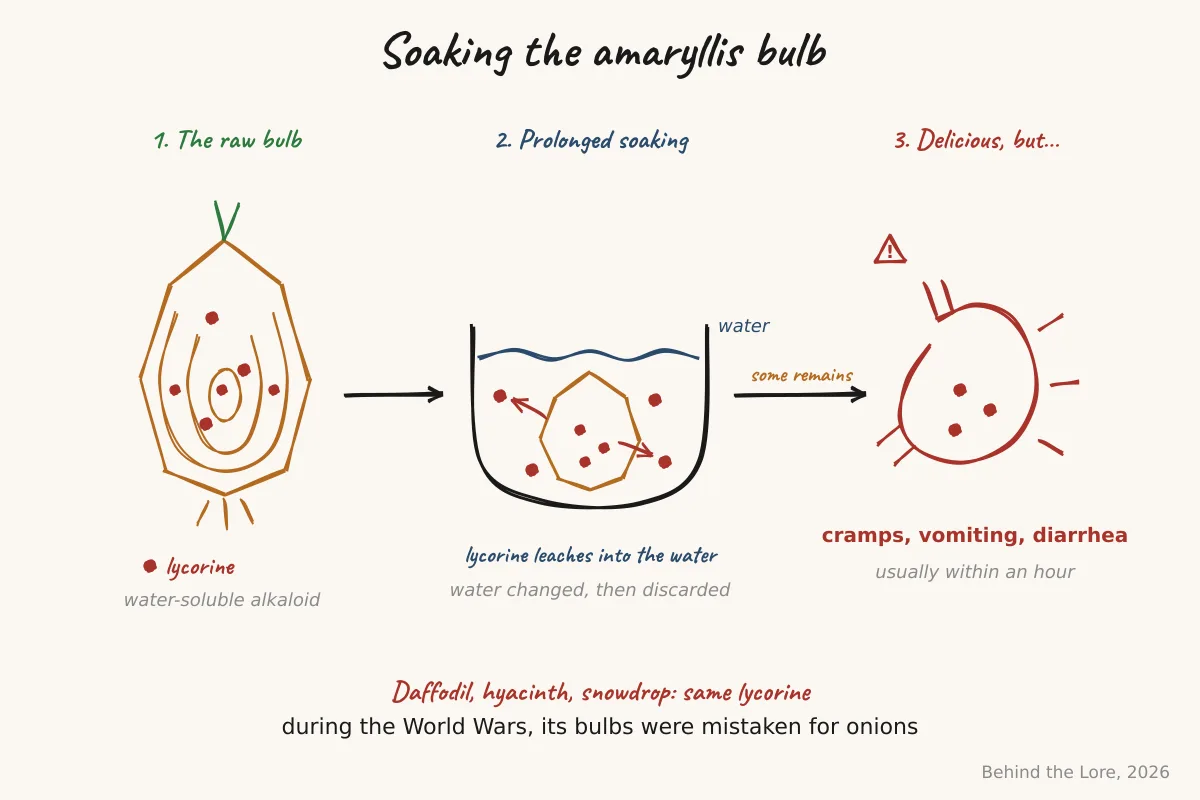
The main alkaloid responsible is lycorine [Wikipedia] . It is a compound of the phenanthridine alkaloid family, concentrated in the bulbs and, to a lesser extent, in the leaves and flowers. Its mechanism of action combines several effects: it inhibits protein synthesis in cells, activates vomiting receptors, and disrupts intestinal absorption. In practice, poisoning shows up as nausea, significant vomiting, abdominal cramps, and diarrhea, generally occurring within an hour of ingestion.
Soaking in water exploits a physicochemical property of lycorine: it is water-soluble. Prolonged immersion, ideally with several changes of water, extracts a significant portion of the alkaloid into the soaking water, which is then discarded. East Asian culinary traditions have codified these preparations over many generations, precisely because the bulbs represent an accessible resource in times of famine. The problem is that the reduction is never total: the amount of residual lycorine depends on soaking duration, how often the water is changed, the temperature, and the exact species. A significant share of poorly soaked bulbs remains capable of causing severe digestive upset.
Comparing this with other toxic bulbs highlights what’s specific about the Amaryllidaceae. Daffodil, hyacinth, and snowdrop belong to the same family and also contain lycorine: their bulbs are regularly mistaken for onion or garlic, causing accidental poisonings. By contrast, autumn crocus, another toxic bulb plant, acts via colchicine, a different mechanism targeting cellular microtubules. These mix-ups between edible and toxic bulbs remain among the frequent causes of plant poisonings reported by poison control centers.
Going further
Sources
Published on
Keep investigating
Auto-suggested from shared concepts, disciplines, episodes, or characters.
Aconite
In The Apothecary Diaries, aconite poisons even through honey. We explain aconitine, its action on nerves, and why it shows no mercy.
Datura
In The Apothecary Diaries, datura is used to induce sleep and feign death. We explain its alkaloids, its toxicity, and its role in the history of anesthesia.
Rhododendron and Mad Honey
In The Apothecary Diaries, a tainted honey and a burned plant cause poisoning. We explain rhododendron's grayanotoxins and the famous mad honey.
Mugwort
In The Apothecary Diaries, mugwort is one of the court's medicinal herbs. We explain its uses and artemisinin, Tu Youyou's antimalarial drug (Nobel 2015).
The Dandelion
In The Apothecary Diaries, Maomao identifies dandelion as a medicinal herb. We explain its diuretic properties, its inulin, and its culinary uses.