Somatization: when the mind makes the body sick
Story context (click to hide this block) (click to show this block)
This paragraph may contain plot information.
While investigating the ghost of the ramparts, Maomao quietly offers a remark that cuts against the supernatural explanations circulating at court: “Many ailments have a mental origin.” This proto-psychosomatic observation becomes her diagnostic compass. If the cause of a disorder is mental, no herbal remedy can fix it, and Maomao, whose expertise lies in plants, honestly acknowledges the limits of her field. Later, Jinshi suggests that love might well be the cure for many ills, an intuition the series leaves open, extending the same idea: the body responds to states of mind.
The subject in depth
Somatization refers to the appearance of real physical symptoms (pain, digestive trouble, malaise, palpitations, deep fatigue) that a medical exam cannot link to any identifiable organic lesion or disease [Wikipedia] . The term is often misunderstood: it does not mean the symptoms are imaginary or exaggerated. They are genuinely real, felt, and in some cases measurable through biological markers. It is their origin that is psychological rather than organic.
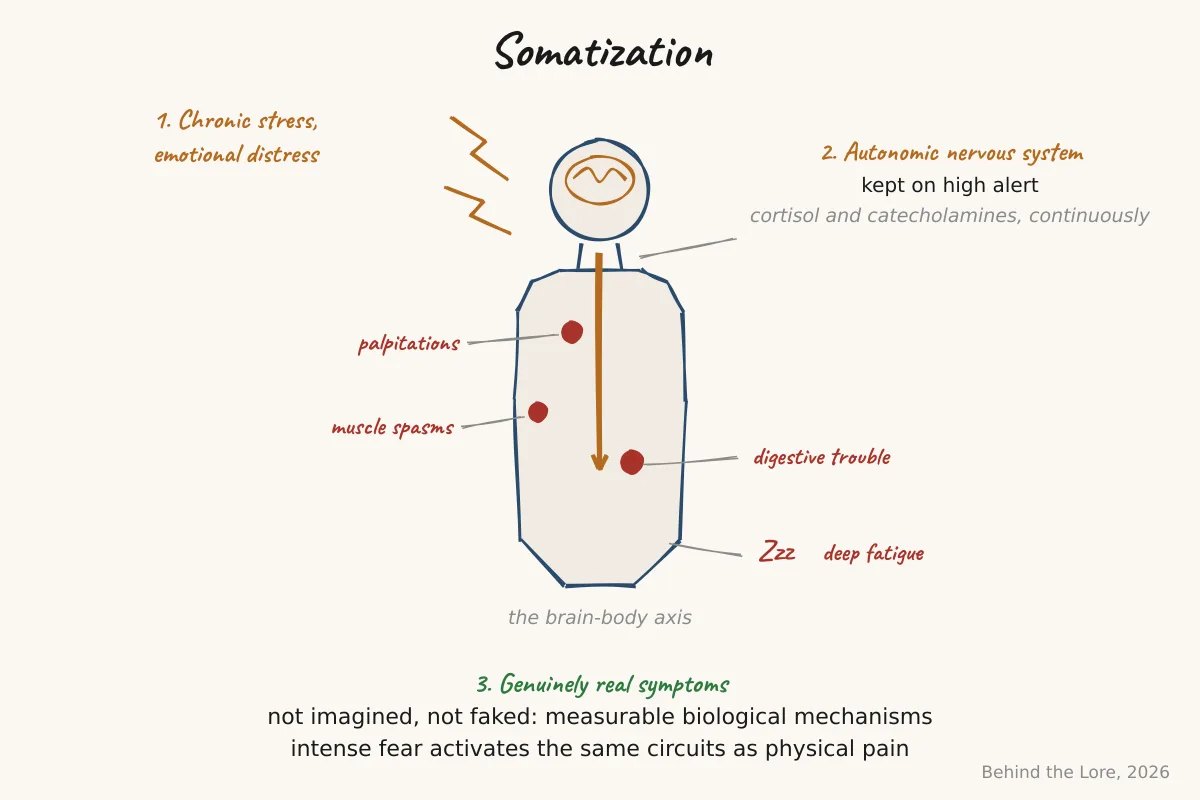
The central mechanism runs through the autonomic nervous system. Under chronic stress or intense emotional distress, the brain keeps the hypothalamic-pituitary-adrenal axis on high alert. This sustained activation continuously releases cortisol and catecholamines, the stress hormones. Repeated cortisol exposure alters intestinal permeability, disrupts pain regulation via the central nervous system, lowers the threshold for perceiving bodily signals, and promotes muscle spasms. These disruptions are what translate into concrete symptoms [Wikipedia] .
Another, more localized mechanism is functional conversion. The DSM-5 describes, under the name “Functional Neurological Symptom Disorder” (formerly “conversion hysteria”), situations where psychological distress manifests as loss of sensation, paralysis, tremors, or seizures resembling epilepsy, with no neurological lesion found on imaging. The brain, in a sense, short-circuits the motor or sensory command under the pressure of an unresolved psychological conflict.
The common mistake is to conclude that a symptom without an organic cause must therefore be false. In reality, the boundary between body and mind is a useful conceptual construct, not a biological one. Every emotion is a neurochemical event: intense fear activates the same circuits as physical pain. Prolonged grief can measurably weaken immunity. Chronic anxiety can help produce a stomach ulcer, a mechanism that is now well documented.
Going further
Sources
Published on
Keep investigating
Auto-suggested from shared concepts, disciplines, episodes, or characters.
Carbon Monoxide
In The Apothecary Diaries, embers bring guests down at a party. We explain carbon monoxide, why it suffocates without warning, and the right thing to do.
Dehydration and Rehydration
In The Apothecary Diaries, Maomao treats heatstroke with salted, sweetened water. We explain dehydration and why salt is vital.
Sleepwalking
In The Apothecary Diaries, Maomao identifies sleepwalking where others see a ghost. We explain the real mechanism behind this parasomnia.
Black Powder
Senku makes gunpowder in Dr Stone. We explain its composition (saltpeter, charcoal, sulfur), the chemical reaction, and its history.
False Pregnancy
A swollen belly, missing periods, milk without pregnancy: The Apothecary Diaries describes pseudocyesis. The hormonal and psychological mechanism.