Sleepwalking: What Science Says
Story context (click to hide this block) (click to show this block)
This paragraph may contain plot information.
A ghost is said to haunt the eastern ramparts of the imperial court: a white figure dances there every night, spreading terror among the servants and concubines. When Jinshi tasks Maomao with solving the mystery, he asks her point-blank whether she knows anything about sleepwalking. She admits her specialty is plants, and that ailments of the mind fall outside her field. But it is Maomao’s father, a renowned physician, who supplies the definition: sleepwalking is an ailment of the mind that drives the patient to act as though awake. The scene also underscores a point modern medicine confirms: this kind of disorder can be faked, as one courtesan used exactly that ploy to lower her buyout price.
The subject in depth
Sleepwalking belongs to the family of parasomnias, disorders that occur during sleep without the person being aware of them [Wikipedia] . It is clearly distinct from REM-sleep parasomnias such as nightmares or sleep paralysis: it occurs during deep slow-wave sleep, also called stage N3, which dominates the first half of the night [Wikipedia] .
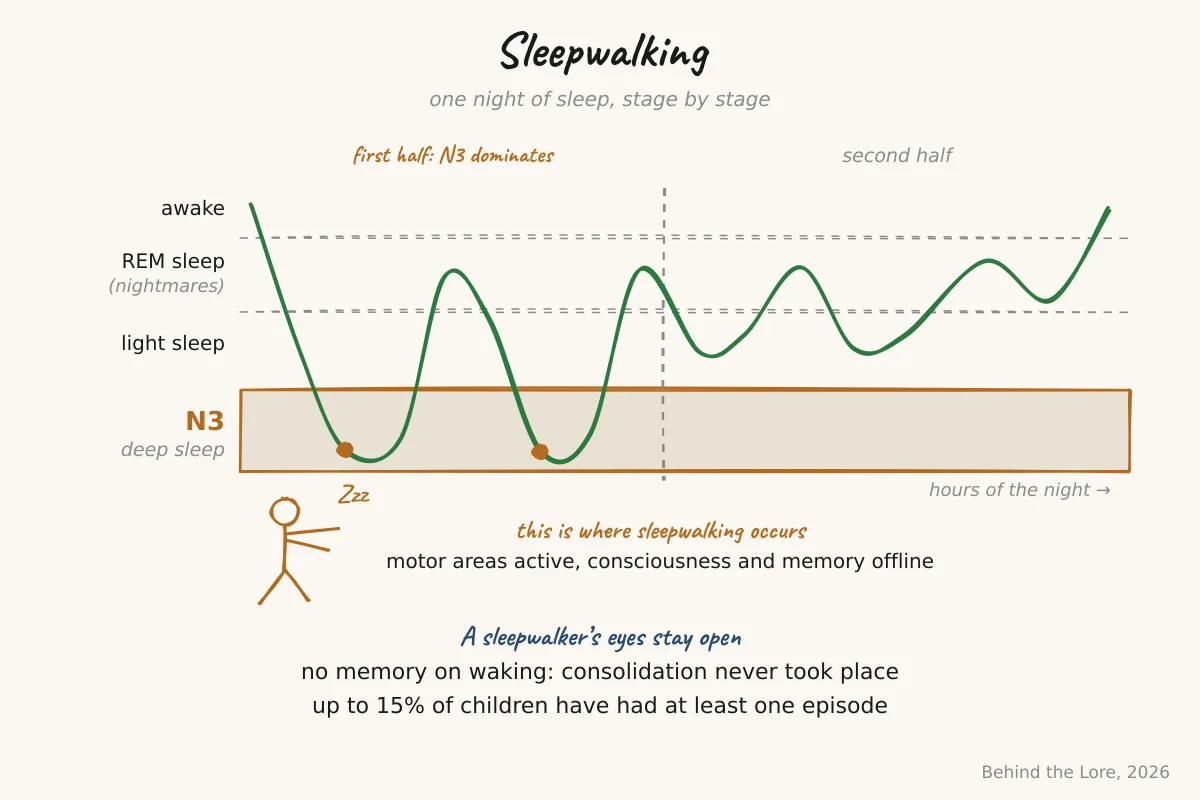
During this stage, slow brain waves signal a state of very low overall cortical activity. Yet certain motor regions remain active enough to produce elaborate behaviors: getting up, walking, opening doors, sometimes speaking. What the brain stops doing is processing sensory information coherently, maintaining self-awareness, and above all, encoding what happens into episodic memory. When the person wakes up, no trace of the episode remains. It isn’t that they forget; memory consolidation simply never took place.
A sleepwalker’s eyes are most often open, which feeds the confusion with a waking state. Their gaze is fixed, poorly reactive. They may answer simple questions, but the answers are incoherent. They avoid obstacles in a rudimentary way. Their behavior is stereotyped and lacks clear purpose, unlike that of someone genuinely awake.
Prevalence is significant: about 2 to 4% of adults have recurrent episodes, and up to 15% of children have experienced at least one, making it one of the most common parasomnias [Wikipedia] . Documented triggers include sleep deprivation, stress, fever, certain medications acting on the central nervous system, and genetic predisposition: the risk is markedly higher in children with a sleepwalking parent.
The question of simulation is medically serious. Without polysomnography, the simultaneous recording of brain waves, muscle tone, and eye movements during sleep, it is clinically difficult to distinguish a genuine episode from a careful imitation. Certain markers guide the differential diagnosis: a true sleepwalker shows characteristic slow waves on EEG, a particular muscle tone, and no response to complex verbal stimuli. But without a laboratory sleep study, these criteria remain out of reach of direct observation.
Going further
Sources
Published on
Keep investigating
Auto-suggested from shared concepts, disciplines, episodes, or characters.
Carbon Monoxide
In The Apothecary Diaries, embers bring guests down at a party. We explain carbon monoxide, why it suffocates without warning, and the right thing to do.
Hypothermia
In The Apothecary Diaries, cold threatens lives. We explain hypothermia, why cold-water immersion is so dangerous, and how to rewarm safely.
Datura
In The Apothecary Diaries, datura is used to induce sleep and feign death. We explain its alkaloids, its toxicity, and its role in the history of anesthesia.
Somatization
In The Apothecary Diaries, some ailments come from the mind. We explain somatization, its real mechanisms, and why these pains are genuinely real.
Black Powder
Senku makes gunpowder in Dr Stone. We explain its composition (saltpeter, charcoal, sulfur), the chemical reaction, and its history.