Silver Vine and Cats
Story context (click to hide this block) (click to show this block)
This paragraph may contain plot information.
In the episode, Luomen explains to Jinshi that a cat could have served as an unwitting messenger because it had sniffed out silver vine hidden in a package. The plant, brewed as tea, promotes restorative sleep according to him, but the use that draws attention is its effect on cats: they’re wild for it, to the point of being sent “almost into a trance.” The cat had rummaged through the drawers precisely to find some, and it’s this irresistible pull that explains its restless behavior and the traces it left behind. The work treats the matter without making a mystery of it, as a fact well known to apothecaries, which biology fully confirms.
The subject in depth
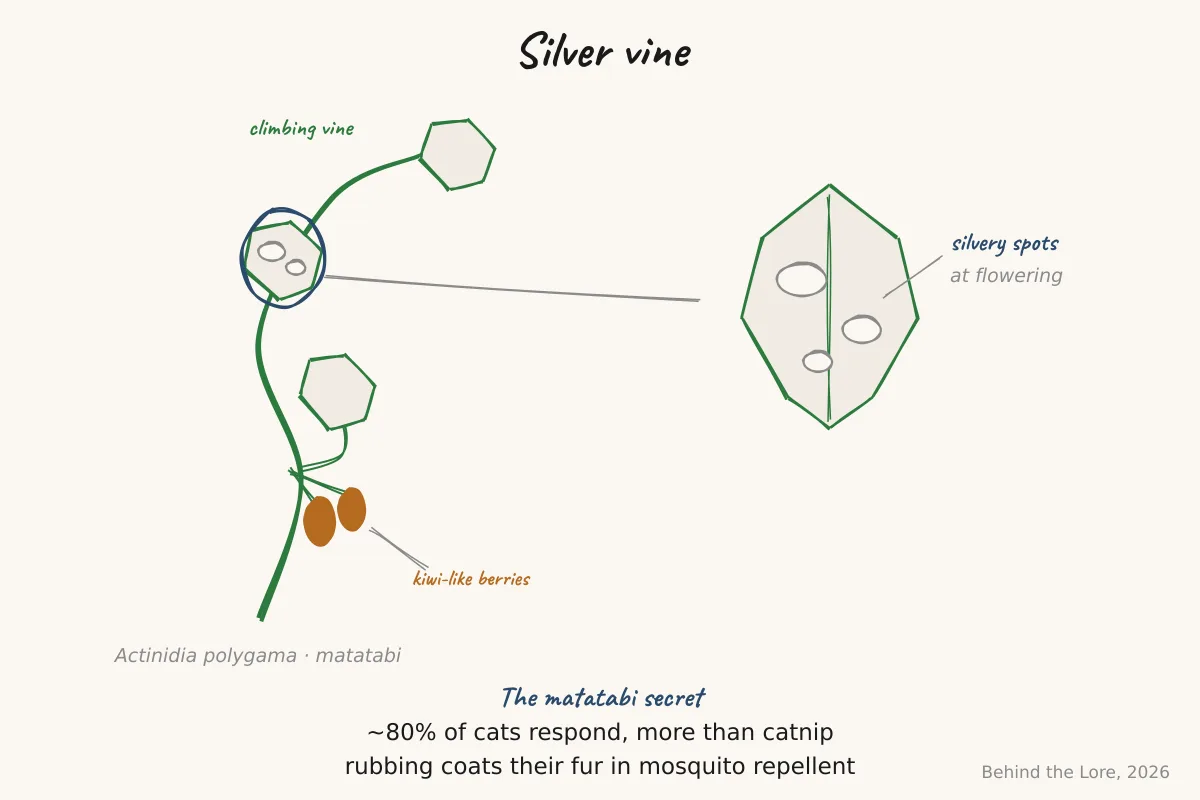
Silver vine is the common name for Actinidia polygama, a climbing vine native to Japan and Korea, belonging to the Actinidiaceae family
[Wikipedia] . Its Japanese name, matatabi, remains common in the scientific literature to describe the effect it produces on domestic cats. The plant owes its other common name to the silvery spots that dot its leaves during flowering, a visual signal that draws human collectors as much as it does cats.
The effect on cats comes down to a family of chemical compounds called iridoids, natural cyclic monoterpenoid molecules. In matatabi’s case, the most active compound is nepetalactol, a molecule related to nepetalactone, found in catnip (Nepeta cataria), the famous “cat herb”
[Wikipedia] . These two molecules aren’t structurally identical, but both activate the same olfactory receptors in cats: the TRPA1 receptors, particularly sensitive in Felidae.
When a cat comes into contact with the plant, whether by smell or by rubbing against it, TRPA1 activation triggers a release of endorphins, the same neurotransmitters involved in feelings of pleasure and calm. The observable behavior is stereotyped and reproducible: the cat rolls on the plant, rubs against it, vocalizes, then settles into a state of calm bordering on drowsiness. This state lasts a limited time, generally five to fifteen minutes, after which the receptor is temporarily desensitized and the animal becomes indifferent to the plant again.
It’s worth clarifying the difference between the two best-known plants for this effect. Catnip (Nepeta cataria) produces its effect mainly through the air, its smell alone being enough to trigger the response
[Wikipedia] . Matatabi also acts through smell, but physical contact with the plant markedly strengthens the reaction. Comparative studies have shown that matatabi is effective on a slightly higher proportion of individuals than catnip: about 80% of domestic cats respond to matatabi, versus 50 to 70% for catnip. This variation is partly genetic, which explains why some cats seem entirely unresponsive to catnip but react to matatabi.
A less intuitive aspect of this phenomenon has been highlighted by recent research: this rubbing behavior isn’t purely a hedonic response. By coating themselves in the plant’s iridoids, cats cover their fur with a substance that turns out to repel mosquitoes and certain biting insects. What looked like self-stimulating behavior appears to be, at least in part, a form of passive chemical protection, shaped by natural selection. The intense sensory response ensures the rubbing is vigorous and repeated, maximizing the amount of repellent deposited on the fur.
Going further
Sources
Published on
Keep investigating
Auto-suggested from shared concepts, disciplines, episodes, or characters.
Aconite
In The Apothecary Diaries, aconite poisons even through honey. We explain aconitine, its action on nerves, and why it shows no mercy.
Datura
In The Apothecary Diaries, datura is used to induce sleep and feign death. We explain its alkaloids, its toxicity, and its role in the history of anesthesia.
Rhododendron and Mad Honey
In The Apothecary Diaries, a tainted honey and a burned plant cause poisoning. We explain rhododendron's grayanotoxins and the famous mad honey.
Invisible Ink
In The Apothecary Diaries, Maomao hides a message in alcohol revealed by flame. We explain why fruit juice, milk, or alcohol brown before the paper does.
Photoperiod and Flowering
How plants measure night length via phytochrome to decide when to flower. Short-day plants, long-day plants, and horticultural forcing explained.