Photoperiod and Flowering in Plants
Story context (click to hide this block) (click to show this block)
This paragraph may contain plot information.
While inspecting a barn, Maomao discovers a plot kept under constant light, including at night. She immediately diagnoses the problem: this prolonged exposure is what’s stunting growth, and even a slight disruption of the light cycle can trigger early flowering or, conversely, block it indefinitely. In a few sentences, she describes what modern botany calls photoperiodism, plants’ ability to sense and use night length as a developmental signal.
The subject in depth
For a long time, it was believed that plants flowered in response to day length. Experimentation corrected that intuition: it’s the length of the night that matters, and more precisely the duration of continuous darkness [Wikipedia] . A break in light, even brief, in the middle of a long night resets the count and changes the plant’s response.
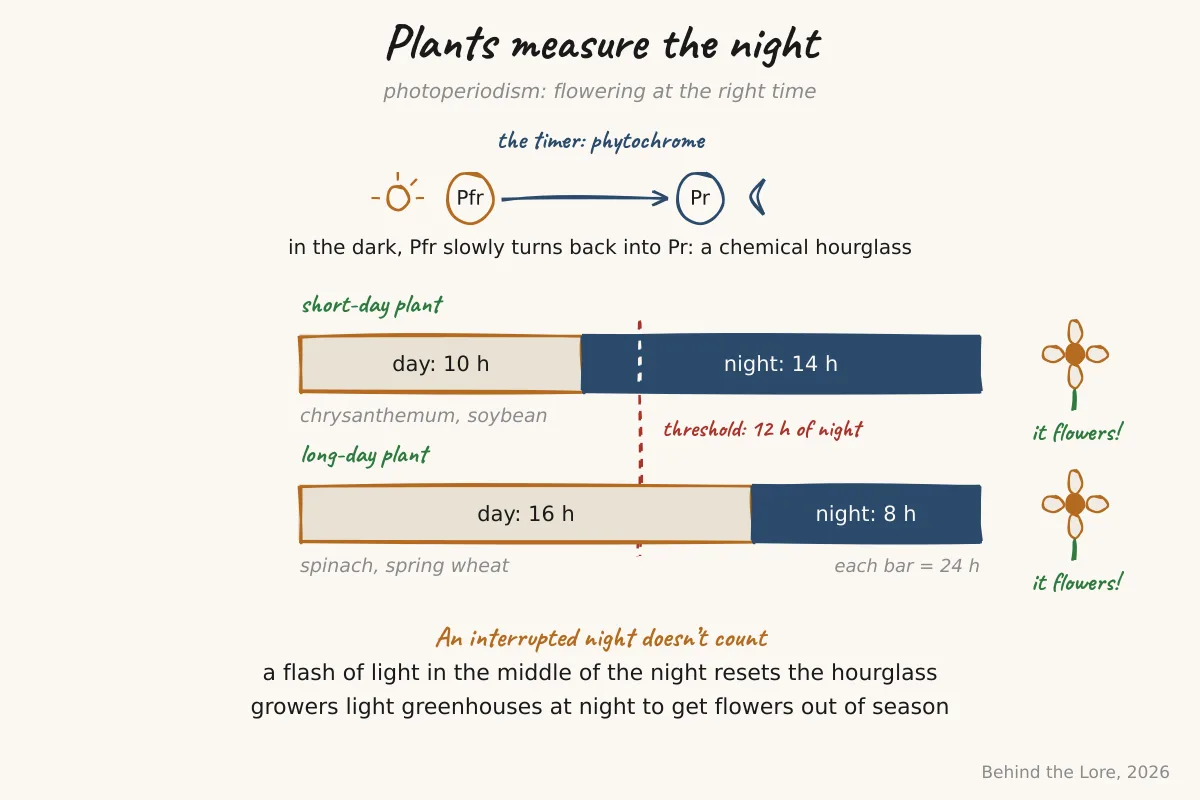
The central sensor in this mechanism is phytochrome, a protein pigment present in nearly all plant tissues. It exists in two interconvertible forms: one activated by red light (Pfr) and one activated by far-red light (Pr). Daylight keeps a high proportion of the pigment in the Pfr form; darkness allows the slow conversion of Pfr back to Pr. By measuring the ratio between these two forms over the course of the night, the plant senses whether the night is long enough.
Depending on the response to this signal, two broad categories are distinguished
- Short-day plants (or long-night plants) flower when the night exceeds a critical threshold, generally twelve to fourteen hours depending on the species. Chrysanthemums, strawberries, autumn rice, and soybeans belong to this group. A night that’s too short, or interrupted by light, keeps the plant in a vegetative state.
- Long-day plants (or short-night plants) flower when the night stays below the critical threshold. Spring wheat, spinach, and radishes are examples. A winter of long nights keeps them in a rosette state until short nights return.
Some species are called day-neutral: their flowering depends on other factors (temperature, plant age) and remains largely insensitive to day length.
Going further
Sources
Published on
Keep investigating
Auto-suggested from shared concepts, disciplines, episodes, or characters.
Aconite
In The Apothecary Diaries, aconite poisons even through honey. We explain aconitine, its action on nerves, and why it shows no mercy.
Datura
In The Apothecary Diaries, datura is used to induce sleep and feign death. We explain its alkaloids, its toxicity, and its role in the history of anesthesia.
Entomophagy
In The Apothecary Diaries, Maomao munches on crickets at the festival. We explain entomophagy, its nutritional value, and its ecological appeal.
Silver Vine
In The Apothecary Diaries, silver vine sends cats into a trance. We explain matatabi, its iridoids, and their dual role as sedative and mosquito repellent.
A Dog's Sense of Smell
Maomao deduces that the dog tracked gunpowder. We explain why dogs smell a hundred times better, how they follow a trail, and how it's used today.