Entomophagy: Eating Insects
Story context (click to hide this block) (click to show this block)
This paragraph may contain plot information.
During the village festival, Maomao accepts without the slightest hesitation the round of grilled insects the villagers offer: crickets, frogs, everything goes. A villager’s remark, “this time of year they’re nice and fat,” betrays practical knowledge of insect seasonality. Facing her, Jinshi shows the typical disgust of a city dweller unused to it. The scene frames entomophagy not as a quaint curiosity, but as an ordinary dietary act within a rural community.
The subject in depth
Entomophagy refers to the human consumption of insects [Wikipedia] . It concerns roughly two billion people today across more than one hundred ten countries, and draws on a broad base of species: beetles, caterpillars, orthopterans (locusts, grasshoppers, crickets), hymenopterans (ants, bees, wasps), termites, and many others.
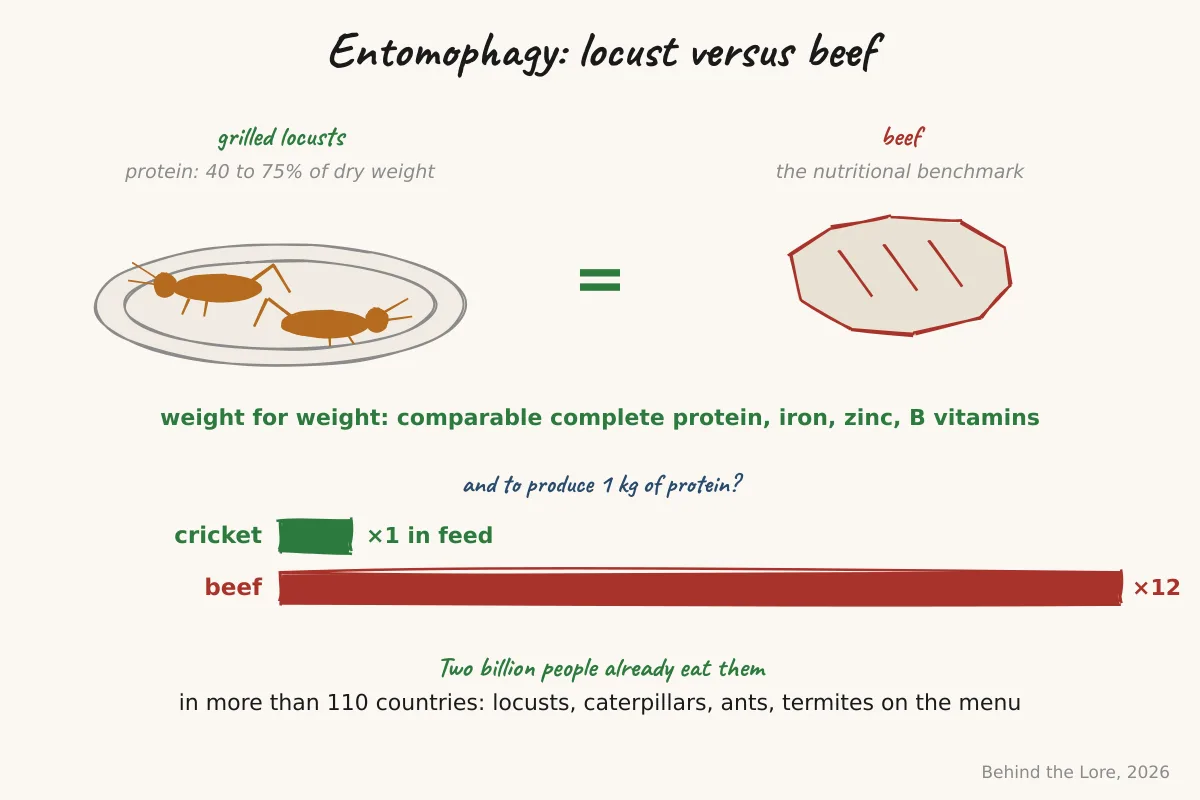
Nutritionally, edible insects offer advantages comparable to conventional meat. Their protein content ranges from 40 to 75% of dry weight depending on species and developmental stage
[Wikipedia] . These proteins are complete, meaning they contain the full set of essential amino acids. The fats present are largely unsaturated, close to those found in fish. Insects also provide heme iron, zinc, calcium, and B vitamins. Weight for weight, a grilled locust rivals a cut of beef on nearly every one of these measures.
The comment about the time of year is not incidental. Most edible insects are indeed seasonal: their fat content peaks before winter diapause or before their reproductive molt, making them more calorie-dense in autumn. Eating them “nice and fat” reflects precise empirical knowledge, passed down from generation to generation.
Ecologically, farming or harvesting insects requires far fewer resources than raising livestock. To produce a kilogram of protein, a cricket consumes roughly twelve times less feed than a cow, emits a tiny fraction of the greenhouse gases, and requires negligible land area. Its water footprint is also much lower.
Going further
Sources
Published on
Keep investigating
Auto-suggested from shared concepts, disciplines, episodes, or characters.
Dehydration and Rehydration
In The Apothecary Diaries, Maomao treats heatstroke with salted, sweetened water. We explain dehydration and why salt is vital.
Honey and Infant Botulism
In The Apothecary Diaries, honey kills a baby. We explain infant botulism: why honey is forbidden before age one, and safe afterward.
Photoperiod and Flowering
How plants measure night length via phytochrome to decide when to flower. Short-day plants, long-day plants, and horticultural forcing explained.
Matsutake
In The Apothecary Diaries, Maomao trades premium matsutake. We explain the obligate mycorrhizal symbiosis that makes it impossible to cultivate.
Royal Jelly
In The Apothecary Diaries, Maomao recognizes royal jelly. We explain how this secretion turns a larva into a queen, and its limits in humans.