Matsutake: Why This Mushroom Costs So Much
Story context (click to hide this block) (click to show this block)
This paragraph may contain plot information.
Maomao gets her hands on some prime, fresh matsutake and uses them as bargaining currency to get what she needs. In a few seconds, the story establishes the essentials: matsutake is a luxury commodity recognized as such at the imperial court, valuable enough to seal a deal. The offhand way Maomao mentions it says everything about the mushroom’s status: an everyday luxury for those who orbit power, an object of desire for everyone else.
The subject in depth
Matsutake is the Japanese name for Tricholoma matsutake, a brown-capped mushroom whose spicy, earthy aroma sets it apart from all its relatives at once [Wikipedia] . It grows mainly in Japan, Korea, northern China, and parts of Siberia and North America. Its scent, due largely to 1-octen-3-ol and methyl cinnamate, is so distinctive that it is a culinary argument in its own right: grilled over coals with salt and soy sauce, it releases an aroma no other mushroom reproduces.
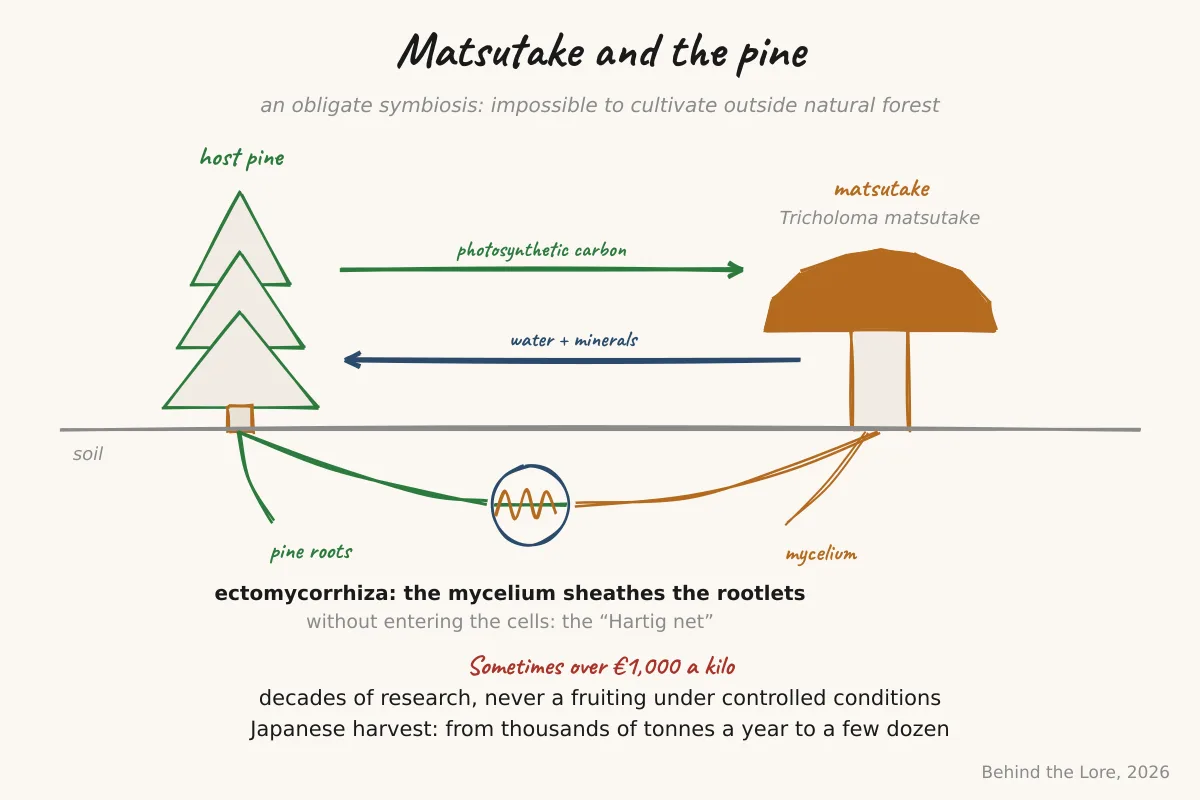
The deep reason for its rarity is biological. Matsutake is an ectomycorrhizal mushroom: its mycelium wraps around the fine rootlets of pines without penetrating the cells, forming a dense sheath called the Hartig net [Wikipedia] . This partnership is not optional: the mushroom cannot fruit outside the root network of a living, healthy host pine. In exchange for the photosynthetic carbon the pine provides, matsutake improves the roots’ absorption of water and minerals.
This biological contract makes cultivation outside its natural habitat practically impossible. To grow a bed mushroom like shiitake, it is enough to prepare a wood or straw substrate and inoculate it with mycelium: the mushroom grows on its own. For matsutake, one would need to reproduce the entire ecology of a mature pine forest, with its soil layers, its pH, its microbial life, and its seasonal cycles. Several decades of agronomic research in East Asia have failed to achieve fruiting under controlled conditions.
World harvests therefore rely exclusively on natural forests. And these forests are declining: in Japan, the area of Pinus densiflora pine stands has shrunk since the 1950s due to the abandonment of traditional forest maintenance, climate change, and the spread of the pine wilt nematode. Japanese production, which once exceeded several thousand tonnes a year, has fallen to a few dozen tonnes, making Japanese matsutake the most expensive in the world, sometimes exceeding a thousand euros per kilogram at the start of the season.
Going further
Sources
Published on
Keep investigating
Auto-suggested from shared concepts, disciplines, episodes, or characters.
Honey and Infant Botulism
In The Apothecary Diaries, honey kills a baby. We explain infant botulism: why honey is forbidden before age one, and safe afterward.
Ginger
In The Apothecary Diaries, Maomao prepares ginger pastilles to keep warm. We explain gingerol, TRPV1, and Chinese pharmacopoeia.
Clay and Kaolin
In The Apothecary Diaries, clay is used as makeup. We explain kaolinite, its layered structure, its absorbent power, and its uses.
Entomophagy
In The Apothecary Diaries, Maomao munches on crickets at the festival. We explain entomophagy, its nutritional value, and its ecological appeal.
Flame Coloration
In The Apothecary Diaries, flame color serves as a clue. We explain why every metal salt burns a different color.