Invisible Ink: Writing Revealed by Heat
Story context (click to hide this block) (click to show this block)
This paragraph may contain plot information.
Maomao slipped in a distress message written in invisible ink, penned with alcohol and hidden to avoid notice. Luomen explains that text written with fruit juice, tea, or alcohol becomes visible under the heat of a flame, because these substances “burn more easily” than paper does. Jinshi thus picks up the heroine’s trail from a message that anyone could have handled without reading a thing.
The subject in depth
An invisible ink is a liquid that, once dry, becomes indistinguishable on the surface until some process reveals it. The thermal family, the one used in the scene, relies on a principle of differential degradation [Wikipedia] .
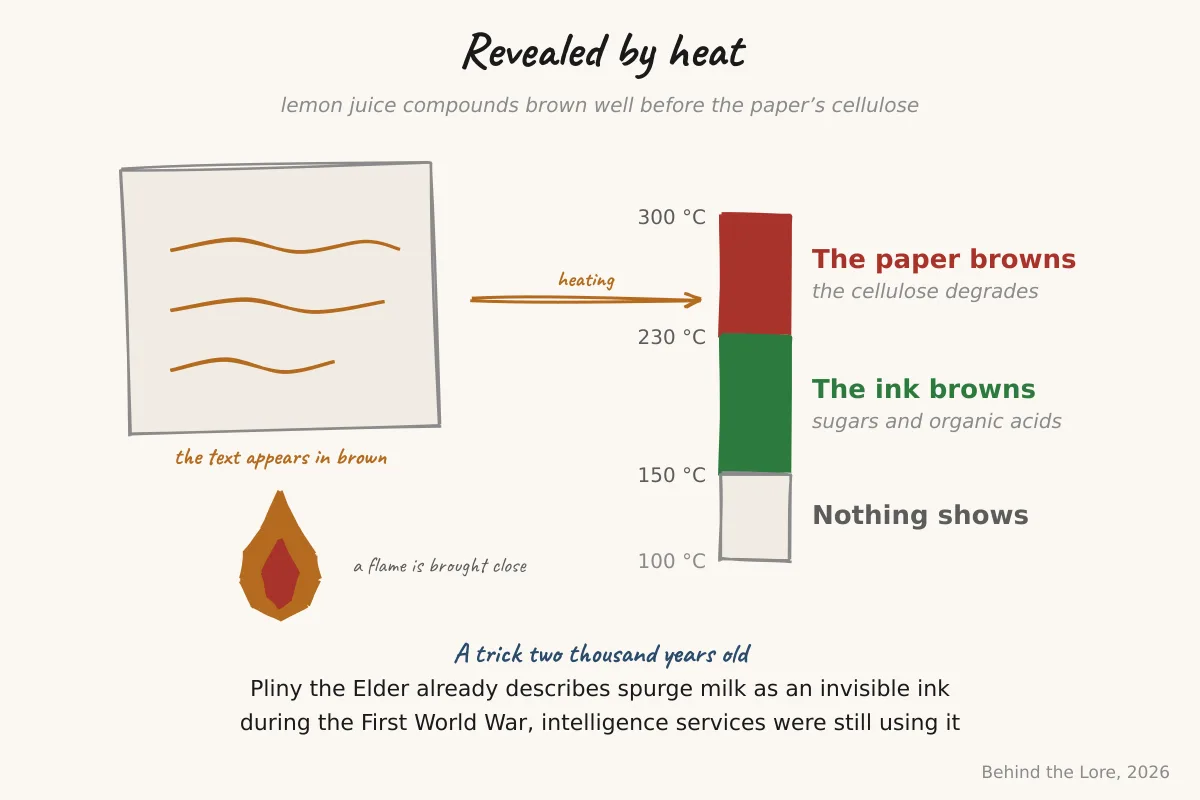
Paper is mainly composed of cellulose. Its visible thermal degradation begins around 230 to 300°C depending on the type of paper. The organic liquids commonly used as invisible inks, lemon juice, orange juice, milk, urine, strong tea, or alcohol, contain simple sugars, organic acids (citric acid, lactic acid, gallic acid), and tannins. These compounds start to break down and brown at around 150 to 200°C, well before the cellulose reaches its own degradation point.
This browning is not combustion in the strict sense. It is a thermal degradation reaction that follows two paths depending on the nature of the compound: caramelization for sugars (breakdown and rearrangement of glucose or fructose molecules under heat), and the Maillard reaction for mixtures containing both sugars and amino acids. Both produce colored brown polymers. Since the sheet itself remains below its own degradation threshold, it doesn’t darken: only the brown text appears.
Urine and milk deserve special mention. Urine contains urea, which breaks down into ammonia under heat, but also residual sugars and uric acid that brown. Milk, rich in lactose and whey proteins, reacts particularly well through the Maillard reaction. These two substances are among the oldest documented invisible inks, which is explained by their universal availability and their perfectly neutral appearance on paper once dry.
The reverse mechanism also exists, with chemical invisible inks revealed not by heat but by reaction with a reagent (phenolphthalein revealed by a base, ferric chloride revealed by tannins, iodine revealed by starch). These variants were developed as early as the 16th and 17th centuries, notably to get around the detection that postal services were beginning to employ.
Going further
Sources
Published on
Keep investigating
Auto-suggested from shared concepts, disciplines, episodes, or characters.
Carbon Monoxide
In The Apothecary Diaries, embers bring guests down at a party. We explain carbon monoxide, why it suffocates without warning, and the right thing to do.
Orpiment and Arsenic
In The Apothecary Diaries, a yellow pigment poisons slowly. We explain orpiment, arsenic, and the chronic poisoning of court painters.
Silver Vine
In The Apothecary Diaries, silver vine sends cats into a trance. We explain matatabi, its iridoids, and their dual role as sedative and mosquito repellent.
Black Powder
In The Apothecary Diaries, Maomao states the exact formula for black powder. We explain the role of each ingredient, the reaction, and the rotten-egg smell.
Dust Explosion
In The Apothecary Diaries, Maomao proves a lit pipe was enough to blow up a flour warehouse. We explain the real physics of dust explosions.