Dust Explosion: When Flour Blows Up
Story context (click to hide this block) (click to show this block)
This paragraph may contain plot information.
After a fire breaks out in a food warehouse, Maomao investigates on behalf of the administration. She reconstructs the scenario step by step: large quantities of stored flour, dust suspended in the warehouse air, and a pipe lit by a guard. To convince her listener, she recreates the phenomenon in miniature with a wooden box, flour blown inside, and a lit wick. The controlled explosion that follows confirms her hypothesis and pinpoints the mechanism with remarkable precision for the story’s era.
The subject in depth
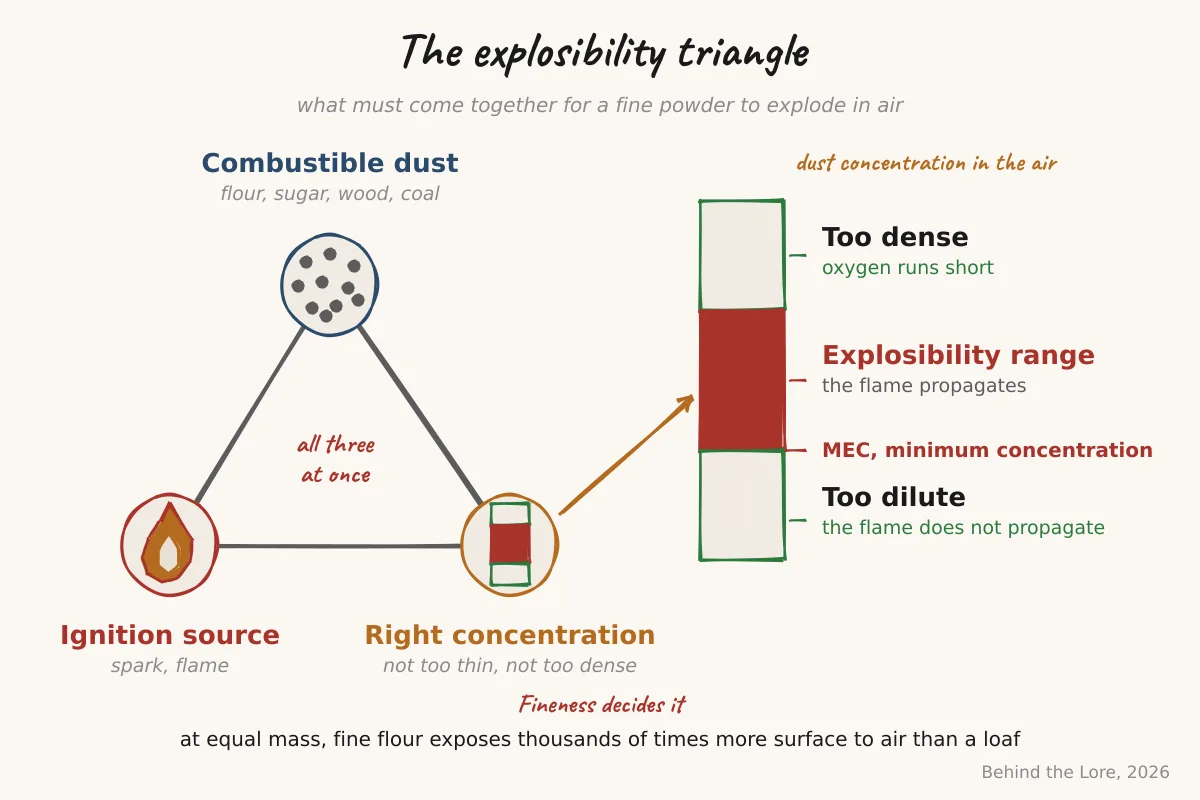
A finely divided powder burns infinitely faster than a solid chunk of the same material. The reason is geometric: the more finely a substance is divided, the greater its total surface area in contact with oxygen. A gram of finely milled flour exposes several thousand times more surface area to air than a piece of bread of the same mass [Wikipedia] . When these particles are dispersed as a dense cloud in a confined space, each one is surrounded by oxygen on all sides. An ignition source as brief as a spark or a pipe flame then triggers the combustion of nearly all the particles almost simultaneously [Wikipedia] .
The heat released in a fraction of a second sharply expands the combustion gases. In a closed or semi-closed space, this expansion has nowhere to go: the pressure rises so fast that it can blow out walls, hurl debris, and trigger further chain combustion. This is called a deflagration, or even a detonation if the pressure wave exceeds the speed of sound in the medium.
Three conditions must be met at the same time for a dust explosion to occur: the presence of a combustible dust (flour, sugar, wood, coal, powdered metals), a concentration in the air between the minimum explosible concentration (MEC) and the maximum explosible concentration, and an ignition source of sufficient energy. Below the MEC, the cloud is too dilute for the flame to propagate; above the maximum concentration, oxygen runs short. The dangerous zone between these two limits is what industry calls the explosibility range.
Going further
Sources
Published on
Keep investigating
Auto-suggested from shared concepts, disciplines, episodes, or characters.
Carbon Monoxide
In The Apothecary Diaries, embers bring guests down at a party. We explain carbon monoxide, why it suffocates without warning, and the right thing to do.
Amaryllis
In The Apothecary Diaries, Maomao mentions amaryllis bulbs: toxic raw, edible after soaking, but always a digestive risk.
Mugwort
In The Apothecary Diaries, mugwort is one of the court's medicinal herbs. We explain its uses and artemisinin, Tu Youyou's antimalarial drug (Nobel 2015).
Salt, Ice, and Cold
Maomao makes ice cream with no refrigerator. We explain freezing-point depression, the NaCl-water eutectic point at -21°C, and colligative properties.
The Dandelion
In The Apothecary Diaries, Maomao identifies dandelion as a medicinal herb. We explain its diuretic properties, its inulin, and its culinary uses.