Salt and ice: why it gets colder than 0°C
Story context (click to hide this block) (click to show this block)
This paragraph may contain plot information.
A block of ice delivered to court as a luxury good ends up in Maomao’s hands. She crushes it, arranges the chips around an inner bowl, pours in salt, then adds a mixture of milk, sugar, and fruit. She stirs everything until the contents solidify. The ice cream is ready. No one names the phenomenon in the scene, but the technique is precise: the salt is not in the mixture being chilled, it is around it, in the ice bath.
The subject in depth
Pure ice melts at 0°C, a value known since Antiquity. What is less well known is that this point can be lowered: adding a solute to water delays its freezing and speeds up the melting of ice already formed. This is freezing-point depression, a so-called colligative property because it depends only on the number of dissolved particles, not on their nature [Wikipedia] .
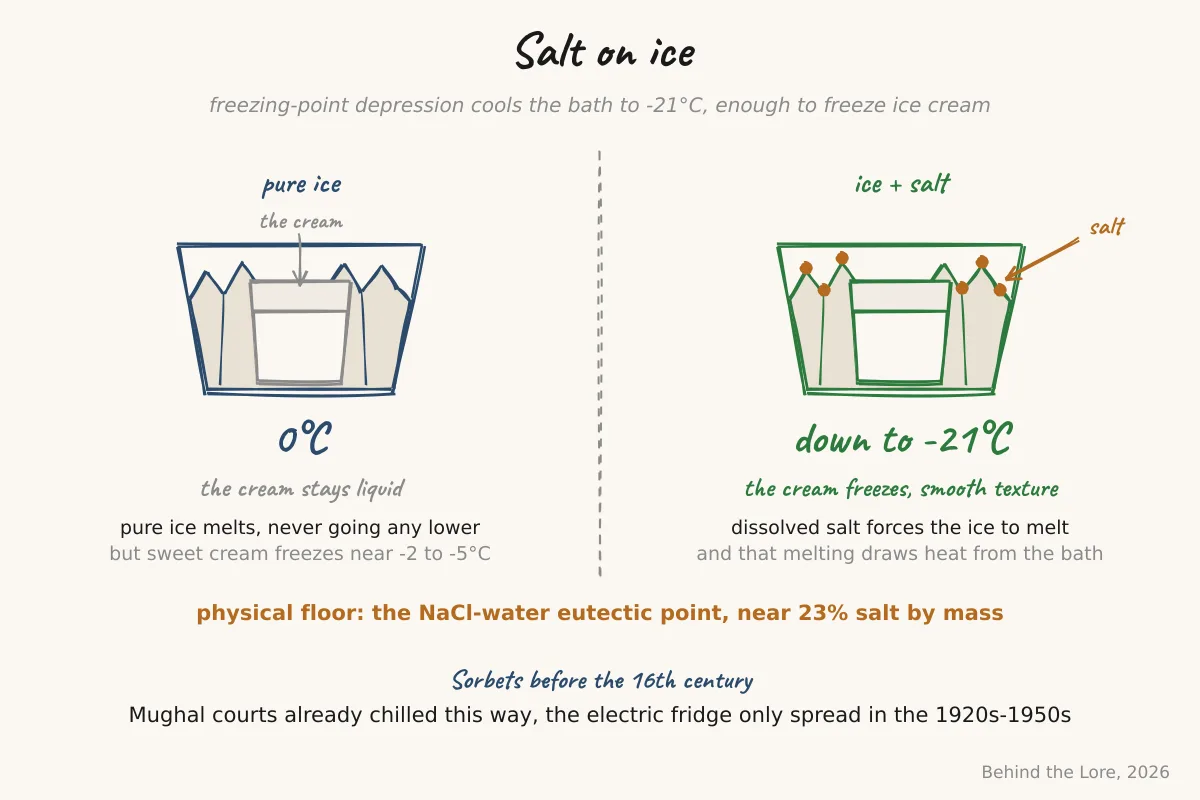
When salt is poured onto ice, the sodium chloride dissolves into the thin film of liquid water that always coats the surface of the crystals. This salty solution has a freezing point below 0°C, so it stays liquid even as the surrounding ice tries to remain solid. To reach thermodynamic equilibrium, more ice melts, and that melting requires energy: it draws it from the surroundings in the form of latent heat. The bath cools down.
The more salt is added, the lower the freezing point drops, up to a physical limit: the eutectic point of the water-sodium chloride system, reached at about -21°C for a concentration of 23% NaCl by mass [Wikipedia] . Beyond that concentration, the salt no longer fully dissolves and the effect stops increasing. -21°C is therefore the floor achievable with ice and ordinary table salt.
That floor is enough to freeze a mixture of sugared, milky water. Pure water freezes at 0°C, but a sugar solution stays liquid a little below that: its own freezing-point depression (caused by the sugar) is small, typically between -2 and -5°C depending on sugar and fat content. A salted ice bath at -15 to -20°C is well below that threshold: it chills the mixture fast enough for fine ice crystals to form everywhere at once, giving ice cream its characteristic smooth texture. That is why Maomao keeps stirring: by continuously agitating the mixture, she breaks up crystals before they can grow large, ensuring a creamy result rather than a grainy one.
Going further
Sources
Published on
Keep investigating
Auto-suggested from shared concepts, disciplines, episodes, or characters.
Mercury
In The Apothecary Diaries, quicksilver goes into a court poison. We explain mercury, its toxicity, and the immortality elixirs that killed emperors.
Hypothermia
In The Apothecary Diaries, cold threatens lives. We explain hypothermia, why cold-water immersion is so dangerous, and how to rewarm safely.
Breech Presentation
In The Apothecary Diaries, Maomao diagnoses a breech baby and prescribes moxibustion. We explain the science behind this ancestral technique.
Dust Explosion
In The Apothecary Diaries, Maomao proves a lit pipe was enough to blow up a flour warehouse. We explain the real physics of dust explosions.
Salting and Brining
In The Apothecary Diaries, Maomao dates a batch of seaweed using her knowledge of brining. We explain how salt preserves food, and why it eventually fails.