Breech presentation
Story context (click to hide this block) (click to show this block)
This paragraph may contain plot information.
A pregnant concubine seeks out Maomao because her usual midwife has fallen ill. While palpating the belly and listening to the patient describe where she feels the baby’s kicks, Maomao notices something unusual: the kicks are concentrated in the lower abdomen, where the head should be at this stage of pregnancy. She concludes the baby is breech, buttocks down, feet up. She then prescribes moxibustion on a precise point of the little toe, combined with exercises, to encourage the fetus to turn on its own. The patient replies that she has already tried moxa without success. Maomao then mentions, as a last resort if the baby does not turn, an abdominal incision that the court’s eunuch physician has already performed.
The subject in depth
In the final weeks of pregnancy, most fetuses settle head-down, the heaviest part of the body naturally migrating toward the lower pelvis [Wikipedia] . When this spontaneous turn does not happen, the baby remains in breech presentation: the buttocks or feet sit in the lower position, and that is the part of the body that would come out first during delivery.
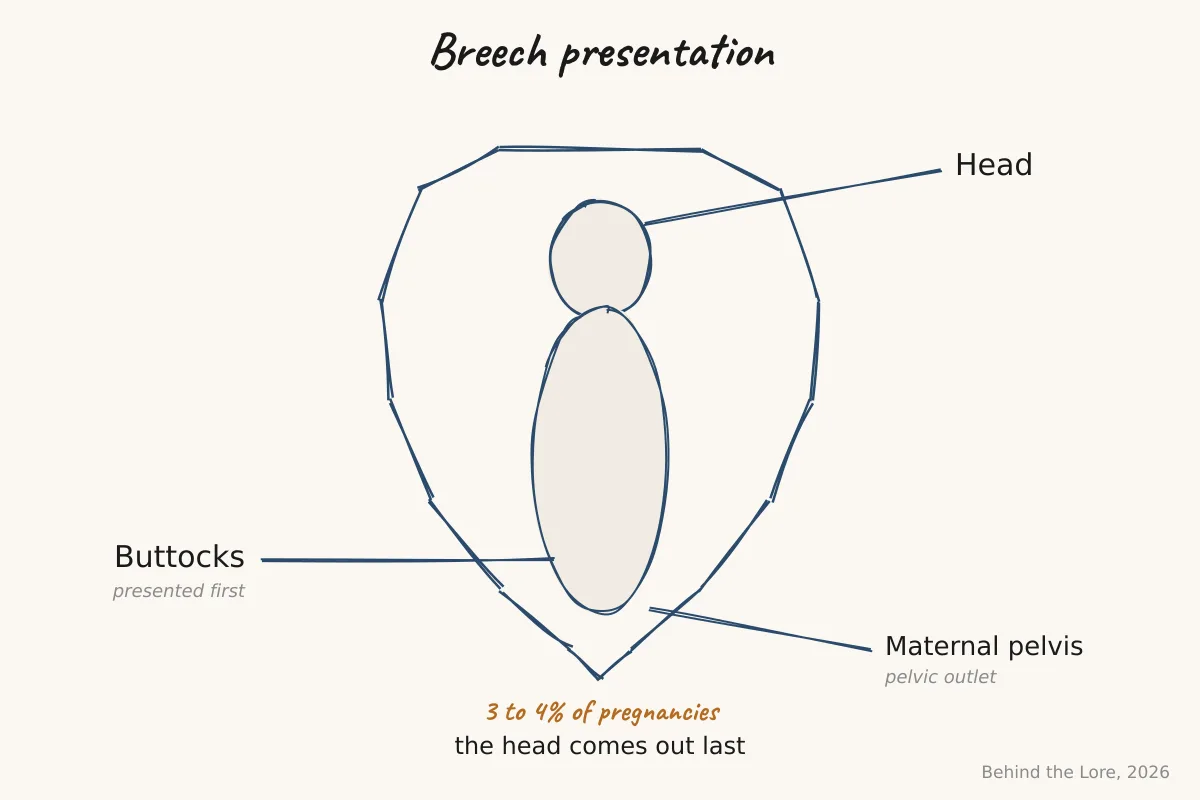
This presentation affects roughly 3 to 4% of full-term pregnancies. It poses a serious mechanical problem: the head, the largest and most rigid part of the fetal body, comes out last. A newborn’s skull bones can deform slightly to pass through the pelvic canal, but only if the head descends gradually, given the necessary time. When the rest of the body comes out first, that time is gone: the head can become stuck, which can lead to asphyxia.
Maomao’s reasoning rests on a solid clinical principle. A fetus in normal, head-down presentation has its active limbs (feet and fists) pointing up, toward the top of the uterus. The mother therefore feels kicks in the upper and side parts of the belly. A breech fetus has the reverse situation: the feet are down, and kicks are felt mostly in the lower abdomen. This indirect examination through kick location foreshadows the Leopold maneuvers, codified in the 19th century, but abdominal palpation to estimate fetal position is attested in medical texts much earlier.
Two main approaches exist to try to correct a breech presentation. The first is moxibustion at point BL67, called Zhiyin in traditional Chinese medicine, located at the outer corner of the little toenail [Wikipedia] . A lit stick of mugwort (Artemisia vulgaris) is held near the point, close enough to produce intense heat without burning, for one to two weeks. The proposed mechanism is thermal stimulation of the acupoint that would increase uterine tone and encourage the fetus to move. The second approach is external cephalic version [Wikipedia] : an obstetrician places their hands on the patient’s belly and rotates the fetus through controlled external pressure, most often starting around the 36th week of amenorrhea, under ultrasound and cardiotocographic monitoring.
Going further
Sources
Published on
Keep investigating
Auto-suggested from shared concepts, disciplines, episodes, or characters.
Carbon Monoxide
In The Apothecary Diaries, embers bring guests down at a party. We explain carbon monoxide, why it suffocates without warning, and the right thing to do.
Dehydration and Rehydration
In The Apothecary Diaries, Maomao treats heatstroke with salted, sweetened water. We explain dehydration and why salt is vital.
Honey and Infant Botulism
In The Apothecary Diaries, honey kills a baby. We explain infant botulism: why honey is forbidden before age one, and safe afterward.
Salt, Ice, and Cold
Maomao makes ice cream with no refrigerator. We explain freezing-point depression, the NaCl-water eutectic point at -21°C, and colligative properties.
Emmenagogue and Abortive Plants
Jasmine, mugwort, rue, chili pepper: were these plants, said to trigger periods or end a pregnancy, really effective? The history and pharmacology behind them.