Perfume Extraction
Story context (click to hide this block) (click to show this block)
This paragraph may contain plot information.
Settled at the inner palace’s dispensary, Maomao takes advantage of the season’s last roses to run the stills of the pharmacy. She explains the process to Jinshi: steam passes through the petals, carries off the scent molecules, then condenses into a distillate that separates into two layers, the essential oil on top and rose water below. She immediately notes that some perfumes, the most concentrated ones, can cause miscarriages, and that the ones she’s distilling are harmless, a way of signaling that she knows the properties of every plant, including the most delicate ones.
The subject in depth
Flowers owe their scent to a mix of volatile organic molecules, mostly terpenes and their oxygenated derivatives [Wikipedia] . These compounds evaporate at room temperature, which is why you can smell a rose without touching it. Extracting these molecules in concentrated form is the whole art of perfumery.
Steam distillation
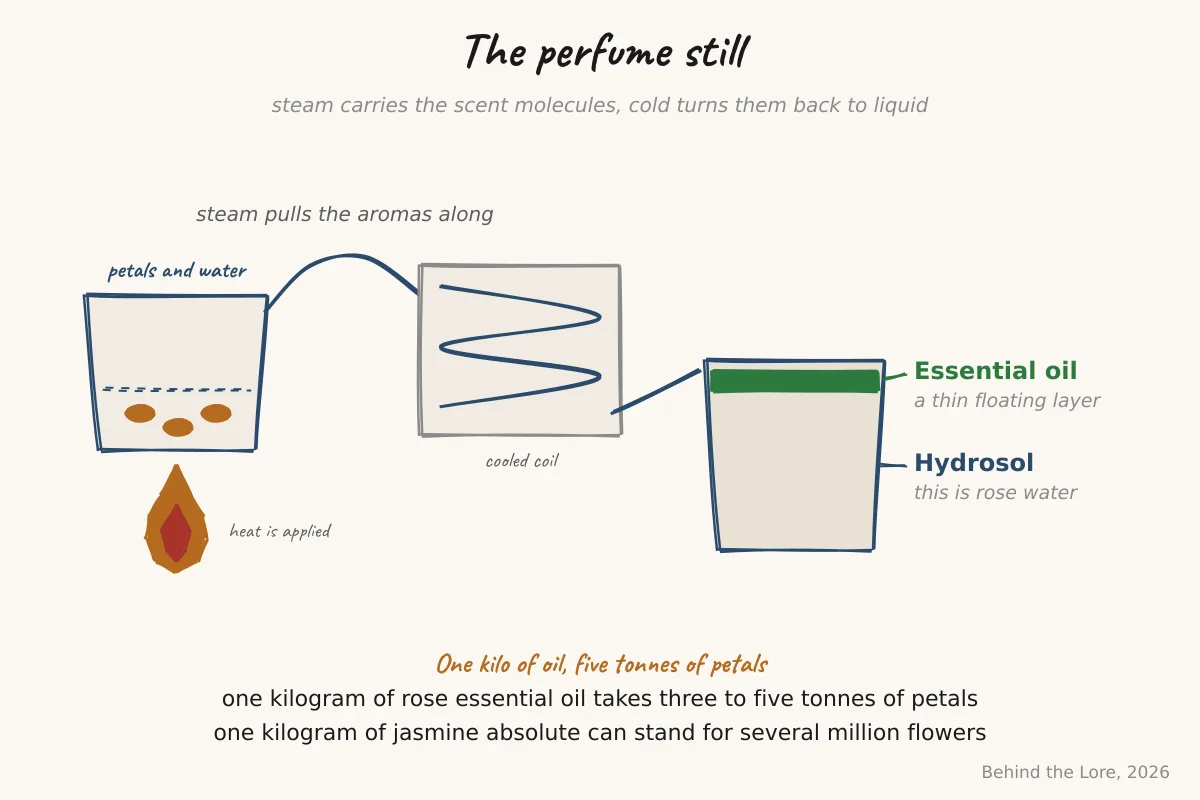
This is the most widespread method, and the one Maomao uses. Petals are placed in a still with water; the steam produced by heating passes through the plant material, pulls out the volatile molecules it contains, and then the whole steam-and-aroma mixture is cooled in a coil and condenses. The distillate collected is a watery mixture topped by a thin layer of oil: this is the essential oil. The watery phase, laden with water-soluble compounds, is called hydrosol or floral water. For rose, this hydrosol is rose water, used for centuries as a cosmetic and medicinal product.
The chemical composition of rose essential oil (Rosa damascena or Rosa centifolia) is dominated by geraniol, citronellol, nerol, and phenylethanol. These are terpene alcohols, molecules built from five-carbon blocks (isoprene) bearing a hydroxyl group. Their structural lightness lets them vaporize easily and interact with olfactory receptors.
Enfleurage
For flowers whose scents are too delicate to withstand heat, enfleurage is used
[Wikipedia] . In the cold technique, fresh petals are laid on a frame coated with neutral fat (purified lard or tallow). The scent molecules passively migrate into the fat over the hours. The petals are replaced several times until the fat is saturated, and the aromas are then extracted with alcohol, which separates the scent compounds from the fatty matter. The result is an absolute, richer and more faithful than distilled essential oil. Jasmine and tuberose owe their characteristic notes to this process, because steam distillation alters or destroys some of their most delicate compounds.
Cold expression
A third technique exists for citrus fruits: mechanical expression of the peel, which releases essential oils without heat or solvent. It doesn’t apply to flowers, whose scent-bearing cells are too diffuse to be pressed directly.
The yield problem
This is where the price of natural perfumes finds its rational explanation. Producing one kilogram of rose essential oil takes roughly three to five tons of petals picked by hand, at dawn, before the sun’s heat begins to volatilize the aromas. For jasmine, the yield is even lower: it takes even more material, and the harvest is entirely manual since the buds must be picked before they fully open. A kilogram of jasmine absolute can represent several million flowers. This minuscule yield isn’t a matter of industrial inefficiency: it simply reflects the very low concentration of scent molecules within the plant’s biomass.
Going further
Sources
Published on
Keep investigating
Auto-suggested from shared concepts, disciplines, episodes, or characters.
Aconite
In The Apothecary Diaries, aconite poisons even through honey. We explain aconitine, its action on nerves, and why it shows no mercy.
Mercury
In The Apothecary Diaries, quicksilver goes into a court poison. We explain mercury, its toxicity, and the immortality elixirs that killed emperors.
Orpiment and Arsenic
In The Apothecary Diaries, a yellow pigment poisons slowly. We explain orpiment, arsenic, and the chronic poisoning of court painters.
Anthocyanins
In The Apothecary Diaries, Maomao reveals why blue roses are impossible. We explain anthocyanins, their response to pH, and their antioxidant property.
Oxalic Acid
Oxalis contains oxalic acid, responsible for its tangy taste. We explain its uses, its effects on the body, and why these plants remain edible.