Oxalic acid: sour taste and toxicity
Story context (click to hide this block) (click to show this block)
This paragraph may contain plot information.
In a flashback to Fonshen’s youth, the courtesan picks oxalis leaves (which she calls “cat’s paws”) and explains how they’re used to soothe insect bites. The scene is brief, but it grounds oxalis in the register of folk remedies known to the women of the quarter long before official apothecaries.
The subject in depth
Oxalic acid (C₂H₂O₄) is the simplest of the dicarboxylic acids: two carboxyl groups (-COOH) linked directly, with no carbon chain between them [Wikipedia] . This minimal structure gives it a pronounced acidity and strong reactivity with calcium and iron ions.
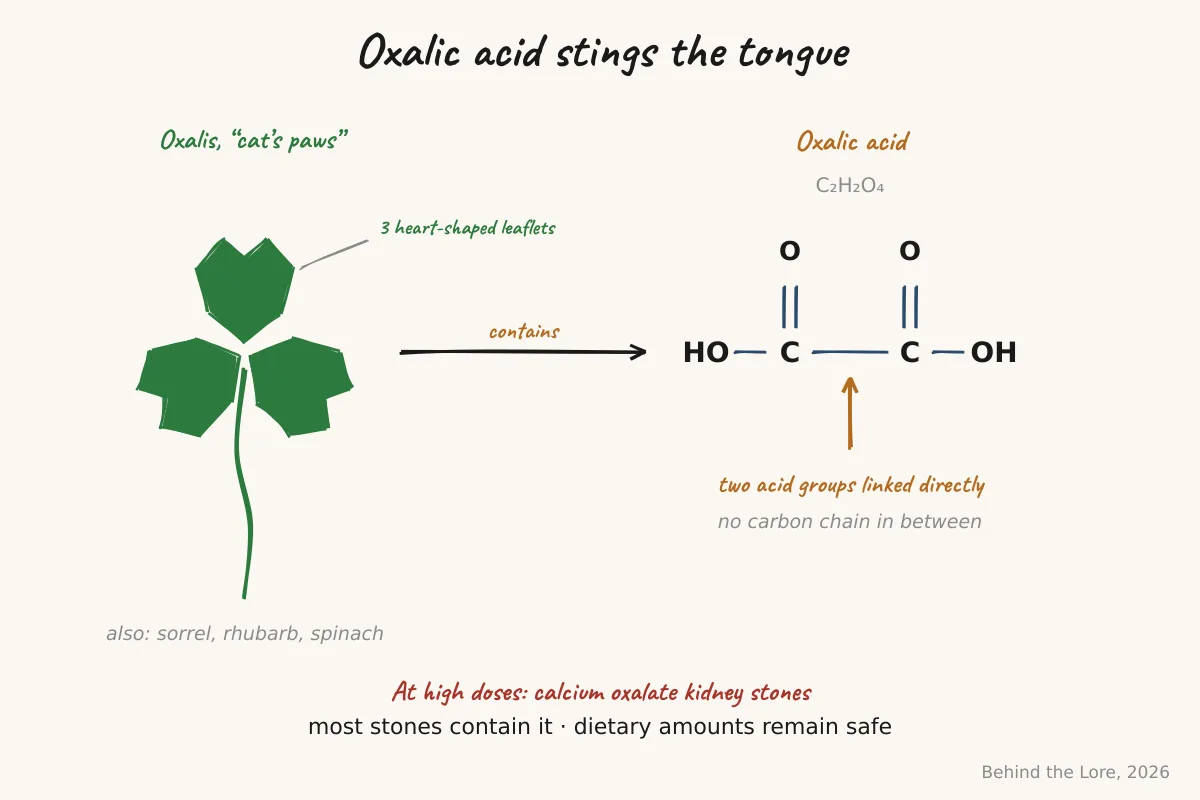
In plants, oxalic acid exists in two forms. In its free form, it is water-soluble and passes easily into the blood after ingestion. As salts (calcium oxalate, potassium oxalate), it can be insoluble and stays trapped in plant tissue. Species of the genus Oxalis, such as the wood sorrel common in European and Asian undergrowth, contain notable concentrations in their leaves and stems
[Wikipedia] . Other common food plants are also rich in it: sorrel, rhubarb, spinach, beets. It is precisely this ubiquity that explains why daily dietary exposure causes no harm for the vast majority of people.
Oxalic acid has a distinctly sharp taste, sharper than the citric acid of lemon or the tartaric acid of grapes. This acidity has long been exploited in non-food domestic uses: rust and ink-stain remover, textile color brightener, wood stripper, antifungal hive treatment. Pure oxalic acid is an industrial chemical, sold as a powder, that has nothing to do with eating a few sorrel leaves in a salad.
The question of toxicity. In a healthy adult, ingested oxalate is largely eliminated by the kidneys without difficulty. Part of it is also broken down by the gut flora, notably by the bacterium Oxalobacter formigenes. Problems arise in three situations: massive and prolonged intake of foods very rich in oxalates, pre-existing kidney failure, or a dietary calcium deficiency. In these situations, oxalate ions accumulate in the renal filtrate and bind to calcium to form calcium oxalate monohydrate (whewellite), an insoluble mineral that precipitates and makes up most of the so-called “calcium” kidney stones (about 75 to 80% of urinary lithiasis cases in industrialized countries).
The acute toxicity of pure oxalic acid, on the other hand, follows a different mechanism: it chelates blood calcium and sharply lowers calcemia, which can cause cramps, cardiac arrhythmias, and kidney failure. This form of poisoning involves industrial-scale doses (accidental ingestion of the pure product, never of food) and has no connection with the ordinary consumption of oxalate-bearing plants.
Going further
Sources
Published on
Keep investigating
Auto-suggested from shared concepts, disciplines, episodes, or characters.
Aconite
In The Apothecary Diaries, aconite poisons even through honey. We explain aconitine, its action on nerves, and why it shows no mercy.
Datura
In The Apothecary Diaries, datura is used to induce sleep and feign death. We explain its alkaloids, its toxicity, and its role in the history of anesthesia.
Anthocyanins
In The Apothecary Diaries, Maomao reveals why blue roses are impossible. We explain anthocyanins, their response to pH, and their antioxidant property.
Perfume Extraction
In The Apothecary Diaries, Maomao distills roses. We explain steam distillation, enfleurage, terpenes, and why natural perfume costs so much.
Ginger
In The Apothecary Diaries, Maomao prepares ginger pastilles to keep warm. We explain gingerol, TRPV1, and Chinese pharmacopoeia.