Anthocyanins: pigments and flower pH
Story context (click to hide this block) (click to show this block)
This paragraph may contain plot information.
When asked for blue roses for the imperial banquet, Maomao answers without hesitation that blue roses don’t exist. She states it as an obvious fact: blue is absent from the rose’s palette, and the flowers of “rare intensity” a nobleman claims to have once seen could not have been natural. The episode’s resolution confirms her hunch: those roses had been dyed through vascular uptake, their stems soaked in water loaded with pigment. Maomao then connects the dyeing technique, the flowers’ color, and the underlying chemistry, explaining that it’s the plant itself that draws the dye up to the petals, as if drinking it.
The subject in depth
Anthocyanins are a family of water-soluble pigments found in many plants: flower petals, fruit (blueberry, pomegranate, aronia berry), leaves (red cabbage, shiso), and sometimes roots
[Wikipedia] . They belong to the larger flavonoid family and are stored in plant cell vacuoles.
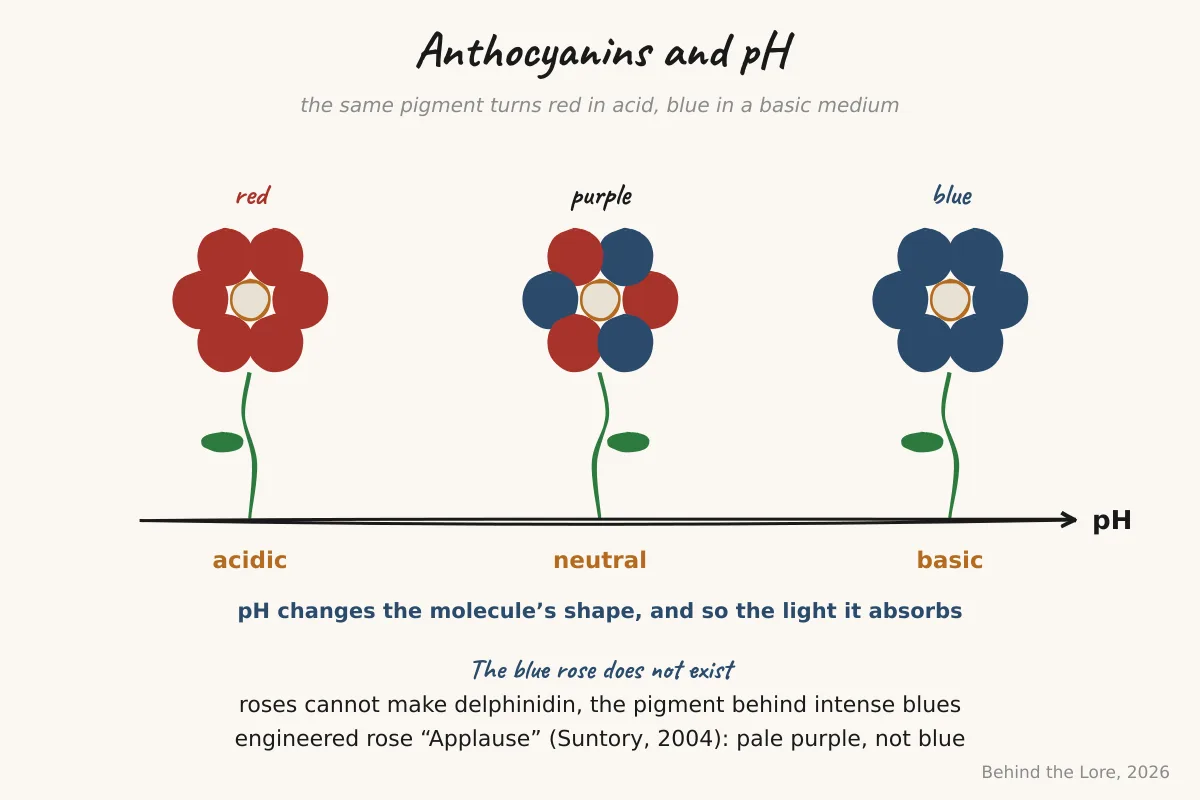
Their most remarkable chemical trait is their sensitivity to pH. In an acidic environment, their molecular structure adopts a cationic form that absorbs green and yellow light: the perceived color is red. In a neutral to slightly basic environment, they take on a quinoidal form that absorbs red and green light: the perceived color shifts to purple, then blue. This behavior makes them a natural colored pH indicator, usable in chemistry classrooms much like litmus [Wikipedia] .
A flower’s color therefore depends on three combined factors: the type of anthocyanin present, the pH of the cell vacuole, and the possible presence of copigments (molecules that stabilize or intensify the color). For a vivid blue, delphinidin is required in particular, the anthocyanin with the greatest number of hydroxyl groups on its aromatic ring. It’s what colors delphiniums, pansies, and certain irises blue.
The rose is genetically incapable of synthesizing delphinidin. Its metabolic pathways produce only pelargonidin (red to orange) and cyanidin (pink to magenta), and the slightly acidic pH of its cells pulls the color further toward red. Without delphinidin and without a suitable pH, no natural combination of factors can reach blue. In 2004, the company Suntory got around this barrier by transferring a petunia gene coding for the delphinidin pathway into the rose genome. The resulting rose, sold under the name “Applause,” is nonetheless pale purple, not truly blue: the acidic pH of rose cells still pulls the resulting color toward red, limiting the outcome.
Going further
Sources
Published on
Keep investigating
Auto-suggested from shared concepts, disciplines, episodes, or characters.
Orpiment and Arsenic
In The Apothecary Diaries, a yellow pigment poisons slowly. We explain orpiment, arsenic, and the chronic poisoning of court painters.
Aconite
In The Apothecary Diaries, aconite poisons even through honey. We explain aconitine, its action on nerves, and why it shows no mercy.
Rhododendron and Mad Honey
In The Apothecary Diaries, a tainted honey and a burned plant cause poisoning. We explain rhododendron's grayanotoxins and the famous mad honey.
Oxalic Acid
Oxalis contains oxalic acid, responsible for its tangy taste. We explain its uses, its effects on the body, and why these plants remain edible.
Perfume Extraction
In The Apothecary Diaries, Maomao distills roses. We explain steam distillation, enfleurage, terpenes, and why natural perfume costs so much.