Musk: from the deer's gland to the bottle
Story context (click to hide this block) (click to show this block)
This paragraph may contain plot information.
Entering Lady Shenmei’s chambers, Maomao immediately identifies the smell of musk and judges it “a curious blend.” The remark says a great deal about her training: recognizing a substance by smell and instantly assessing how well it harmonizes with other components is a diagnostic skill in its own right within court pharmacology. For an apothecary, the nose is a working instrument as reliable as the scale.
The subject in depth
Raw musk is secreted by the musk gland, an organ located on the abdomen of the musk deer (Moschus moschiferus), a small, solitary deer of Central Asia’s mountain forests
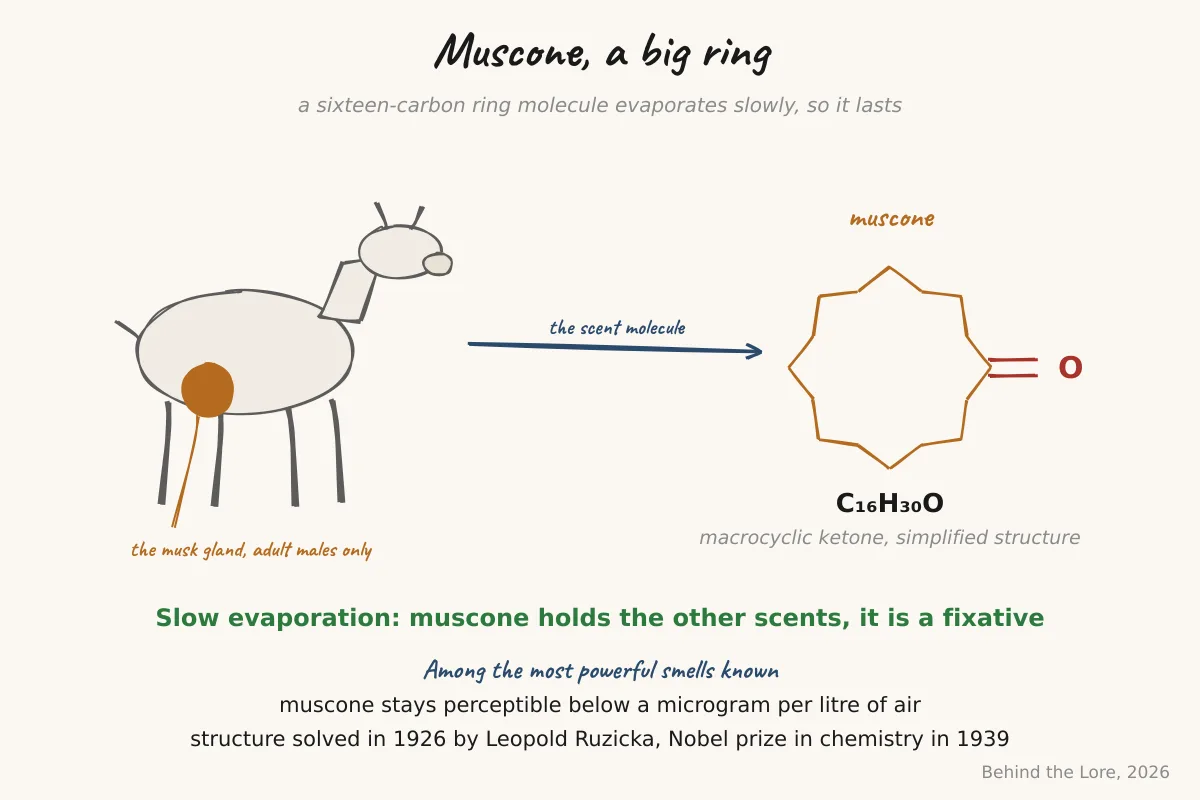
[Wikipedia] . Only adult males possess this gland, which produces a brownish, granular substance with an intensely animalic odor. In imperial China, musk was used in court perfumes, ritual incense, and medicinal preparations believed to have stimulating and emmenagogue properties.
The molecule responsible for the characteristic scent is muscone, or (R)-(+)-muscone, a macrocyclic ketone with the formula C₁₆H₃₀O [Wikipedia] . Its sixteen-carbon ring structure, with a single carbonyl group, sets it apart from floral or citrus fragrances: macrocyclic molecules evaporate slowly, which explains musk’s remarkable persistence on skin and textiles. In perfumery, this slow evaporation makes it a fixative, a substance that holds back and prolongs the other components of a fragrance accord. Muscone was isolated and identified in 1906 by the Austrian chemist Ernst Späth, and its macrocyclic structure was clarified in 1926 by Leopold Ruzicka, who would receive the Nobel Prize in Chemistry in 1939, in part for this work on terpenes and macrocyclic substances.
The concentration of muscone in the gland is low, and the scent of raw musk is complex: it combines muscone with other components, including steroids and fatty acids, producing that animalic, powdery, warm note that Maomao perceives. Even highly diluted, muscone remains perceptible at concentrations below a microgram per liter of air, ranking musk among the most powerful odorants known.
Going further
Sources
Published on
Keep investigating
Auto-suggested from shared concepts, disciplines, episodes, or characters.
Mercury
In The Apothecary Diaries, quicksilver goes into a court poison. We explain mercury, its toxicity, and the immortality elixirs that killed emperors.
Orpiment and Arsenic
In The Apothecary Diaries, a yellow pigment poisons slowly. We explain orpiment, arsenic, and the chronic poisoning of court painters.
Nicotine and Tobacco
In The Apothecary Diaries, macerated tobacco serves as a poison. We explain nicotine, its acute toxicity, and why diluting a poison can make it worse.
Beeswax
Beeswax, a hydrophobic mix of esters that melts around 62°C. Candles, ointments, waterproofing, lost-wax casting: its ancient uses explained.
Insect Pheromones
In The Apothecary Diaries, crushed insects draw swarms of males. We explain pheromones, the silkworm moth's bombykol, and their modern uses.