Insect Pheromones: chemical signals
Story context (click to hide this block) (click to show this block)
This paragraph may contain plot information.
During the nighttime show Maomao organizes, insects get crushed against an outfit: their glands release sex pheromones, and swarms of males converge almost instantly. In a few seconds, and without any explicit explanation, the scene illustrates the principle of chemical signaling in moths and butterflies: a single molecular signal is enough to mobilize individuals from a distance.
The subject in depth
The term “pheromone” was coined in 1959 by biochemists Peter Karlson and Martin Lüscher, from the Greek for “to carry” and “hormone” (to stimulate). It refers to any chemical substance released by one individual and perceived by another member of the same species to trigger a specific physiological or behavioral response [Wikipedia] .
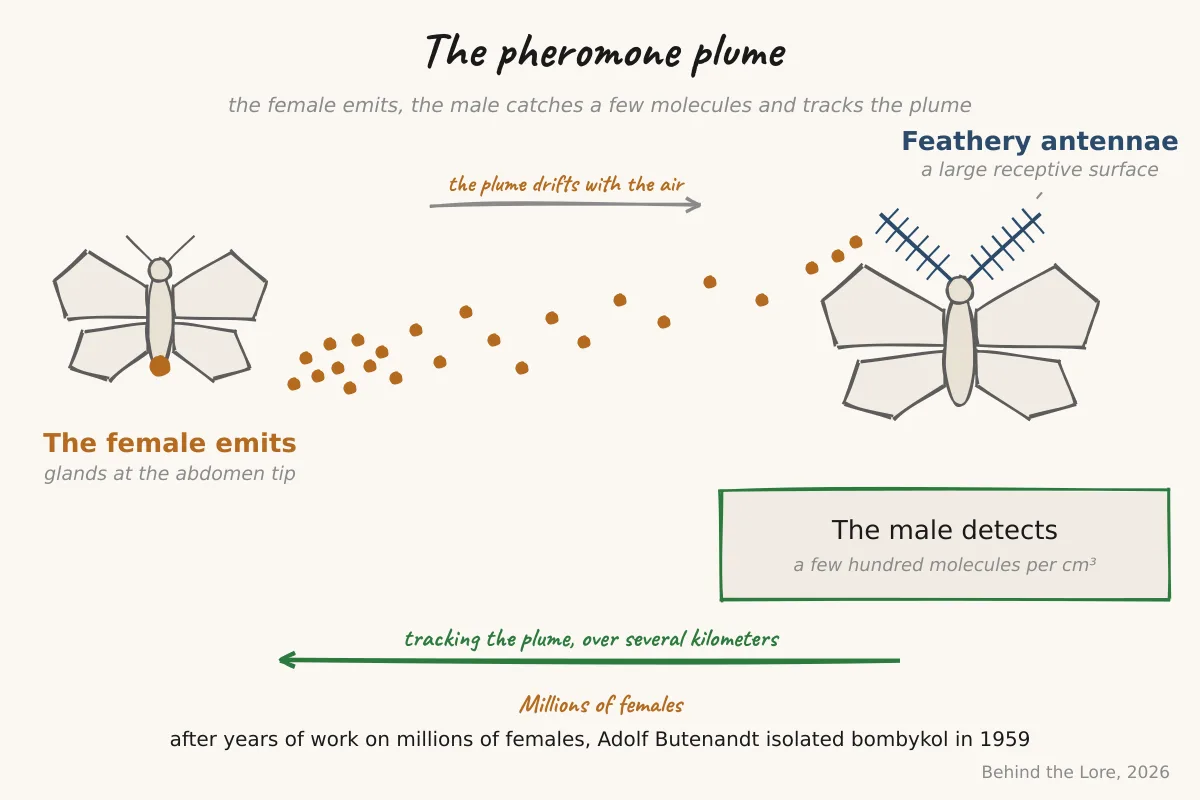
The main classes are quite distinct. Sex pheromones signal readiness to reproduce; trail pheromones mark a path between a food source and the nest; alarm pheromones warn the colony of danger. Each signal is species-specific, which prevents interference between closely related populations.
The textbook example is bombykol, the sex pheromone of the female silkworm moth (Bombyx mori), isolated in 1959 by Adolf Butenandt after years of work on millions of females
[Wikipedia] . The male detects this molecule at concentrations of a few hundred molecules per cubic centimeter of air, thanks to the long, feathery antennae that multiply the receptive surface. The olfactory receptors carried on these antennae are almost perfectly selective: they respond only to bombykol and essentially ignore everything else. When a scent plume drifts through the air, the male follows the concentration gradient upwind and can locate a female several kilometers away.
This mechanism works because the molecule, a sixteen-carbon alcohol with two double bonds in a precise configuration, fits perfectly into the male’s receptors. A slight change in geometry (flipping the E/Z configuration of one double bond) is enough to cancel the behavioral response, which illustrates how exact this molecular recognition is.
The release of pheromones by crushing the insect’s body is biologically consistent: the pheromone glands of female moths and butterflies are located at the tip of the abdomen, in cuticular structures. Crushing ruptures these structures and releases the stored supply of molecules all at once, producing a brief but very intense signal.
Going further
Sources
Published on
Keep investigating
Auto-suggested from shared concepts, disciplines, episodes, or characters.
Carbon Monoxide
In The Apothecary Diaries, embers bring guests down at a party. We explain carbon monoxide, why it suffocates without warning, and the right thing to do.
Aconite
In The Apothecary Diaries, aconite poisons even through honey. We explain aconitine, its action on nerves, and why it shows no mercy.
Beeswax
Beeswax, a hydrophobic mix of esters that melts around 62°C. Candles, ointments, waterproofing, lost-wax casting: its ancient uses explained.
Musk
In The Apothecary Diaries, Maomao recognizes the scent of musk. We explain muscone, the musk deer's gland, and synthetic musks.
Caffeine
Senku brews a caffeine stimulant from tea leaves. We explain how caffeine acts on the brain, its real effects, and how much of the power-up drink is myth.