Fingerprints: Revealed by Powder
Story context (click to hide this block) (click to show this block)
This paragraph may contain plot information.
To identify the culprit behind a poisoning by suspicious soup, Maomao asks for cotton, flour, and a brush. She dusts the flour onto a cotton pad, taps it gently against the polished silver bowl, blows off the excess with the brush, and obtains four distinct sets of prints, distinguished by their size and position. She concludes without hesitation on the culprit’s identity. In a minute’s work, she independently reinvents forensic powder dusting, a technique that would not enter official judicial procedure in the West until the following century.
The subject in depth
The inner surface of the fingers and palms is covered with papillary ridges, microscopic skin features whose arrangement in arches, loops, and whorls is unique to each individual and stable from birth to death [Wikipedia] . These ridges are pierced with sweat pores: every contact with a smooth surface deposits an invisible film of sweat (water, chlorides, amino acids) and sebum (fatty acids, triglycerides). This deposit is what’s called a latent print, invisible to the naked eye on a clean surface, but physically present.
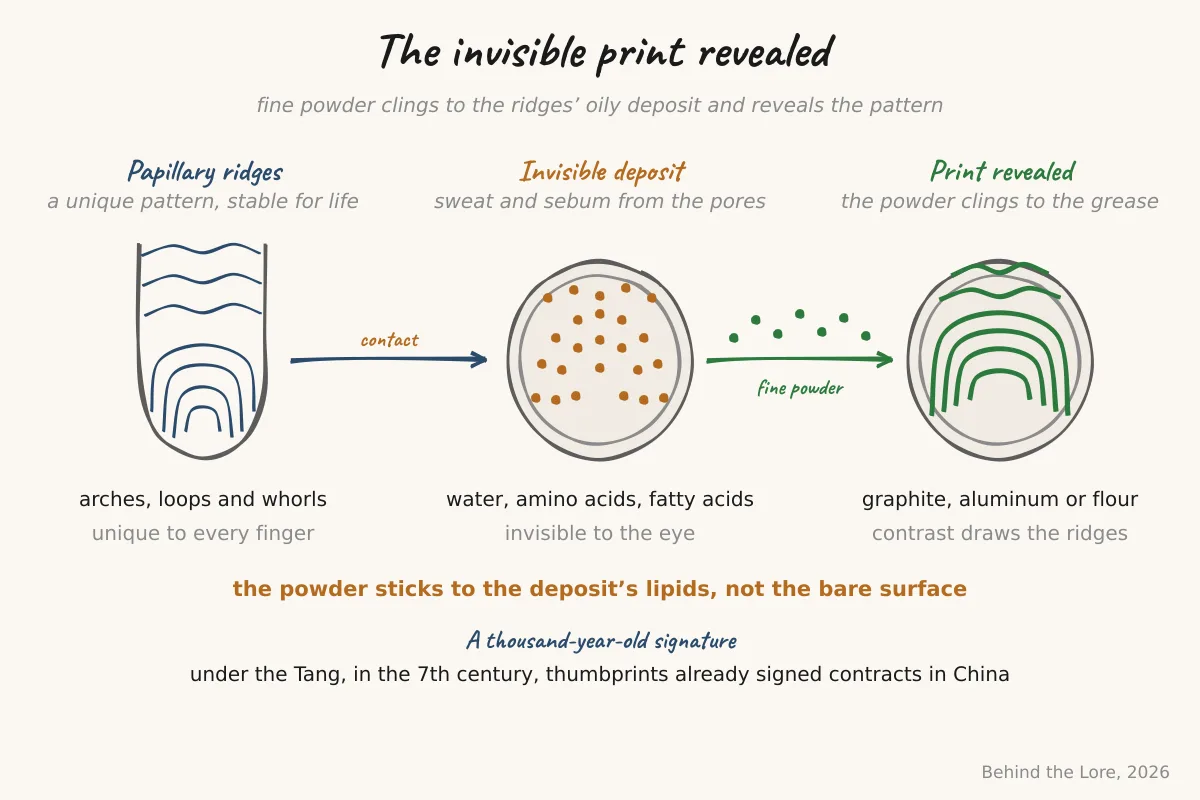
The principle behind dusting is simple: a fine-grained powder, applied gently, adheres preferentially to the oily areas of the deposit rather than to the bare surface. The color contrast between the powder and the background then reveals the precise geography of the ridges. Modern forensic labs use specialized powders: graphite (dark gray on a light background), aluminum (silvery), lycopodium (yellow on a dark background), or even fluorescent powders observed under ultraviolet light. Wheat flour, rich in starch and protein, can play a similar role on very smooth, polished surfaces like silverware, adhering to the lipid residue through physico-chemical interactions close to those governing professional powders. The resulting contrast is markedly lower, but the principle still holds.
Modern methods go well beyond dusting. Ninhydrin reacts with the amino acids of the sweat deposit to form a purple compound (the Ruhemann reaction), which reveals prints on porous paper. Cyanoacrylate fuming (heated superglue) produces a white polymer that binds specifically to the amino acids and chlorides of a print and can treat complex surfaces. Each of these methods targets a different chemical fraction of the deposit: lipids for dusting, amino acids for ninhydrin and cyanoacrylate.
The uniqueness of fingerprints is a property established empirically over millions of comparisons: no two individuals, nor even two fingers of the same individual, have ever been found to share the same ridge pattern [Wikipedia] . This uniqueness, combined with the permanence of the pattern, underpins the entire forensic value of the discipline.
Going further
Sources
Published on
Keep investigating
Auto-suggested from shared concepts, disciplines, episodes, or characters.
Orpiment and Arsenic
In The Apothecary Diaries, a yellow pigment poisons slowly. We explain orpiment, arsenic, and the chronic poisoning of court painters.
Aconite
In The Apothecary Diaries, aconite poisons even through honey. We explain aconitine, its action on nerves, and why it shows no mercy.
Silver and Poison Detection
Silverware tarnishes from sulfur, not pure arsenic. We explain the chemistry of silver sulfide and why the silver poison test is a partly-founded myth.
Black Powder
In The Apothecary Diaries, Maomao states the exact formula for black powder. We explain the role of each ingredient, the reaction, and the rotten-egg smell.
Elixirs of Immortality
Several Chinese emperors were killed by elixirs meant to make them immortal. Waidan alchemy, cinnabar, mercury, and arsenic explained.