Does silver really detect poison?
Story context (click to hide this block) (click to show this block)
This paragraph may contain plot information.
Gaoshun points out to Maomao that soup served in a silver vessel loses all its flavor appeal, since silver oxidizes quickly on contact with a hot liquid. The remark seems trivial, but it touches on one of the most widespread beliefs of court pharmacology: that silverware reveals the presence of poison. Maomao, the seasoned pharmacist, knows how to tell what silver actually detects from what tradition wrongly credits it with.
The subject in depth
Silver is a noble metal, but not an inert one. It reacts readily with sulfur compounds present in the atmosphere, such as hydrogen sulfide (H₂S), or released by certain foods rich in sulfur-containing amino acids: eggs, legumes, meats under heat. The reaction produces silver sulfide (Ag₂S), a black solid that deposits as a layer on the metal’s surface [Wikipedia] . This is the ordinary tarnishing of silverware, a familiar phenomenon at any well-stocked table.
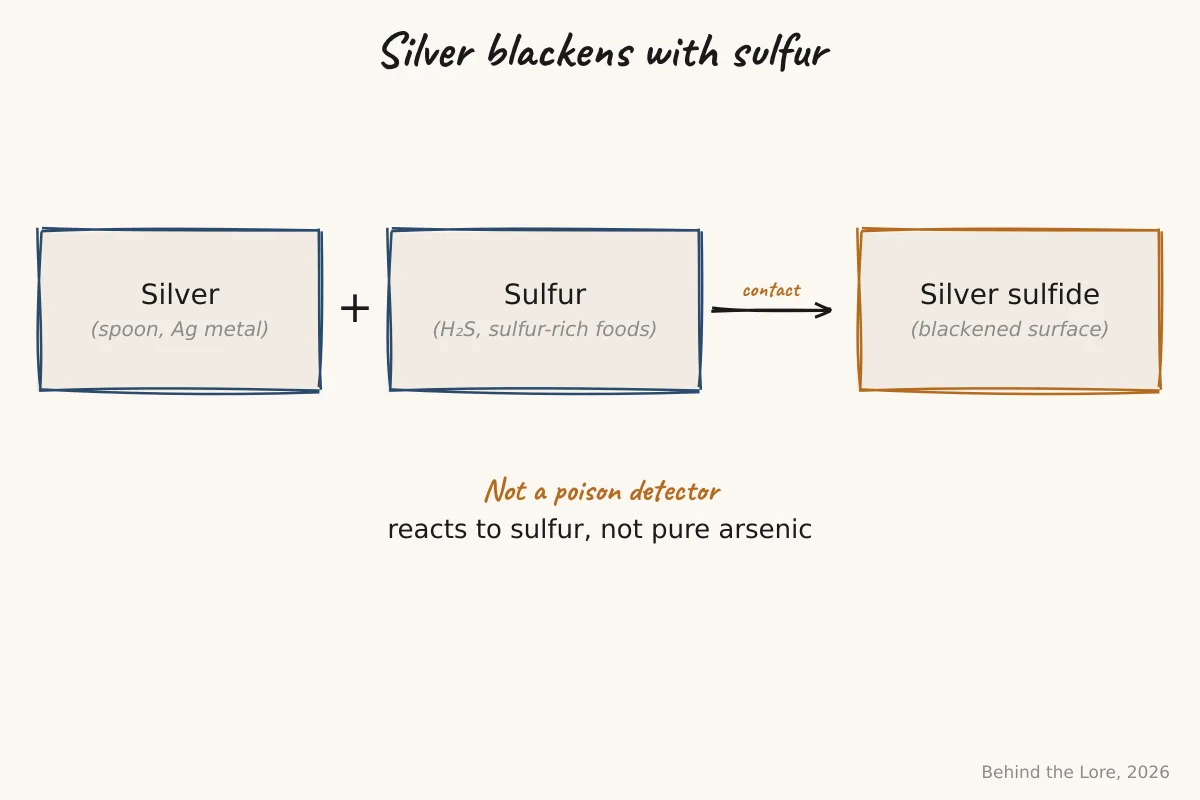
This blackening is chemically distinct from any interaction with arsenic. Arsenic trioxide (As₂O₃), the form most commonly used historically as a poison, does not react directly with silver under the conditions of a meal. Silver metal, in its bulk form, is therefore a very poor detector of pure arsenic [Wikipedia] .
Why, then, did the belief persist for centuries? Because the arsenic that circulated in historical pharmacopoeias and poison cabinets was only rarely pure. It was extracted from sulfur-bearing ores: arsenopyrite, realgar, orpiment, and its preparations retained traces of sulfur compounds. When this impure arsenic was added to a dish, the sulfides it contained reacted with the silver spoon and blackened it. The test seemed to work, but it was detecting the sulfur contaminant, not the arsenic itself. The confusion between the two kept the legend alive for several centuries.
There is a nuance: certain arsenic compounds, such as natural arsenic sulfide (As₂S₃, yellow orpiment), do contain sulfur and would blacken silver. In that specific case, the test might have produced a positive result, but it would still be unable to distinguish sulfurated arsenic from an ordinary sulfur-rich food. A poached egg in a silver bowl blackens the spoon just as well as a sulfurated poison would.
Going further
Sources
Published on
Keep investigating
Auto-suggested from shared concepts, disciplines, episodes, or characters.
Orpiment and Arsenic
In The Apothecary Diaries, a yellow pigment poisons slowly. We explain orpiment, arsenic, and the chronic poisoning of court painters.
Aconite
In The Apothecary Diaries, aconite poisons even through honey. We explain aconitine, its action on nerves, and why it shows no mercy.
Revealing Fingerprints
Revealing fingerprints with flour. We explain the chemistry of latent prints and the history of dactyloscopy, born in ancient China.
Elixirs of Immortality
Several Chinese emperors were killed by elixirs meant to make them immortal. Waidan alchemy, cinnabar, mercury, and arsenic explained.
Lead White Makeup
In The Apothecary Diaries, white makeup kills courtesans. We explain why this ceruse-based cosmetic caused deadly lead poisoning.