Clinical signs: diagnosing by observation
Story context (click to hide this block) (click to show this block)
This paragraph may contain plot information.
Lihaku comes to see Maomao about a matter that is anything but medical: buying out a courtesan’s contract. But the moment he stands before her, Maomao cannot help examining him like a practitioner. She observes his muscle tone, his proportions, the texture of his skin, and deduces, without him saying a word, his lifestyle habits, his rough diet, his level of physical activity. She then explains that some patients refuse to open up, which is exactly why it matters for an apothecary to observe: their lifestyle habits show on their body. This moment makes explicit a principle the story has been showing from the start: Maomao diagnoses with her eyes first.
The subject in depth
Medical semiology is the branch of medicine that studies and interprets the signs produced by an organism [Wikipedia] . A clinical sign is anything objectively observable by the practitioner, as opposed to a symptom, which is what the patient feels and describes. Together, they build a clinical picture, a coherent image of a person’s state of health.
The clinical examination is classically organized around four techniques [Wikipedia] . Inspection comes first: a simple look reveals skin and mucous-membrane color (pallor, jaundice, cyanosis), limb shape, nail condition, posture, gait, and body weight. Palpation adds touch: texture, warmth, tenderness under pressure, organ consistency. Percussion involves tapping the chest or abdominal wall to assess the density of underlying structures through the sound produced. Auscultation, finally, listens to internal sounds, heart murmurs, breath sounds, bowel sounds.
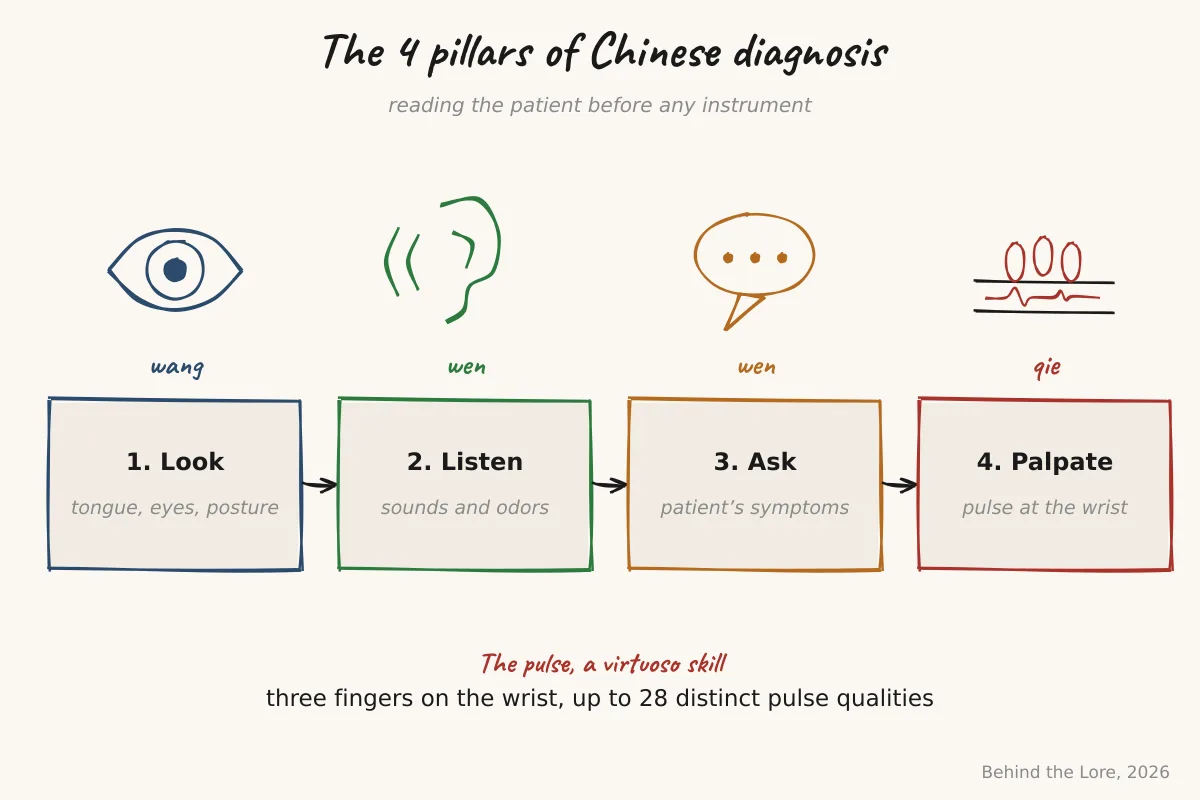
This framework is universal in modern medicine, but it is far from recent. Classical Chinese medicine formulated its own four pillars of diagnosis long before the common era: wang (visual inspection of complexion, tongue, eyes, posture), wen (listening to sounds and perceiving odors), another wen, interrogation (gathering the symptoms described by the patient), and qie (pulse palpation). Pulse diagnosis, in particular, represents a remarkably refined skill in the Chinese tradition: the practitioner places three fingers on the wrist and distinguishes up to twenty-eight different pulse qualities (speed, amplitude, depth, regularity) each associated with a particular internal state. Modern medicine has confirmed that the pulse does carry rich information about heart rate, blood pressure, and flow, but the twenty-eight-category reading remains an empirical clinical skill that is difficult to standardize.
What stands out in Maomao’s practice is precisely the primacy of inspection. She does not wait to be told anything. She reads. A soldier’s body reveals repeated physical exertion in muscle mass, palpable bone density, calluses. A heavy drinker’s body reveals a strained liver in the tint of the eye whites, the vein pattern on the nose, hand tremors. An undernourished body reveals its deficiencies in the state of the hair and nails, slow wound healing. These signs persist because the body is a slow recorder: habits are written onto it over weeks and months, not hours.
Going further
Sources
Published on
Keep investigating
Auto-suggested from shared concepts, disciplines, episodes, or characters.
Dehydration and Rehydration
In The Apothecary Diaries, Maomao treats heatstroke with salted, sweetened water. We explain dehydration and why salt is vital.
Mercury
In The Apothecary Diaries, quicksilver goes into a court poison. We explain mercury, its toxicity, and the immortality elixirs that killed emperors.
Kudzu
In The Apothecary Diaries, over-concentrated kudzu turns into glue. We explain kuzu starch, its medicinal uses, and its invasion beyond Asia.
Gluten
In The Apothecary Diaries, wheat-flour glue illustrates gluten. We explain glutenins, gliadins, viscoelasticity, and celiac disease.
Papermaking
In The Apothecary Diaries, Maomao diagnoses crumbly paper. We explain papermaking, cellulose, and Cai Lun's invention.