Nerve Damage and Paralysis
Story context (click to hide this block) (click to show this block)
This paragraph may contain plot information.
A eunuch recently recruited to the court is reported to have been brutally beaten. The consequence is specific: the entire left side of his body ended up paralyzed, and he hides skin covered in scars beneath his clothes. This clinical detail, brief but precise, draws the link between repeated mechanical trauma and one-sided hemiplegia.
The subject in depth
The nervous system carries orders from the brain to the muscles as electrical impulses. When a nerve or the spinal cord is damaged, this signal is interrupted in whole or in part, and the corresponding muscle no longer receives instructions: it becomes paralyzed [Wikipedia] .
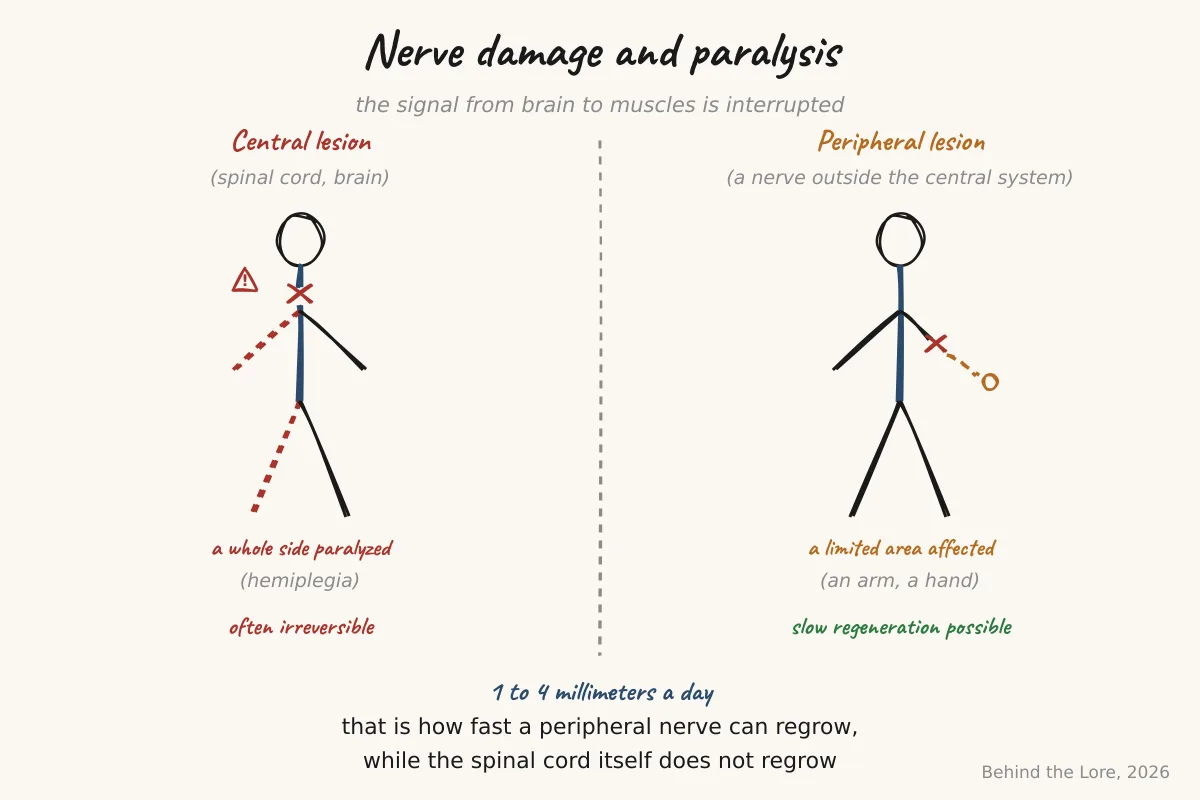
Neurology distinguishes two broad categories of injury by location.
A central lesion affects the brain or spinal cord, the central nervous system. A one-sided brain injury (stroke, head trauma) causes paralysis on the opposite side of the body, because motor pathways cross over. A spinal cord injury cuts off control below the level of the damage, affecting both legs or all four limbs depending on the height of the lesion. The description of “the entire left side paralyzed” following repeated blows points toward a central injury, likely head trauma affecting the right hemisphere or a unilateral high spinal cord lesion.
A peripheral lesion affects a nerve located outside the central nervous system
[Wikipedia] . It affects a limited area: an arm, a hand, a patch of skin. It is seen particularly in brachial plexus trauma (violent pulling on the arm or shoulder) or prolonged nerve compression.
The distinction is not merely anatomical: it determines the possibilities for recovery. Peripheral nerves can, slowly and partially, regenerate their myelin sheath and axons, at a rate of roughly 1 to 4 millimeters per day. The spinal cord and brain, by contrast, lack this regenerative capacity: a complete spinal cord transection remains, even today, irreversible. Current research (stem cell grafts, electrical stimulation, neuro-controlled prosthetics) is opening new avenues, but no treatment currently restores a severely damaged spinal cord in routine human clinical practice.
Going further
Sources
Published on
Keep investigating
Auto-suggested from shared concepts, disciplines, episodes, or characters.
Carbon Monoxide
In The Apothecary Diaries, embers bring guests down at a party. We explain carbon monoxide, why it suffocates without warning, and the right thing to do.
Aconite
In The Apothecary Diaries, aconite poisons even through honey. We explain aconitine, its action on nerves, and why it shows no mercy.
Bear Bile
Why did bear bile, a traditional TCM remedy, lead to a modern drug? UDCA dissolves gallstones and treats the liver.
Castration and Eunuchs
In The Apothecary Diaries, Jinshi embodies the archetype of the court eunuch. We explain the real effects of castration by age, and the role of testosterone.
Color Blindness
In The Apothecary Diaries, red-green color blindness unlocks a dynastic mystery. We explain cone cells, the X chromosome, and prevalence.