Lizard tail autotomy: why the tail grows back
Story context (click to hide this block) (click to show this block)
This paragraph may contain plot information.
Maomao spots a lizard in the palace gardens and stops, intrigued by a phenomenon she must have seen a thousand times without ever really questioning it: the animal’s tail has grown back. She reasons aloud, wonders how this is possible, and considers devising a potion that could reproduce the mechanism in humans. The lizard is just a narrative pretext, but the question it raises (how can a living being rebuild a lost limb) is one of the most fertile in modern biology.
The subject in depth
Caudal autotomy is an animal’s ability to voluntarily separate from part of its own body [Wikipedia] . In lizards, this mechanism concerns the tail and relies on a distinctive vertebral architecture: the caudal vertebrae have preformed fracture planes, zones of reduced resistance built directly into the bone. When a predator grabs the tail, a reflexive muscle contraction breaks the vertebra exactly at that point, releasing the tail without uncontrolled bleeding. The break is clean and fast, and the abandoned tail keeps thrashing for a few seconds, distracting the predator long enough for the lizard to escape.
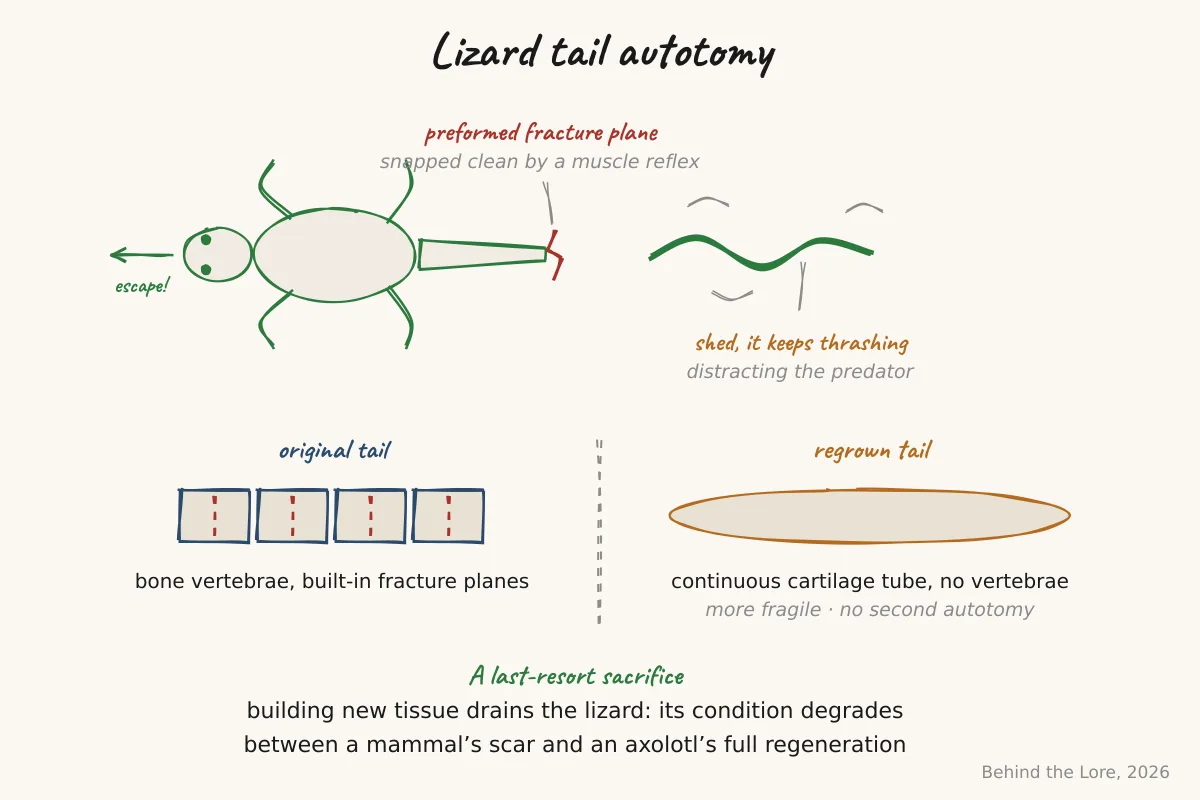
This sacrifice comes at a price, however. The tail does not grow back identically [Wikipedia] . The regenerated tissue is a continuous tube of cartilage, with no vertebrae or built-in fracture planes. The new tail is therefore structurally different from the original: more flexible, less sturdy, often a slightly different color, and now incapable of a second autotomy at that same point. Functionally, the tail plays a role in balance, fat storage, and social signaling, losing it, even temporarily, changes the animal’s behavior.
The energy cost is also considerable. Synthesizing new tissue draws on resources the lizard can no longer devote to foraging, reproduction, or fleeing other predators. Studies have shown that individuals that lost and then regenerated their tail had degraded physical condition during the regrowth phase. Autotomy is therefore a last-resort solution, not a casual strategy.
At the cellular level, regrowth involves local proliferation of stem cells located at the tip of the stump. These cells form a structure called a blastema, similar to what is seen in amphibians capable of regenerating entire limbs. But in lizards, this blastema only rebuilds cartilage and connective tissue, not differentiated bone. A lizard’s partial regeneration sits halfway between the simple scarring of a mammal and the full regeneration of an axolotl.
Going further
Sources
Published on
Keep investigating
Auto-suggested from shared concepts, disciplines, episodes, or characters.
Aconite
In The Apothecary Diaries, aconite poisons even through honey. We explain aconitine, its action on nerves, and why it shows no mercy.
Dehydration and Rehydration
In The Apothecary Diaries, Maomao treats heatstroke with salted, sweetened water. We explain dehydration and why salt is vital.
Drinking Water and Waterborne Diseases
Why does boiling water make it safe to drink? Cholera, dysentery, typhoid: we explain waterborne diseases and the story of John Snow.
Miasma Theory
In The Apothecary Diaries, incense is burned to ward off illness. We explain miasma theory, its kernel of truth, and how Pasteur overturned it.
Quarantine and Isolation
In The Apothecary Diaries, a contagious patient is isolated. The history of quarantine, fomites, and isolation long before germs were understood.